

Cutting Single-Use Bioreactor Design Cycle From Months To A Single Session
Highlights
- Multi-day drafting → a single session: the average time to move a draft design from the sales team to an engineering-approved final design
- A sales cycle that once ran weeks to six months — from first customer call to final approval — no longer stalls on the design process.
- Hundreds of thousands of historical assemblies, previously locked in incompatible CAD, PDF, and scanned formats, made searchable.
- Engineers can search both by natural language and by sketching a drawing — not just by submitting a full draft.
- Recommendations are ranked by confidence — matches above 90%, and a secondary tier at 80–90% — so engineers know how much scrutiny a suggested match needs.
- Human-in-the-loop at every decision point: the system narrows, the engineer decides.
- Compliance and manufacturability risk surfaced continuously during design, not just at final review.
Overview
The Client is a Fortune 500 global life sciences company providing analytical instruments, laboratory equipment, software, and scientific services to laboratories, pharma, and biotech companies.
The company is one of the world's largest suppliers of custom bioprocess and medical device assemblies — including single-use bioreactors built from combinations of tubes, clamps, bags, and connectors — engineered largely to order for its customers. Its design history spans hundreds of thousands of assemblies accumulated over decades.
Challenge
Client's customers enter the business pipeline with schematics of medical or biotech devices they would like to manufacture. Together with sales teams and drafting engineers, a ready-for-production assembly, made of components such as tubes, clamps, and bags, is iteratively built and refined.
The catalog of assemblies contains hundreds of thousands of drawings, yet every new sales cycle still had to be run from scratch.
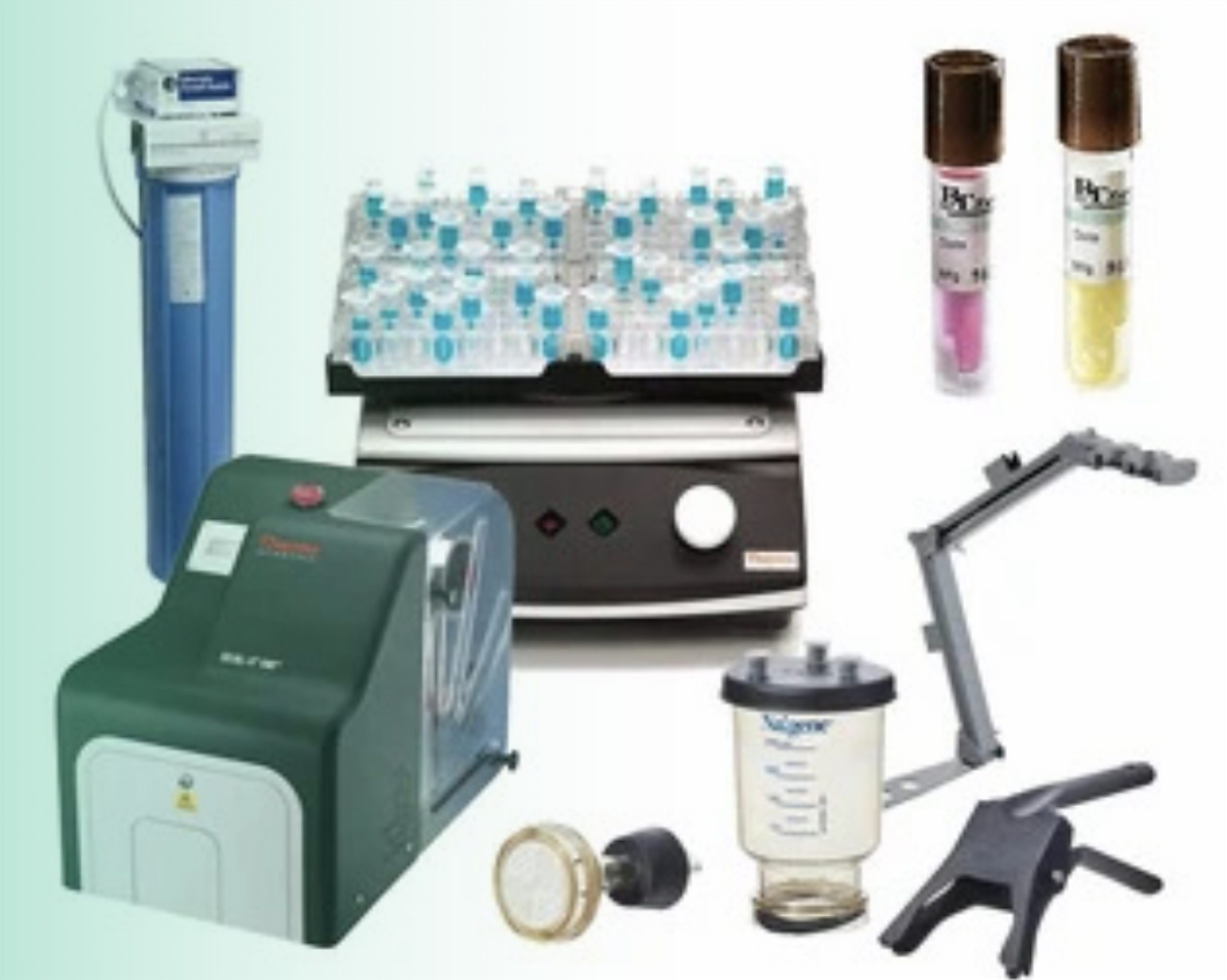
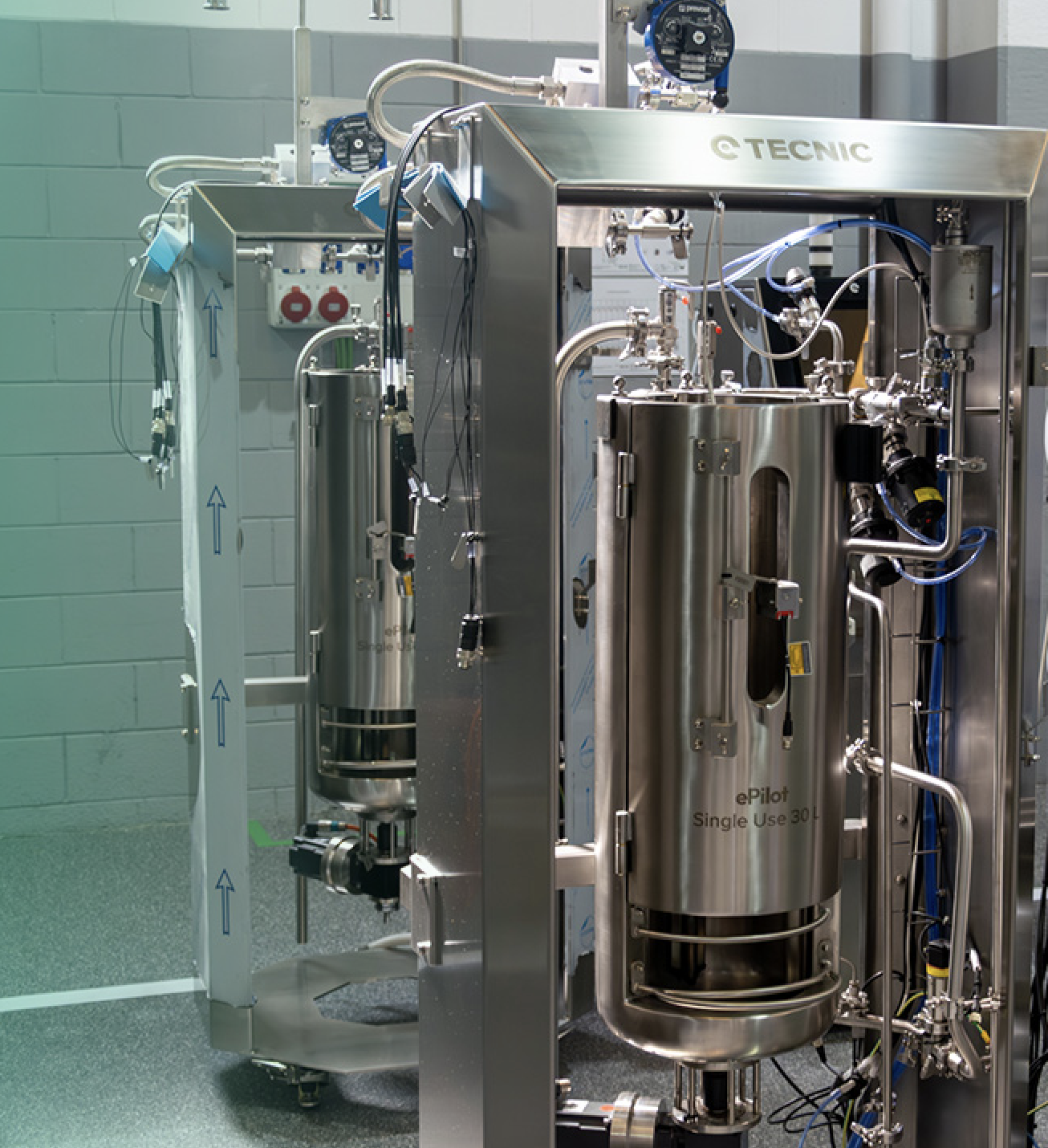
Source: An image of a single-use bioreactor
To design and validate new assemblies, client's teams relied on individual knowledge and manual workflows. Designs existed in different formats: CAD files and DWGs contained structured data, while PDFs and scanned drawings contained only images. Designs in different formats couldn't be searched against each other.
A single sales cycle from the first call, through initial drafting and rounds of reviews and redrafting, to final approval took from several weeks to six months.
It created several recurring challenges:
- Slow design cycles. With no shared system for search, real-time design, or built-in production intelligence, engineers relied mainly on their memory to find relevant prior work.
- Inconsistent reuse of components, even when a close match already existed in the catalog.
- Late surfacing of manufacturing and compliance issues, often after multiple rounds of client review and rework.
- Team size grew alongside demand, since it was the easiest lever to keep pace.
Together, these challenges raised costs, added rework, and reduced confidence in design decisions.
Solution
The historical drawings live in incompatible formats, use inconsistent labeling conventions, and encode information — component shape, spatial relationships, connection points — that text search cannot read.
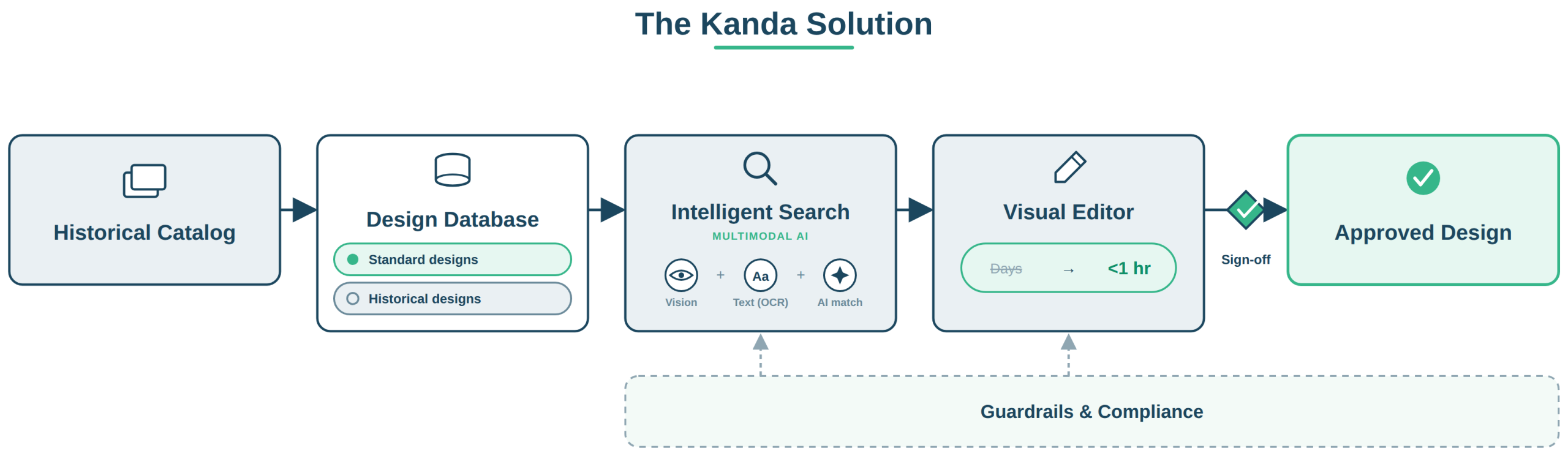
The Kanda team built a unified AI-enabled platform where engineers and sales teams can search, design, and validate single-use bioreactor assemblies together, live during the sales call.
Building the foundation: a searchable design database
Before engineers can search anything, the catalog has to be readable by the platform.
In batch mode, Kanda's engine goes through the client's hundreds of thousands of existing assemblies, decomposing each into subcomponents. For every part, it extracts shape and geometric features, materials list, text labels, and how the parts connect.
Kanda worked with the client's engineering team to grade that catalog into a two-tier database the AI could reliably reason over.
- Standard designs: assemblies used frequently, built entirely from the client's own standard components. These are the highest-confidence matches and easiest for engineers to adopt the ones engineers can adopt with the least friction.
- Historical, non-standard designs: older, non-standard a broader set of past work that mostly uses the client's components, with third-party parts minimized wherever possible.
This approach does two things at once:
- It gives the recommendation engine a way to rank confidence, since a match against a standard design is a stronger signal than a match against a one-off historical design
- It gives the client's engineers a system that steers new designs toward standardization over time, reducing part-number sprawl and third-party dependency as a side effect of normal use.
Intelligent Search
When an engineer brings a new drawing, whether a CAD export, a PDF, or a scanned image, the platform utilizes multimodal AI to process it:
- Computer vision to identify and segment the physical components in a drawing.
- Text recognition (OCR) to read text labels that engineers actually use.
- A large language model (LLM) matches each component to the correct label by combining the component's image crops, spatial positions, and extracted text, returning a structured record for every component on the drawing.
This multimodal strategy, geometry plus text plus metadata, generates a structured record for every component of the drawing.
Engineers can search relevant assemblies using AI chatbot without restrictions of file format. The platform searches the catalog and ranks the closest matches, combining how similar components look and read, their known IDs, and their metadata into one result. Each match is grouped by confidence level.
Visual Editor
Sales teams and drafting engineers can design assemblies together in real time, during the same session, quickly updating the existing designs pulled from search.
The manual drafting process, which once required days of effort, now delivers a viable draft in less than an hour.
Guardrails & Compliance Intelligence
Every component is checked against compliance rules and internal compatibility, as engineers design and build, not only at final review. Risks are flagged early for the team to confirm, with a human still signing off on every platform decision, keeping them aligned with the client's internal standards and industry regulatory requirements.
Outcome
Kanda helped the Client to move from a manual sales process to one built for reuse and speed.
- Lower design cost through reuse. Engineers now use a multimodal AI assistant to find and reuse existing assemblies and components through natural language search
- Shortened sales cycle. The drafting step at the core of every sales cycle, once taking over several weeks or months, now happens in a day, with a workable draft ready after a single session with the customer.
- Rework caught before it starts. Manufacturability and compliance risks are now revealed during design, not after multiple rounds of client review, cutting late-stage rework.
- Drafters focused on judgment, not repetition. Experienced drafting engineers now spend less time interpreting requests and more time validating and optimizing designs, where their expertise matters most.
- Faster to revenue. Fewer cycles are needed to reach approval, with less dependence on a large drafting team to sustain volume.
Technical Approach
- Computer vision — component segmentation (Meta's Segment Anything Model)
- Dual-engine OCR — text label extraction from mixed-format drawings
- LLM reasoning layer — matches labels to components using image crops and spatial position
- Plugin-based architecture — batch processing for the historical catalog, single-file recognition for new drawings, sharing one feature extraction pipeline
- Structured drawing database — two-tier (standard/historical) reference set built from client's CAD archive
- Recommendation/matching engine — natural-language processing, sketch, and drawing-based search, ranked by confidence tier
- Canvas-based visual editor — live, collaborative design session between sales and engineering
- Compliance/manufacturability checker — continuous, in-workflow validation with human sign-off