
Agentic AI vs Generative AI: Understanding Core Differences and Use Cases
 Chris McDermut
Agentic AI and generative AI are two evolutions of traditional AI that serve different purposes despite their frequent overlapping. Gen AI focuses on generating original content and analyzing it, while agentic AI plans and acts toward a goal with only limited, defined human intervention, meaning it does not operate free of oversight.
Understanding where one ends and the other begins matters more than ever, as vendors increasingly market both under the same “AI” umbrella, and businesses risk investing in the wrong architecture for their actual use case. This article breaks down the core differences between agentic AI vs generative AI, discusses how the two are often combined in real-world workflows, and what risks organizations should account for.
What Is the Difference Between Agentic AI and Generative AI?
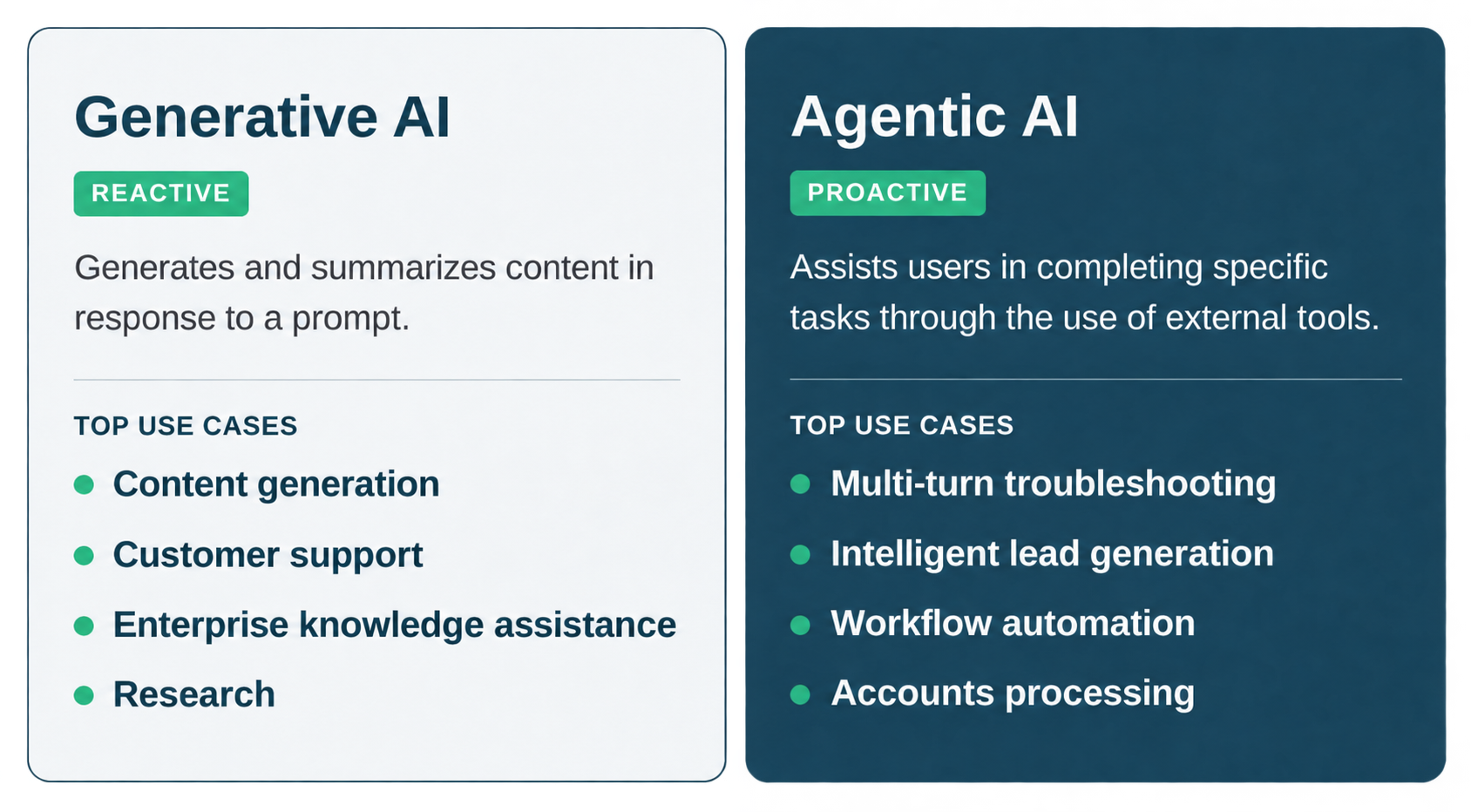
The most important distinction between generative AI and agentic AI is the degree of autonomy each is designed to operate with, and autonomy here is a spectrum, not a switch. Generative AI sits at the low-autonomy end: it responds to a prompt and stops, with a person reviewing the output before it goes anywhere else. Agentic AI moves further along that spectrum by chaining decisions and actions together, but how far it moves is defined by the constraints built around it: what it’s permitted to do without asking, which actions require an approval gate first, and what triggers an escalation. Both models are preprogrammed; agentic AI simply operates within a wider, but still bounded, set of permissions.
What Is Generative AI?
- A type of AI that creates new content (text, images, music, code) by learning patterns from existing data. Beyond generation, it’s also strong at document analysis, summarization, and data extraction, and it powers many customer service chatbots and virtual assistants.
- Generative AI works through several functioning models: prompt-response (a single-step, direct output from one prompt) and chaining (multiple prompts linked together so one output feeds the next)
- Gen AI is most commonly applied across the following use cases: real-time customer support through chatbots and virtual assistants, coding and debugging assistance for developers, content generation ranging from marketing copy to reports, document analysis and summarization for faster review of large text volumes, and internal data queries that let employees pull information without manually searching through systems.
What Is Agentic AI?
- Agentic AI is a goal-oriented system that reasons, plans, and acts autonomously with minimal human supervision, being proactive rather than reactive. It still has to be preprogrammed, though, and human-in-the-loop (HITL) oversight remains critical to the model.
- Agentic AI operates through four core phases: perception (reading inputs and grasping context), planning (breaking a high-level goal into sub-tasks), action (executing decisions using tools), and evaluation (checking outputs, correcting them, and adapting as conditions change).
- The most widespread agentic AI use cases include full end-to-end handling of Tier 1 requests such as password resets, intelligent routing of complex support tickets to the right team, assistance with coding tasks including test execution, and predictive maintenance paired with inventory optimization.
Agentic AI vs AI Agents
Agentic AI and AI agents often get confused, so it’s important to differentiate between the two.
An AI agent is a single tool that performs a specialized task within an agentic AI system. Hence, an agentic AI system can consist of multiple AI agents, but each AI agent is designed specifically for one task. Combined together, AI agents create a smooth and automated workflow which eventually meets the initial high-level goal.
Agentic AI vs Generative AI: a Comparison Table
| Generative AI | Agentic AI | |
| Main goal | Generate original content, handle simple repetitive tasks, analyze and summarize documents | Achieve a high-level goal such as full workflow completion |
| Operational model | Reactive, mostly prompt-response | Proactive, goal-driven execution |
| Task scope | Bounded or single-step tasks | Multi-step and conditional workflows |
| Planning | Limited planning within a response | Explicit task decomposition and replanning |
| Memory and state | Session context or retrieved information | Persistent workflow state and action history |
| Tool use | Optional retrieval or analysis tools | Tools and APIs used to perform actions (i.e., database connectors, code interpreters, etc.) |
| Human oversight | A human reviews all generated output | Configurable approvals and intervention thresholds |
| Infrastructure | Primarily a model-serving layer | Orchestration, memory, tools, permissions, and monitoring |
| Potential concerns | Inaccurate, biased, or harmful output | Unintended actions in connected systems |
| Expected output | A generated artifact | A completed or advanced business process |
Combining Agentic AI and Generative AI for Effective Workflows
Agentic AI coordinates the workflow: it decides what happens and when. Generative AI is called in only when content needs to be created. Here’s how that plays out in a sales follow-up, from a flagged lead to a verified outcome.
- Receiving a goal: a sales rep flags a lead that’s gone quiet. Agentic AI then initiates the workflow.
- Retrieving relevant data: agentic AI selects needed tools and pulls CRM history, past emails, and deal stage together for the analysis.
- Assessing current conditions: the system checks whether the lead meets criteria for outreach (e.g., no contact in 14+ days) and makes a decision whether to follow up or not.
- Generating the output: a generative AI model drafts a follow-up email tailored to the deal context.
- Requesting human approval: for anything customer-facing or revenue-impacting, the system routes the draft to the rep for review before it goes out. During this stage, agentic AI is responsible for permissioning and approval-gate enforcement.
- Performing the authorized action: once approved, agentic AI executes an action aka sends the email.
- Updating the system of record: the CRM logs the outreach and timestamps it, with agentic AI responsible for state management.
- Verifying goal completion: the system checks for a reply or engagement signal and decides whether to close the loop or trigger another step.
When Should You Use Agentic AI vs Generative AI?
The right choice comes down to the problem and the expected outcome, not a permanent bet on one technology over the other. If the task ends once content is produced, generative AI does the job. If the task isn’t done until an action is taken, a system updated, or a decision carried out across multiple steps, agentic AI closes that gap. Task complexity, required autonomy, and regulatory exposure sharpen the decision further, and many organizations start with generative AI for a narrow task, then add an agentic layer once the surrounding workflow becomes repeatable enough to automate.
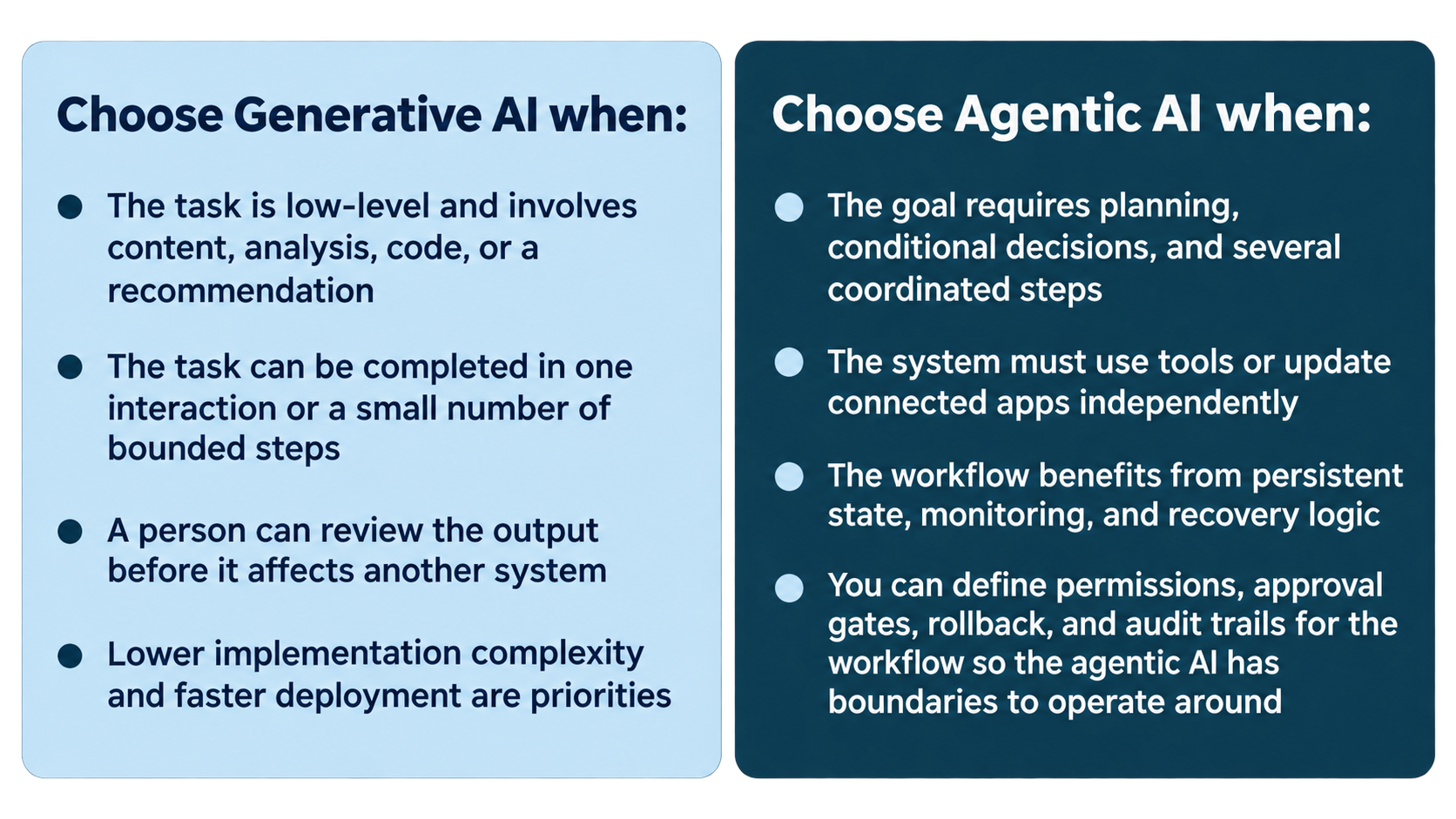
Choose Generative AI when:
- The task is low-level and involves content, analysis, code, or a recommendation
- The task can be completed in one interaction or a small number of bounded steps
- A person can review the output before it affects another system
- Lower implementation complexity and faster deployment are priorities
Choose Agentic AI when:
- The goal requires planning, conditional decisions, and several coordinated steps
- The system must use tools or update connected apps independently
- The workflow benefits from persistent state, monitoring, and recovery logic
- You can define permissions, approval gates, rollback, and audit trails for the workflow so the agentic AI has boundaries to operate around
Risks, Safety, and Governance
When deploying an AI solution, it is critical to be aware of potential risks, limitations and bottlenecks that inevitably come alongside the technology. Since Gen AI and agentic AI differ by mode of operation, levels of access and integration with third-party systems, their potential concerns and risks differ slightly.
Generative AI risks:
- Hallucinations. Generative AI quickly produces confident-sounding output but it might be factually wrong, containing invented statistics, fake citations, or incorrect answers. Because it reads well, hallucinated content is often harder to catch than an obvious error, making human review essential.
- Bias: Training data may contain societal biases, which then surface in generated content. The risk of a bias hence requires ongoing evaluation.
- Harmful or low-quality content. Without guardrails, models can generate inaccurate, off-brand, or offensive content. Hence, it’s important to implement strict quality control processes and evaluate content regularly.
- Privacy leakage. Models can inadvertently expose sensitive information from training data or mishandle personal data included in a prompt, which is a particular concern in regulated industries like healthcare and finance.
- Copyright concerns. Because models train on existing content, outputs can closely resemble copyrighted text, code, or images. Organizations need clear policies for reviewing outputs and understanding how their vendor addresses copyright risk.
- Insecure generated code. Generated code can run correctly while containing security flaws such as hardcoded credentials, missing validation, or vulnerable dependencies. Since it often looks clean at a glance, standard code review and security testing remain necessary regardless of who wrote it.
Agentic AI risks:
Unintended tool calls. An agent can select the wrong tool, call it with incorrect parameters, or take an action that wasn’t actually predefined. This may result in data exposure or leakage, execution loops and unwanted modifications.
Excessive system permissions. Agentic systems often need access across multiple applications to function, but overly broad permissions expand the blast radius of any mistake or compromise, leading to potential security risks.
Cascading errors. Because agentic workflows chain steps together, one wrong decision or bad data point early on can negatively impact the final outcome, turning one error into a sequence of compounding ones.
Prompt injection through external data. Agents that read from external sources such as emails, web pages, or documents can encounter hidden instructions embedded in that content, which may hijack the agent’s behavior.
Uncontrolled action loops. An agent stuck evaluating the same condition, retrying a failing step, or looping between two states without making progress can waste resources or repeat an action more times than intended. Workflows need defined limits and exit conditions to prevent this.
Unclear accountability. When an agent acts autonomously across several systems, tracing who or what is responsible for an outcome becomes harder, especially without detailed logging. Clear audit trails and defined ownership are what make an autonomous action attributable after the fact.
Agentic AI vs Generative AI: Which Approach Fits Your Goal?
There’s no universal answer to which approach fits a given task. The right choice between agentic AI vs generative AI depends on how complex the workflow is, how much system access it needs, how costly a mistake would be, and how much human oversight the process requires. A task with low stakes and a single output usually needs less architecture than one that touches customer data or triggers real-world actions. Rather than guessing at the right setup, it’s worth mapping your specific use case against these factors before building anything.
Discuss your use case with our AI team to identify the safest, simplest architecture for your goal.