

Google AI Studio vs Azure AI Studio: Revolutionizing the Machine Learning Landscape
The landscape of machine learning and artificial intelligence is a rapidly expanding frontier, with Google AI Studio and Azure AI Studio emerging as key players. Gartner’s Magic Quadrant for Strategic Cloud Platform Services report highlights the strategic importance these providers hold in the realm of enterprise IT infrastructure and platform services. These platforms represent the pinnacle of AI development tools, each having significant market presence and influence. In this blog post, we’ll get into what each of these platforms offers, compare their features and capabilities, and explore their real-world applications. Whether you’re a seasoned developer or just starting in the field of AI, this post will provide valuable insights into these two powerful tools.
What is Google AI Studio?
Google AI Studio is a platform by Google that simplifies the integration of Gemini models through a user-friendly and secure API. It offers developers quick prompt development, by allowing them to efficiently convert ideas into code for building generative AI applications. The EMEA Google Cloud Applied AI Summit was a significant event in the AI community, highlighting the latest advancements in AI technology. Among the key focuses was Google AI Studio, a robust platform that stands at the cutting edge of AI development. As explained by Google Cloud CEO Thomas Kurian, this platform is a testament to Google’s commitment to advancing AI technology. It offers a suite of tools that enable developers to create sophisticated AI models with ease. It is known for its powerful Tensor Processing Unit (TPU), the Cloud TPU v5p, which offers enhanced performance and scalability.What is Azure AI Studio?
Azure AI Studio, provided by Microsoft Azure, is a cloud-based environment empowering developers and data scientists with a comprehensive suite of tools and services for efficient AI development and experimentation. The platform boasts its integration into the larger Azure ecosystem (Azure Storage, Azure Databricks, and Azure Machine Learning) and enhanced data movement. These capabilities offer a collaborative development environment, essential for modern AI development.Comparative analysis and core features table
The table below provides a snapshot of the core features and distinctions between Google AI Studio and Azure AI Studio, highlighting their strengths and potential areas of consideration. Each platform offers unique benefits tailored to different needs in the AI and machine learning landscape.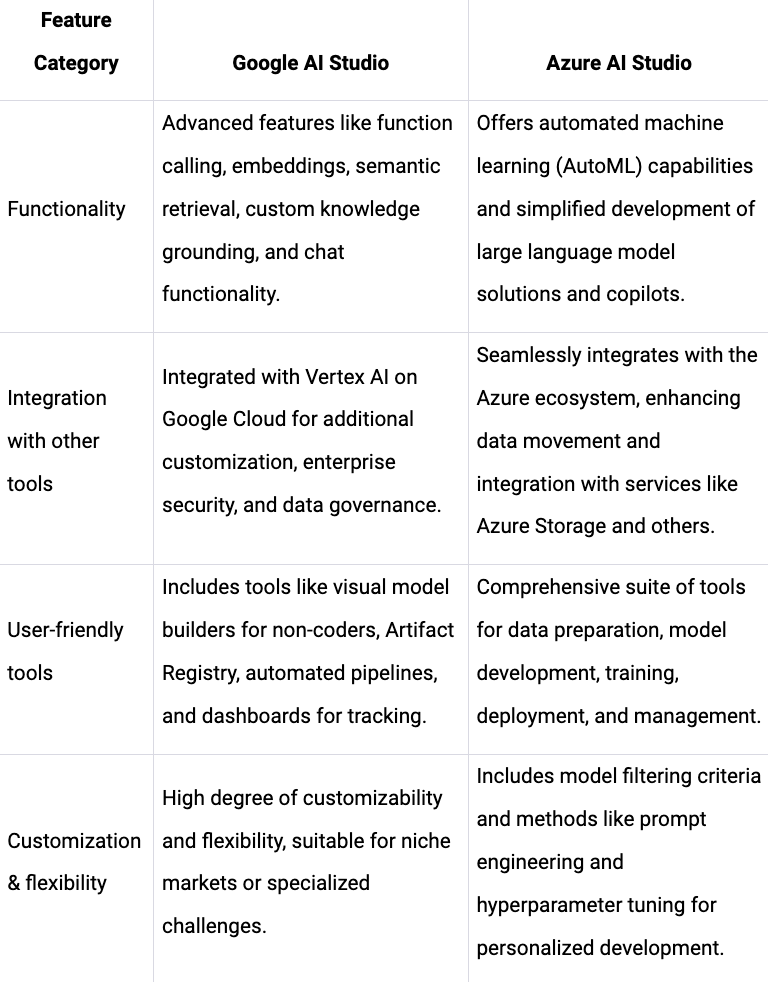
The future of AI and ML: Enhanced AI capabilities provided by Google Cloud and Microsoft Azure
Google I/O 2023 was abuzz with a series of GenAI-related announcements, underscoring the pivotal role of Generative AI not just in Google Cloud, but also across its search and enterprise divisions, including Google Workspace. Google’s investment in foundation models – Codey, Chirp, PaLM, and Imagen – marks a significant step in this direction. These models, accessible through Vertex AI, offer Google Cloud customers the flexibility to consume and fine-tune them with custom datasets. The models in Vertex AI expands this capability further, featuring both open-source and third-party foundation models. Google has also launched GenAI Studio and no-code tools like Gen App Builder for intuitive app development based on GenAI. As for Microsoft, Azure’s exclusive partnership with OpenAI positions it at the forefront of the generative AI landscape. Azure OpenAI stands out as one of the most mature and established GenAI platforms in the public cloud arena. Azure OpenAI integrates a broad range of foundation models from OpenAI, with notable exclusions like Whisper. These models are readily available through familiar APIs and client libraries. In addition to these developments, Microsoft has been actively contributing to the open-source community.Impact on industries
Beyond their contributions to the wider tech community, Google and Azure stand at the forefront of driving substantial advancements in specific industries. The following is a concise overview of the impact of these products on common business domains.-
Healthcare
-
Retail and e-commerce
-
Finance and banking
-
Education and learning
Conclusion
The journey into the future of artificial intelligence and machine learning brings endless possibilities. With Google AI Studio and Azure AI Studio leading the charge, we are embracing a new era where AI not only enhances our daily lives but also drives innovation across all sectors. As these platforms evolve, they will undoubtedly open new horizons, unlocking the full potential of AI and ML. Eager to be a part of this AI-driven future? Contact us to explore how Google AI Studio and Azure AI Studio can revolutionize your business or project with cutting-edge AI solutions.Related Articles

AI in eLearning: Personalizing Learning for Employees, Students, and Online Learners
Technology is changing how we learn and teach. The old classroom model, where everyone follows a standard curriculum, is being replaced. As businesses and schools look for better ways to teach skills and share information, artificial intelligence has really paved the way. It moves education beyond a single method for everyone and makes it a…Learn More
Exploring Predictive Modeling in Healthcare
The tech revolution isn't just on the horizon. It's here. Imagine data, numbers, and machine learning taking over patient care, boosting efficiency, and enhancing the decision-making process. With predictive analytics leading the charge, we are no longer stuck waiting — we are predicting, preventing, and proactively managing health outcomes and resources. This article gets into…Learn More
Effective FinOps Strategies to Achieve Cloud Cost Efficiency
As organizations embrace the cloud, the pay-as-you-go model offers scalability; however, controlling its costs goes beyond mere management. In this regard, the FinOps framework serves as a beacon for financial and operational brilliance. In this article, we’ll discover what FinOps is, explore its key benefits and principles, and delve into practical FinOps strategies tailored for…Learn More
How to Protect Your Data With Google Cloud Platform
Nearly half of the world’s leading companies are planning to increase their investments in cloud tools due to the economic climate. These numbers not only confirm an ongoing trend but also show how cloud tools have significantly changed the way businesses operate worldwide. In this context, Google Cloud Platform (GCP) stands out with its set of tools…Learn More