

Expanding Access to a Hereditary Cancer Risk Platform: Kanda and Dana-Farber Scale PREMMplus
Inherited genetic mutations account for 5-10% of all cancers, yet many people who carry these mutations never get tested. The problem isn't a lack of effective screening tools, it's limited access to them. Genetic counselors, the specialists who traditionally guide patients through hereditary cancer risk assessment, are in critically short supply. For every person who completes genetic testing, many more fall through the cracks. Dana-Farber Cancer Institute set out to change this. Their researchers had developed PREMMplus, a clinically validated algorithm that predicts an individual's likelihood of carrying inherited mutations in 19 cancer-related genes, including those linked to breast cancer, ovarian cancer, colorectal cancer, and other hereditary cancers. The science was validated across more than 30,000 individuals with 89-94% sensitivity and greater than 97% negative predictive value. But developing a clinical algorithm and deploying it at scale are two different challenges. The new hereditary cancer risk assessment platform offered the infrastructure needed to put this tool into the hands of patients, providers, and health systems worldwide.
The Challenge: From Research Tool to Scalable Platform
Dana-Farber had been running a provider-facing website for their earlier PREMM5 screening model, focused specifically on Lynch syndrome. But PREMMplus represented something more ambitious: a broader, multigene risk assessment tool designed to support panel-based genetic testing and reach a much wider audience. The vision was clear. PREMMplus had to work for everyone, including patients filling out forms at home, small clinics running on basic systems, major hospitals with complex electronic records, genetic testing labs, insurers and services that gather family history data. Each group works differently and each faces different regulatory requirements. Building a platform that could handle all of them at once required solving some serious technical problems.
Strict PHI Boundaries
The public-facing website couldn't store or process any protected health information and it needed to operate completely outside HIPAA scope. Meanwhile, the licensed platform for healthcare organizations required full audit logging, data retention, and clinical workflow integration. These two environments had to remain completely separate, with no risk of data commingling.Multi-Tenant Architecture
Health systems, labs, and payers each needed their own space. This covers everything from isolated environments with custom branding, to configurable workflows and dedicated analytics. A genetic testing company couldn't share infrastructure or data with a hospital system. That was non-negotiable.EHR Integration Readiness
The first deployments wouldn't need electronic health record integration. But the architecture had to support FHIR and HL7 standards from the start. Major health systems would eventually come on board. They'd expect seamless connections to Epic, Cerner, and other clinical systems.Localization and Accessibility
The platform had to support multiple languages, with English and Spanish to start and room to add more down the road. It also had to meet ADA accessibility standards. Language barriers and disabilities shouldn't keep anyone from hereditary cancer risk assessment.The Solution: An API-First, Cloud-Native Architecture
Kanda built the PREMM platform using a cloud-native, API-first architecture deployed in AWS. This approach allowed Dana-Farber to separate environments cleanly while maintaining a single codebase.Two Distinct Experiences, One Core Engine
The public PREMM website (now live at premm.dfci.harvard.edu) operates as a stateless application with no user accounts, no saved drafts, and no persistent data storage. Patients and healthcare providers complete the hereditary cancer risk assessment questionnaire, receive their risk level, and can download a PDF summary, all without any data being retained on the server. Behind this public interface, the same PREMMplus algorithm powers a licensed platform where healthcare organizations get their own tenant environment. This includes a Control Center for Dana-Farber's central PREMM team to manage models and global settings, plus Client Admin workspaces where each customer organization can configure their own screeners, manage users, view usage metrics, and access audit logs.Security Without Compromise
Kanda's custom software development approach prioritized security architecture from the start. Data classification explicitly minimizes where PHI can appear. The public site is designed to be completely out of scope for HIPAA, while the licensed platform implements role-based access control, comprehensive audit logging, and environment isolation for each tenant. For the licensed platform, encryption protects genetic information both at rest (using customer-specific encryption keys) and in transit (TLS 1.2+). Each tenant's data lives in logically isolated environments, with row-level security and sharding techniques available for larger customers.Built for Integration
The API-first design means the platform is ready for the next wave of healthcare integration requirements:- Embedding screeners and risk scores directly into EHR workflows
- Powering laboratory ordering portals and pre-test workflows
- Supporting payer eligibility and care management programs
- Feeding downstream analytics for population health management
Technical Implementation
The platform runs on modern web and service technologies, with a microservices architecture that allows independent scaling and updates of components.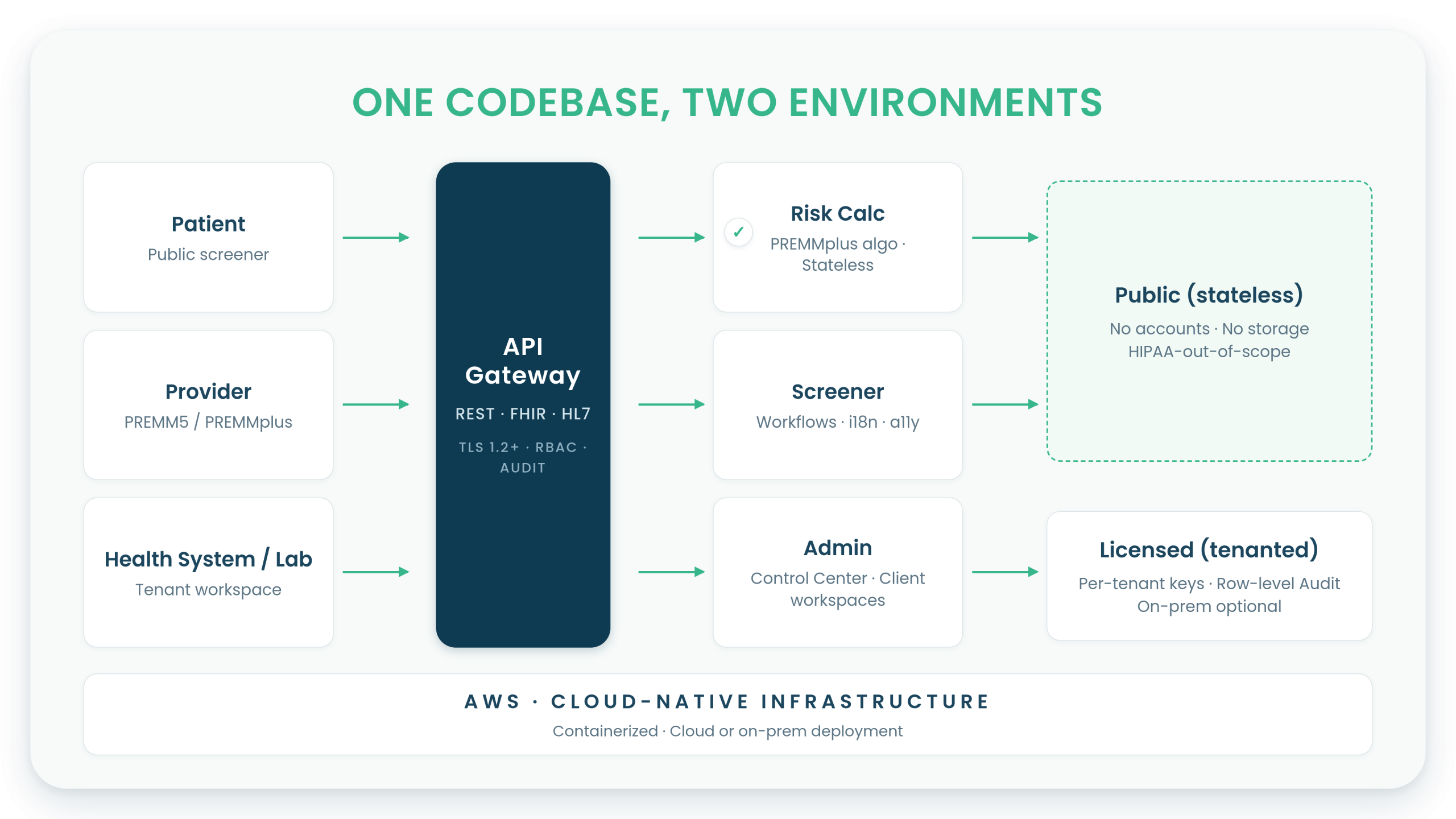 The backend services expose APIs for risk calculation, screener workflows, and administrative operations. The PREMMplus public API computes risk scores without saving any patient data. Users receive their risk score in real-time, and nothing identifiable remains on the server after the session ends.
The frontend delivers accessible experiences across phones, tablets, and desktops. Multi-language support uses a localization system designed for easy expansion to additional languages as Dana-Farber's global reach grows.
For customers deploying the licensed platform, the architecture supports both cloud-based and on-premises deployment options. Organizations with strict data residency requirements can run the platform within their own infrastructure using containerized deployments.
The backend services expose APIs for risk calculation, screener workflows, and administrative operations. The PREMMplus public API computes risk scores without saving any patient data. Users receive their risk score in real-time, and nothing identifiable remains on the server after the session ends.
The frontend delivers accessible experiences across phones, tablets, and desktops. Multi-language support uses a localization system designed for easy expansion to additional languages as Dana-Farber's global reach grows.
For customers deploying the licensed platform, the architecture supports both cloud-based and on-premises deployment options. Organizations with strict data residency requirements can run the platform within their own infrastructure using containerized deployments.
Risk Stratification Models and Version Control
Managing a clinical algorithm across multiple deployments requires careful version control. The platform implements a three-tier versioning scheme that tracks major changes (affecting mandatory questions), minor updates (non-mandatory question changes), and algorithm adjustments separately. When Dana-Farber updates the PREMMplus model based on new research, the platform can roll out changes systematically, notifying customers, tracking compliance across deployments, and ensuring that risk assessment remains consistent and clinically validated.Validated Clinical Performance
PREMMplus is a clinically validated genetic risk assessment tool that helps identify patients who should undergo genetic testing for hereditary cancer syndromes. By estimating an individual's likelihood of carrying pathogenic variants in cancer susceptibility genes, PREMMplus helps determine who is most likely to benefit from further testing. The algorithm was developed using data from over 7,000 individuals who underwent hereditary cancer evaluation at Dana-Farber's Cancer Genetics Program, then validated across two independent cohorts totaling more than 23,000 additional individuals. At the recommended 2.5% risk threshold, PREMMplus demonstrates:- 89-94% sensitivity for identifying individuals with pathogenic germline variants in high-penetrance cancer genes
- Greater than 97% negative predictive value, meaning people with low scores can be confident they're unlikely to carry concerning mutations
- Number needed to test is approximately 16, meaning for every 16 people screened above the threshold, one carrier is identified