
HL7 & FHIR Integration Services
Secured and standard-driven healthcare interoperability solutions powered by HL7, FHIR, USCDI, and modern healthcare data exchange technologies
Client Spotlight
Trusted by 100+ HealthTech Clients






Core HL7 & FHIR Integration Services
We provide full-scale HL7 integration services and FHIR development across the whole integration lifecycle. Our engineers work at the protocol level, building robust message flows, transformations and monitoring, keeping the system running smoothly. Data mapping is core for all of the below: correct data mapping is the key to an interface that not only works technically, but delivers decision-ready data.
HL7 v2 Interface Development
Development and support of ADT, ORU, ORM, SIU, DFT, MDM interfaces across clinical and administrative healthcare systems.FHIR API Development and Deployment
Development of secure FHIR APIs, USCDI-compliant interfaces and SMART on FHIR applications for EHR systems, patient portals and digital health solutions.HL7 Data Integration and Transformation
Mapping, transforming and validating clinical data during data transfers between EHRs, labs and applications, terminology normalization for standardized data exchange.Legacy Interface Modernization
Modernization of legacy interface estates and introduction of FHIR integration where it makes sense, not requiring the full interface replacement.HL7 to FHIR Migration
Transformation of HL7 v2 message flows into FHIR resources, providing a bridge between legacy infrastructure and modern API-based applications.Ongoing Interface Monitoring and Support
Ongoing support, message-level monitoring and maintenance of the interface as systems upstream change, ensuring reliability of the interface after go-live.
Why Healthcare Interoperability Projects Fail
HL7 and FHIR integration projects don't usually fail on paper. They fail in production, and typically due to one of the following four reasons.
- Complex resource mappingThe same clinical event presents differently in each source system. The same ADT message arrives from two EHRs with different segments, Z-segments and value types. Properly mapping this complex structure into the canonical model or FHIR resource requires detailed and meticulous work. We provide robust data mapping and terminology normalization, ensuring that downstream healthcare systems will get the same high-quality data no matter the source.
- Inconsistent source dataData mapping cannot be applied in case there are missing identifiers, non-standardized code sets and free-text fields where structured data should be. We normalize, validate and standardize clinical and administrative data, using SNOMED, CT, RxNorm, ICD and CPT terminologies to make it usable once it's received.
- Interface performance and stability under loadThe interface that works perfectly during a demo might suddenly start dropping messages when real-life clinical traffic starts flowing through it. Kanda Software develops robust interface architecture with persistent queues, retry logic and message monitoring ensuring seamless message delivery even during traffic spikes and system synchronization.
- Security and compliance pressureHealthcare data should be HIPAA-compliant, meet audit requirements and satisfy the regulatory deadline. Kanda Software designs a robust and secure integration architecture with encryption, audit logging of message exchange and access controls built in from the beginning. Our approach ensures both secure healthcare data exchange and high performance of the integration solution.
Kanda Software in Numbers
- 30+ Years in the Industry
- 100+ HealthTech Clients
- 850+ Engineers
- Standards-Based Interoperability
HL7 v2, FHIR R4, USCDI, SMART on FHIR
HL7 & FHIR Integration Case Studies

Expert Perspective
Daniel Kogan, Chief Technology Officer, Kanda Software
HL7 v2.x vs. FHIR R4: Which Standard to Choose?
Both standards are currently actively used, and the majority of production environments run both in parallel. Choice depends on the data type being moved, destination and driving requirements. Below is the comparison of HL7 v2.x and FHIR R4 on criteria relevant to any project.
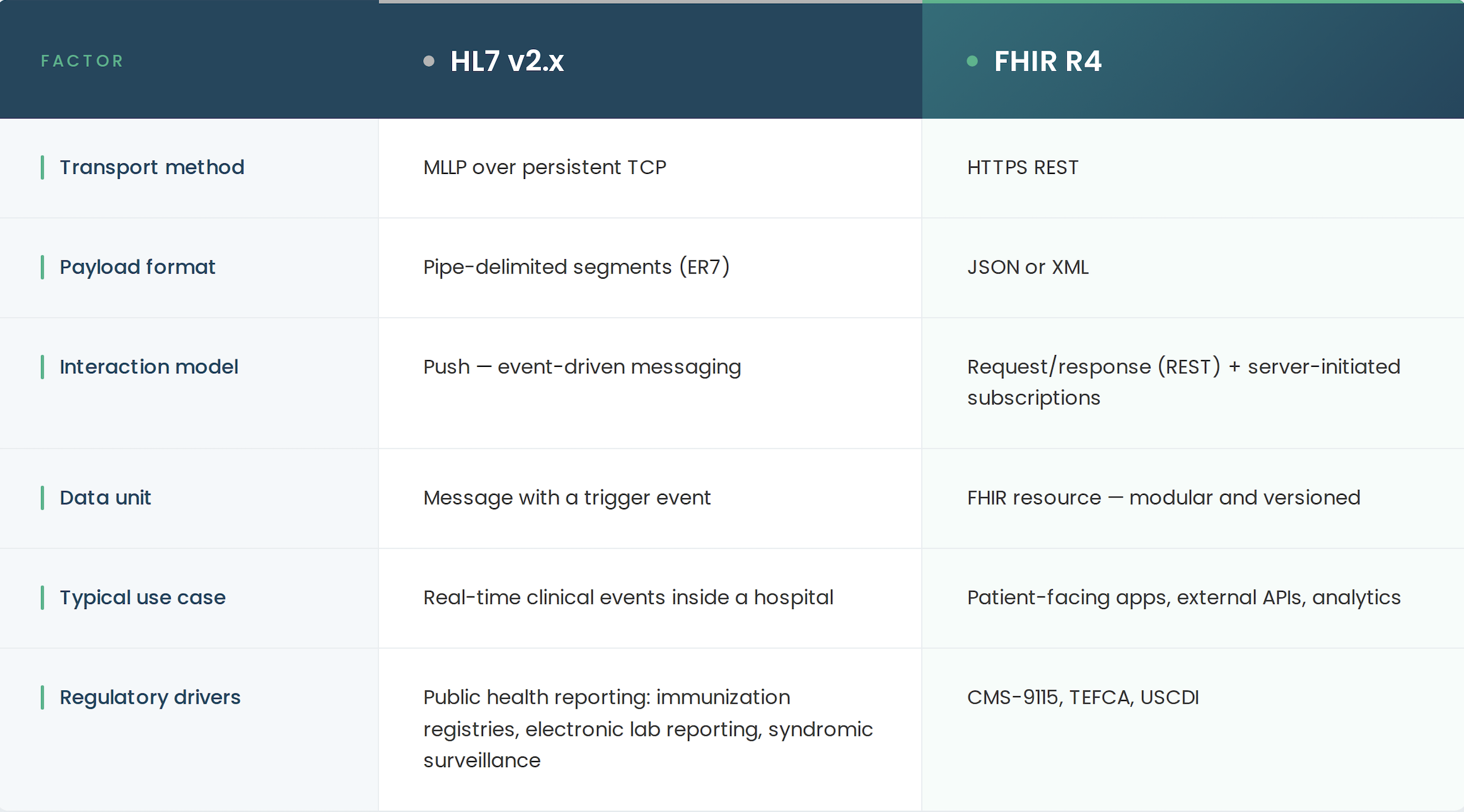
In what cases each is better: For real-time clinical events inside a hospital, HL7 v2 wins in terms of coverage, because virtually every EHR supports it natively. For patient-facing applications, non-EHR integrations or compliance with CMS-9115, TEFCA and USCDI standards – FHIR R4, fast healthcare interoperability resources is the modern, REST and subscription-based standard. The vast majority of production environments run both, and require v2-to-FHIR bridge inside the integration engine. Kanda Software specializes precisely in this environment: reliable messaging now, and standardized data formats prepared for the future requirements.
HL7 v2 Messages & FHIR Resources Kanda Software Engineers Work With
Kanda's engineers build interfaces for the HL7 v2 messages that process the clinical and administrative data in most healthcare environments. We map each HL7 message to its corresponding FHIR R4 resource for fhir resource modeling and modernization. Health Level Seven v2 remains the standard for real-time messaging; FHIR R4 is the standard where data goes when it needs to be integrated with an API, application or analytics platform.
Messages we build and support:
Integration Scenarios per Organization Type
Different types of organizations require different integration scenarios, calling for different sets of messages, volumes and latency requirements. Kanda Software provides tailored architecture design for the given scenario.
EHR Platforms & Integration Engines Our Engineers Work With
Kanda Software works with the interface engines responsible for listening, transforming and routing HL7 messages, ensuring that connected and disparate systems remain synchronized and communicate with each other in the same language.
The engine layer is where reliability happens: message listeners, transformation logic, routing rules and monitoring that ensure seamless data exchange between clinical systems and hospital information systems. We design, develop and support that layer as part of each interface project.
As a member of the Epic Vendor Services program, we perform single- and bi-directional Epic integration along with other leading platforms.
Kanda Software builds HL7 and FHIR interfaces for the major EHR platforms and sets up the operations for the integration engine underneath them. EHR and clinical platforms:
What You Get When You Partner with Us
Our HL7/FHIR Integration Process
Kanda Software follows a straightforward process for HL7/FHIR integrations from assessment to go-live and support. Each step is designed to ensure integrity and efficiency of operations with the data prior to deployment in production environments.
- 5 Important Steps
- 1) Assessment — identify existing interfaces, message types, source systems and certification paths; uncover hidden requirements early.
- 2) Specification & mapping design — document fields, trigger events, mapping tables, acknowledgment and retry strategy before writing code.
- 3) Interface build — develop interfaces and transformations in the integration engine with automated tests.
- 4) Testing & validation — verify mappings and messages against realistic production data.
- 5) Go-live & support — coordination, stabilization, ongoing monitoring and updates as upstream systems change.
HL7 to FHIR Migration & Modernization
Kanda Software modernizes legacy HL7 interfaces to FHIR without a full replacement. Running v2 and FHIR in parallel during the migration period ensures the smooth operation.
Organizations do that for a reason: regulatory requirement (FHIR-based API is a requirement of the CMS Interoperability and Prior Authorization Final Rule, CMS-0057-F, with phased compliance dates starting in 2026, and first date of mandatory compliance for FHIR-based APIs is January 1, 2027, for impacted payers) or vendor consolidation (after merger) or legacy interface engines becoming difficult to maintain. Full replacement is hardly ever a viable option, as existing systems are performing important clinical workflows and cannot simply be turned off.
Our approach creates a bridge between HL7v2 and FHIR R4 during transition. Kanda Software keeps existing HL7v2 messaging working for real-time clinical events while implementing FHIR R4 resources and APIs parallel to them, mapping v2 segments into FHIR resources via the integration engine. Legacy interfaces continue to deliver robust data exchange while new FHIR-based capabilities become available for apps, analytics and regulatory endpoints. Once the workflow is validated, it gets migrated to FHIR. This phased approach ensures data exchange security during the whole transition process and gives organizations flexibility to modernize in their own time, not at one risk-prone cutover.
Compliance & Regulatory Alignment
Kanda's HL7/FHIR integration practice is designed with HIPAA compliance and regulatory alignment in mind, with specific integration safeguards such as encrypted data in transit, audit logging of message exchange and BAA coverage. Interface-layer compliance is a separate practice from application security. The integration solutions we offer, in addition to being compliant with the regulatory framework, are also in line with the trajectory that is set by FHIR-based Patient Access API defined by CMS-9115-F (2020) and CMS-0057-F (2024, effective January 1, 2027), as well as the TEFCA and USCDI initiative for more widespread adoption of FHIR. Our expertise is built in the environment of tight regulation, and Kanda Software prides itself on experience in HIPAA, HITRUST, FDA, CLIA, and NIST compliance, as well as our ISO 27001 certification. Every integration solution is crafted according to the requirements of the regulation framework relevant to the movement of the data. Kanda Software focuses on the controls around the data:
We turn Ideas into Products. Challenges into Wins. Product Owners into Heroes.
 Clynt TaylorCEO, Trapelo
I have had a very positive experience working with Kanda over the past eight years. They have partnered with us in designing and building very sophisticated applications in the use of precision medicine for cancer therapy selection. I highly recommend them for their expertise, professionalism and value.
 Sapna SyngalMD, MPH, Dana-Farber Cancer Institute
In addition to the technical execution, Kanda functioned as a true product development partner rather than simply a vendor delivering a product. Their team engaged deeply with the clinical and regulatory realities of our work, from three-tier version control for algorithm updates to accessibility and localization requirements.
Read Original
HL7 & FHIR Integration Questions, Answered.
Get Your HL7/FHIR Integration Estimate
Whether you're building a new FHIR-enabled product, connecting an application to an EHR, modernizing your legacy HL7 interfaces, or developing an interoperability layer between multiple systems – Kanda Software can help you define and deliver the best approach. Tell us about your HL7/FHIR integration requirements and interoperability goals, and our team will suggest how we can assist.
- Contact Us
- Find Us on Social Media
- Want to join the Kanda team?