

March 18, 2026
Transport and Logistics
Why Your Aviation Surveillance Data Management Needs Improvement
Key Takeaways
The problem isn’t the lack of data. It’s that most organizations can’t actually use it well. Fragmented systems, outdated pipelines, and manual workarounds leave operations teams making critical decisions on incomplete or stale information and in aviation, that can be critical.
This article breaks down the most common aviation data management failures, why they persist, and what it actually takes to fix them through purpose-built aviation software development.
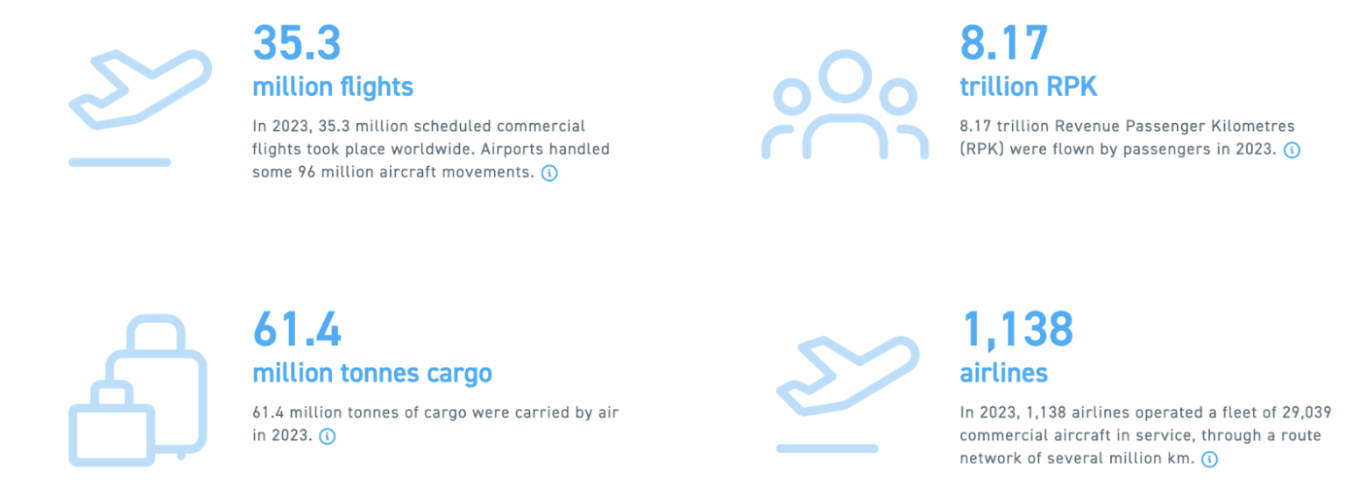 Source: ATAG
On top of that, the expansion of UAS (drone) operations into controlled airspace, rising traffic density (IATA projects over 5.2 billion passengers by 2026), and the rapid growth of predictive analytics in maintenance are all generating data faster than most organizations can process it. According to GM Insights, the predictive airplane maintenance market alone was valued at $5.3 billion in 2024 and is expected to more than triple by 2034. All of this data needs somewhere to go—and something useful to do when it gets there.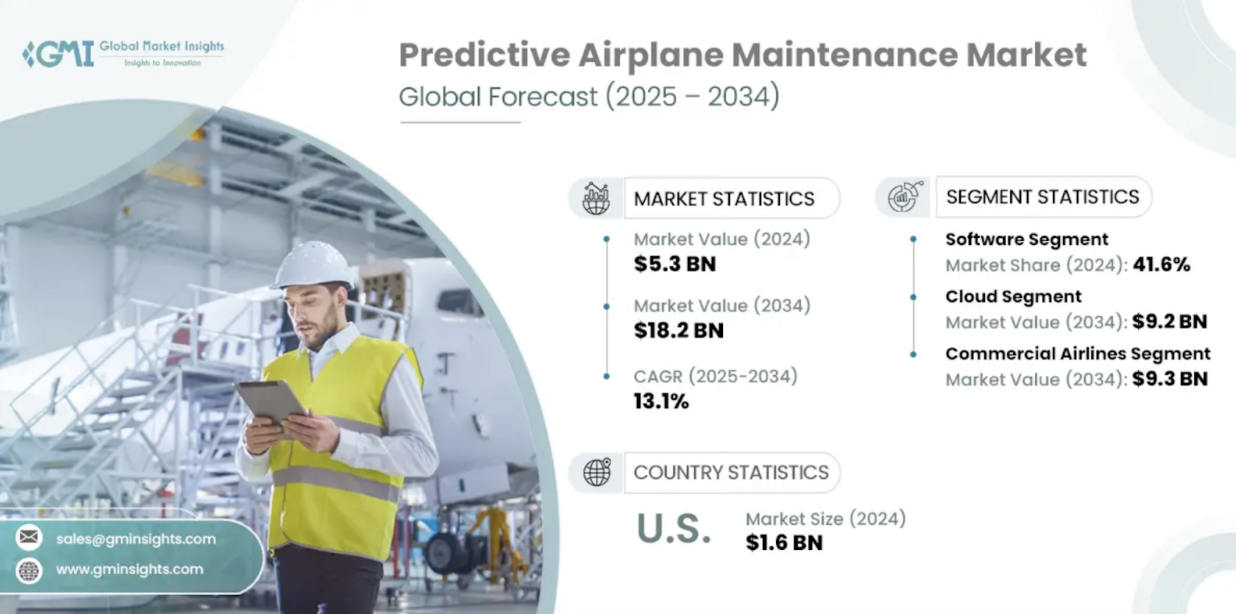 Source: GMI
For one of our clients, a leader in aviation fuel contract services, Kanda handles core development, ongoing releases, and QA support for the company’s B2B platform—the system that industry brokers and operators depend on every day to manage fuel purchases, simplify workflows, and accelerate their businesses.
In a different corner of the industry, Kanda partnered with a private aviation technology platform connecting brokers and operators of charter aircraft, to design and build a web-based carbon emission monitoring, reduction, and offsetting tool. The platform helps individual and corporate jet owners meet sustainability regulations, measure their impact, and achieve certification. This is exactly the kind of compliance-heavy, data-intensive challenge that mirrors the demands of aviation data management more broadly.
Both projects reflect what we bring to aviation engagements: an understanding of how regulated industries work, experience building platforms where accuracy and uptime aren’t optional, and a team that’s comfortable operating in complex, multi-stakeholder environments.
We can help with:
The signs of poor data management are usually hiding in plain sight: delayed surveillance feeds, manual reconciliation processes, compliance scrambles, and integration projects that never seem to end. If any of that sounds familiar, the fix isn’t another bolt-on tool. It’s a deliberate investment in an architecture designed for aviation from the ground up.
- The FAA's SWIM network moves nearly 5 TB of aviation data per day and most organizations can't keep up.
- Five red flags: delayed feeds, manual workarounds, slow compliance, no audit trails, painful integrations.
- Root causes: legacy sprawl, weak data governance, and IT owning what should be an operations problem.
- Poor maintenance data costs major carriers $100M–$200M a year in avoidable disruptions.
- Off-the-shelf tools rarely fit aviation's real-time, multi-source, compliance-heavy reality.
The problem isn’t the lack of data. It’s that most organizations can’t actually use it well. Fragmented systems, outdated pipelines, and manual workarounds leave operations teams making critical decisions on incomplete or stale information and in aviation, that can be critical.
This article breaks down the most common aviation data management failures, why they persist, and what it actually takes to fix them through purpose-built aviation software development.
Source: ATAG
The Scale of Aviation Data—and Why It’s So Hard to Manage
What “Surveillance Data” Actually Includes in Aviation
Aviation data is much broader than just flight tracking. Surveillance data spans a wide range of feeds and formats, each typically siloed with its own vendor, update cadence, and data model:- ADS-B (Automatic Dependent Surveillance–Broadcast): satellite-derived position, altitude, and velocity data broadcasted by aircraft in real time.
- Primary and secondary radar feeds from ground-based systems.
- ACARS (Aircraft Communications Addressing and Reporting System): digital messages between aircraft and ground stations covering everything from engine performance to gate assignments.
- Weather systems: METAR, TAF, SIGMET, and other meteorological data used in flight planning and real-time decision-making.
- Maintenance records and MRO logs: inspection schedules, component life-cycle data, and repair histories.
- NOTAM (Notice to Air Missions) data: real-time advisories on airspace restrictions, runway closures, and hazards.
- Crew scheduling and dispatch feeds tied to FAA duty-time regulations.
Why Data Volumes Are Growing Faster Than Management Capabilities
Several forces are pushing aviation data volumes up beyond what most legacy platforms can handle. The FAA’s NextGen program and Europe’s SESAR initiative are both driving a shift toward satellite-based surveillance and digital data sharing. According to the Department of Transportation, nearly 5 terabytes of aviation data, covering flight movements, weather, and air traffic flow constraints, now move through the FAA’s System Wide Information Management (SWIM) enterprise every single day.On top of that, the expansion of UAS (drone) operations into controlled airspace, rising traffic density (IATA projects over 5.2 billion passengers by 2026), and the rapid growth of predictive analytics in maintenance are all generating data faster than most organizations can process it. According to GM Insights, the predictive airplane maintenance market alone was valued at $5.3 billion in 2024 and is expected to more than triple by 2034. All of this data needs somewhere to go—and something useful to do when it gets there.
Source: GMI
Five Signs Your Aviation Data Management Needs a Serious Upgrade
1. Real-Time Data Is Delayed or Inaccessible
If controllers or ops managers are making decisions based on data that’s even a few minutes old, that is a problem. In aviation, stale data is a safety risk. The FAA’s 2020 ADS-B Out mandate made satellite-based surveillance the primary tracking medium in U.S. airspace. According to FlightAPI, by mid-2024, roughly 168,000 registered U.S. aircraft had ADS-B installed, and Flightradar24 recorded over 134,000 commercial flights in a single peak day. If your systems can’t ingest, process, and deliver that data in real time, your team is always working from an incomplete picture.2. Your Teams Rely on Manual Processes to Reconcile Data
Spreadsheets, copy-paste workflows, and email chains are still shockingly common as “data connectors” in aviation operations. The hidden cost here is enormous: every manual handoff introduces a chance for error, and every error eats response time. If your ops team spends hours pulling data from one system and re-entering it in another just to get a full picture, that can be a major liability.3. Compliance Reporting Takes Days Instead of Hours
Meeting the requirements of FAA Part 139, ICAO Annex 15, or ASIAS data submissions is already complex. When aviation data management is poor, compliance becomes reactive and expensive. Teams scramble to collect data from multiple systems, reconcile formats, and assemble reports manually. What should take hours stretches into days. And when auditors or regulators come knocking, you don’t want to be the organization digging through inboxes to find the right records.4. You Can’t Trace Data Lineage or Audit Decisions
In incident investigations or safety reviews, traceable, time-stamped data chains aren’t optional—they’re non-negotiable. If your organization can’t show exactly where a data point came from, when it was generated, and who acted on it, you’re carrying a significant safety and liability exposure. Many organizations simply don’t have this capability built into their current systems.5. Integrating a New Data Source Requires a Major Project
Here’s a good test: how long would it take to add a new sensor type, airport feed, or analytics tool to your current setup? If the answer is “months of custom integration work,” that’s a sign the underlying architecture wasn’t designed for scale or flexibility. Modern aviation data platforms should make onboarding new data sources straightforward, not a capital project.The Root Causes: Why Aviation Data Management Stays Broken
Overreliance on Legacy Systems and Point Solutions
Many aviation organizations have spent decades layering vendors and bolt-on tools on top of each other. The result is an architecture that actively resists integration. When the FAA built its En Route Automation Modernization (ERAM) system, it replaced a platform with roots in the 1960s. Most airlines and airports haven’t made moves that bold. Instead, they’re running critical operations on systems that were never designed to share data at today’s scale or speed. For organizations dealing with similar challenges, legacy transformation and cloud modernization is often the first step toward a more sustainable architecture.Data Governance Gaps Specific to Aviation
Unlike healthcare (HIPAA) or finance (SOX), aviation doesn’t have a single dominant data standard that all systems adopt. The FAA’s SWIM initiative is an important step toward standardized data exchange across the National Airspace System, but implementation is still inconsistent. SWIM was first conceptualized by Eurocontrol back in 1997, and while it’s now a core part of both NextGen and Europe’s SESAR program, many organizations still operate with fragmented governance models that make real-time data sharing harder than it should be.Treating Data Infrastructure as an IT Problem, Not an Operations Problem
This is one of the most common mistakes. When aviation data management is owned entirely by IT without deep operations input, you end up with systems that are technically functional but operationally useless. Controllers, MRO technicians, dispatchers, and compliance officers all need different things from the same underlying data. If system builders aren’t talking to system users, you end up with elegant databases that nobody actually opens. Taking a data-driven approach in product management helps bridge that gap by keeping real user needs at the center of every design decision.What Good Aviation Data Management Actually Looks Like
Unified Data Pipelines with Real-Time Processing
A well-architected aviation data platform does a few things well: it ingests data from multiple sources, normalizes formats across vendors, enables real-time query and alerting, and provides full audit trails. Cloud infrastructure from providers like AWS, Azure, or GCP makes this kind of architecture more accessible than it used to be—but the engineering still has to be done right. Migrating data to the cloud isn’t just about moving files; it’s about redesigning how data flows through your entire operation.Role-Based Access and Contextual Data Delivery
Controllers, MRO technicians, operations planners, and compliance officers all need different views of the same underlying data. Good aviation data services design around those roles. A maintenance engineer doesn’t need the same dashboard as an air traffic flow manager. The data is the same; the context is different. Getting this right reduces noise, speeds up decision-making, and keeps the right people focused on the right information.Predictive Analytics Built into the Workflow
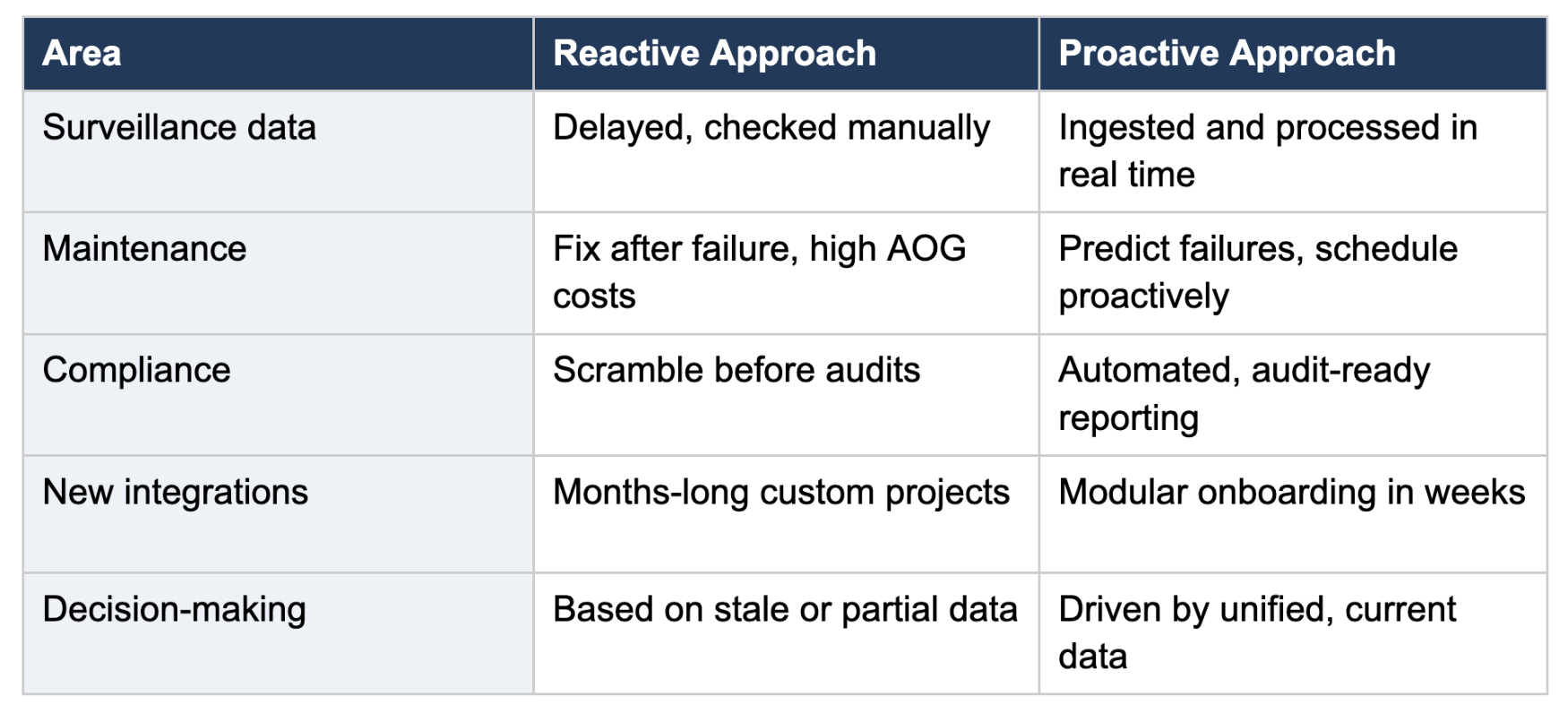
The goal isn’t more dashboards that describe what already happened. It’s systems that surface anomalies and risks before they become incidents. Predictive maintenance is probably the most mature use case here. As noted by ePlaneAI, a study published in Procedia CIRP found that unplanned maintenance costs between two and five times more than scheduled maintenance. And according to Boston Consulting Group (via PowerAeroSuites), maintenance-related disruptions can cost major carriers between $100 million and $200 million a year in lost revenue and passenger compensation. Better data management is what makes the difference between reactive firefighting and proactive risk management. Reactive vs. Proactive Aviation Data Management
The Case for Custom Aviation Software Development
Why Off-the-Shelf Platforms Often Fall Short
Generic data management tools aren’t built for aviation-specific data types, regulatory requirements, or real-time demands. They might handle basic analytics just fine, but when you need to ingest ADS-B feeds alongside MRO logs and weather data—all in real time, all under strict compliance rules—most off-the-shelf platforms start to buckle. Aviation is too specialized and too safety-critical for a one-size-fits-all tool.What to Look for in an Aviation Software Development Company
If you’re evaluating partners for custom aviation software development, there are a few things worth paying attention to:- Domain familiarity: Do they understand the difference between ACARS and ADS-B? Can they speak to FAA and ICAO requirements without a cheat sheet?
- Real-time data engineering: Building systems that process high-volume, time-sensitive feeds is a different discipline than building standard enterprise software.
- Cloud engineering depth: Experience with AWS, Azure, or GCP for scalable, secure data pipelines. This includes DevOps maturity—automated deployments, monitoring, and infrastructure as code.
- Integration track record: Have they delivered complex, multi-source data integrations before? Ask for specifics.
Building vs. Buying—Making the Right Call
There’s no universal answer here. The right choice depends on a few key factors:- Data volume and velocity: If you’re dealing with high-frequency, multi-source real-time feeds, custom is usually the better bet.
- Integration complexity: The more legacy systems and vendor-specific formats you need to connect, the less likely it is that a platform product will do the job.
- Compliance specificity: Aviation-specific regulatory requirements often require custom logic that no generic tool includes out of the box.
- Long-term scalability: If your data management needs are going to grow significantly over the next 3–5 years (and in aviation, they almost certainly will), building on a flexible, custom architecture tends to pay off.
Kanda in Aviation: Real-World Experience
While aviation surveillance data management may be a specific discipline, Kanda is no stranger to the broader aviation industry, or to building software that has to perform under the strict regulatory and operational demands it brings. We’ve worked directly with aviation companies where reliability, compliance, and real-time data accuracy are baseline requirements.For one of our clients, a leader in aviation fuel contract services, Kanda handles core development, ongoing releases, and QA support for the company’s B2B platform—the system that industry brokers and operators depend on every day to manage fuel purchases, simplify workflows, and accelerate their businesses.
In a different corner of the industry, Kanda partnered with a private aviation technology platform connecting brokers and operators of charter aircraft, to design and build a web-based carbon emission monitoring, reduction, and offsetting tool. The platform helps individual and corporate jet owners meet sustainability regulations, measure their impact, and achieve certification. This is exactly the kind of compliance-heavy, data-intensive challenge that mirrors the demands of aviation data management more broadly.
Both projects reflect what we bring to aviation engagements: an understanding of how regulated industries work, experience building platforms where accuracy and uptime aren’t optional, and a team that’s comfortable operating in complex, multi-stakeholder environments.
How Kanda Can Help
Building a modern aviation data management platform requires deep experience in real-time data systems, cloud infrastructure, regulatory environments, and the operational realities of aviation. Kanda has been delivering custom software development for complex, data-intensive industries for decades, and we bring that same discipline to aviation.We can help with:
- Assessing your current data architecture and identifying the gaps that are costing you the most time and money.
- Designing and building unified data pipelines that ingest, normalize, and process aviation surveillance data in real time.
- Integrating legacy systems with modern cloud platforms (AWS, Azure, GCP) without ripping and replacing everything at once.
- Building role-based dashboards and analytics tools tailored to controllers, MRO teams, compliance officers, and operations managers.
- Implementing predictive maintenance frameworks that turn raw sensor data into actionable insights.
- Setting up DevOps practices and CI/CD pipelines so your aviation data infrastructure can evolve as your needs grow.
Conclusion
Aviation data management isn’t a back-office IT concern. It’s an operational capability that directly affects safety, efficiency, and the bottom line. Organizations that treat it as such and invest in unified data pipelines, real-time processing, and purpose-built aviation software, are the ones that can actually use their data instead of drowning in it.The signs of poor data management are usually hiding in plain sight: delayed surveillance feeds, manual reconciliation processes, compliance scrambles, and integration projects that never seem to end. If any of that sounds familiar, the fix isn’t another bolt-on tool. It’s a deliberate investment in an architecture designed for aviation from the ground up.
Related Articles

7 Software Innovations to Fix Your Aviation Ops
Running aviation operations means dealing with flight scheduling conflicts that cause expensive delays, fuel costs that change unpredictably, maintenance tracking problems that ground aircrafts when you need them most, crews spread across time zones, constant regulatory requirements, and data trapped in systems that don't talk to each other. According to IATA's 2025 report, supply chain…Learn More
The Main Obstacles in Building Custom ERP and How to Overcome Them
Efficient resource management and planning is an essential component of a successful company. Any company's growth comes with an operational routine that cannot be handled without the right tools and technologies. During the last year, custom-developed ERPs allowed over 50% of companies to streamline their efficiency by organizing accounting, onboarding, logistics, HR and other processes,…Learn More