

DevOps in Enterprise: Improved Business Productivity and Performance
Does DevOps work only for startups? Let’s debunk this myth right off the bat. No, it doesn’t. And digging a bit deeper into the topic, it would be fair to say that while in startups DevOps adoption may seem seamless, in enterprises, overcoming the fear of implementing DevOps can lead to impressive results. This assumption is backed by a recently published Acumen Research and Consulting report. The report titled “DevOps Market Size, Share, Analysis Report and Region Forecast, 2022 – 2030” says: The Global DevOps Market size accounted for USD 7,398 Mn in 2021 and is expected to reach USD 37,227 Mn by 2030 with a considerable CAGR of 20% during the forecast timeframe of 2022 to 2030. In this article, we will observe what makes a successful DevOps practice, the main challenges of DevOps implementation in an enterprise, and how this methodology, once applied, can maximize business efficiency.
What is DevOps?
At the heart of DevOps lies cultural transformations. By cultural transformations, DevOps evangelists mean the changes in the mindset, i.e. in the approaches to the development and deployment processes. First of all, it implies overcoming siloed Dev and Ops teams’ mentality for the sake of the combined power of the two named groups. And secondly, it implies leveraging the best practices, including automation and innovative tools, as well as incorporating structural changes to accelerate the development of new applications and ease up the maintenance of the existing ones.What makes a successful DevOps practice?
Below we will list 4 key components that can yield victory in the company’s DevOps initiatives.- Automation
- Cooperation
- Agility
- Code ownership
Key challenges of DevOps adoption in an enterprise
For enterprises, the idea of DevOps adoption may seem daunting. There are multiple reasons why. Let’s disclose 3 key challenges slowing down companies’ initiatives towards DevOps.Challenge 1. A shift from legacy applications to microservices
The transition from legacy systems to microservices implies having a basis for automation, configuration management and continuous delivery in place in order to manage the gradually increasing operational workloads associated with microservices. However, these changes seem trivial compared to the bunch of issues legacy systems may cause, including instability, lack of support, losing on innovations, and falling behind the competitive market.Challenge 2. The conflict between the development and operations teams’ toolset
The diverse toolset and metrics these two teams work with may lead to natural resistance to any significant changes in the usual workflows and routine. The solution, though not the easiest one, can be cooperation between teams with the primary goal of making a universal system by integrating the tools of both teams and unifying the metrics they track. Yes, sometimes, to embrace innovation and make a step forward, you need to be ready to sacrifice your well-established routine and customs.Challenge 3. Cultural changes
The Dev and Ops mentality prevailing in most organizations is often a stumbling block to adopting the DevOps methodology. Historically development and operations teams got used to maintaining diverse functions and sticking to counter goals. However, integrating two siloed teams should become the highest priority for the management willing to push forward the DevOps practice. By setting common objectives, building up a proper resource management strategy and identifying product owners, enterprises can boost the movement from a siloed culture to a unified DevOps system.Benefits of DevOps implementation for enterprises
Among the numerous benefits of DevOps for organizations, some critical pros directly impact companies’ profitability and cost-effectiveness.-
Minimum production costs
-
Faster ROI
-
Enhanced customer experience
-
Improved reliability
DevOps and its impact on a business performance
The Google Cloud Platform & DevOps Research and Assessment (DORA) study for 2021 highlights the difference between companies at various stages of DevOps adoption and outlines the direct correlation between excellence in software delivery and increased performance in a company’s technology modernizations. The Google Study classified teams as elite, high, medium or low performers based on 4 key software delivery performance metrics ( Deployment Frequency, Lead Time for Changes, Change Failure Rate, and Time to Restore Service). Similarly to previous years’ study findings, elite teams kept evolving in terms of software delivery pace. Thus the lead time for changes, i.e. the amount of time it takes a commit to get into production, was reduced from a maximum of 1 day to a maximum of 1-hour timeframe for such teams. Moreover, compared with low performers, elite performers have 6570x faster time-to-recover from incidents when failure does happen. These findings are another standing illustration of the vivid fact – companies with a high level of velocity and stability driven by thoroughly implemented DevOps practices are increasingly successful in terms of business performance and efficiency. More interesting findings of the research are depicted in the picture below: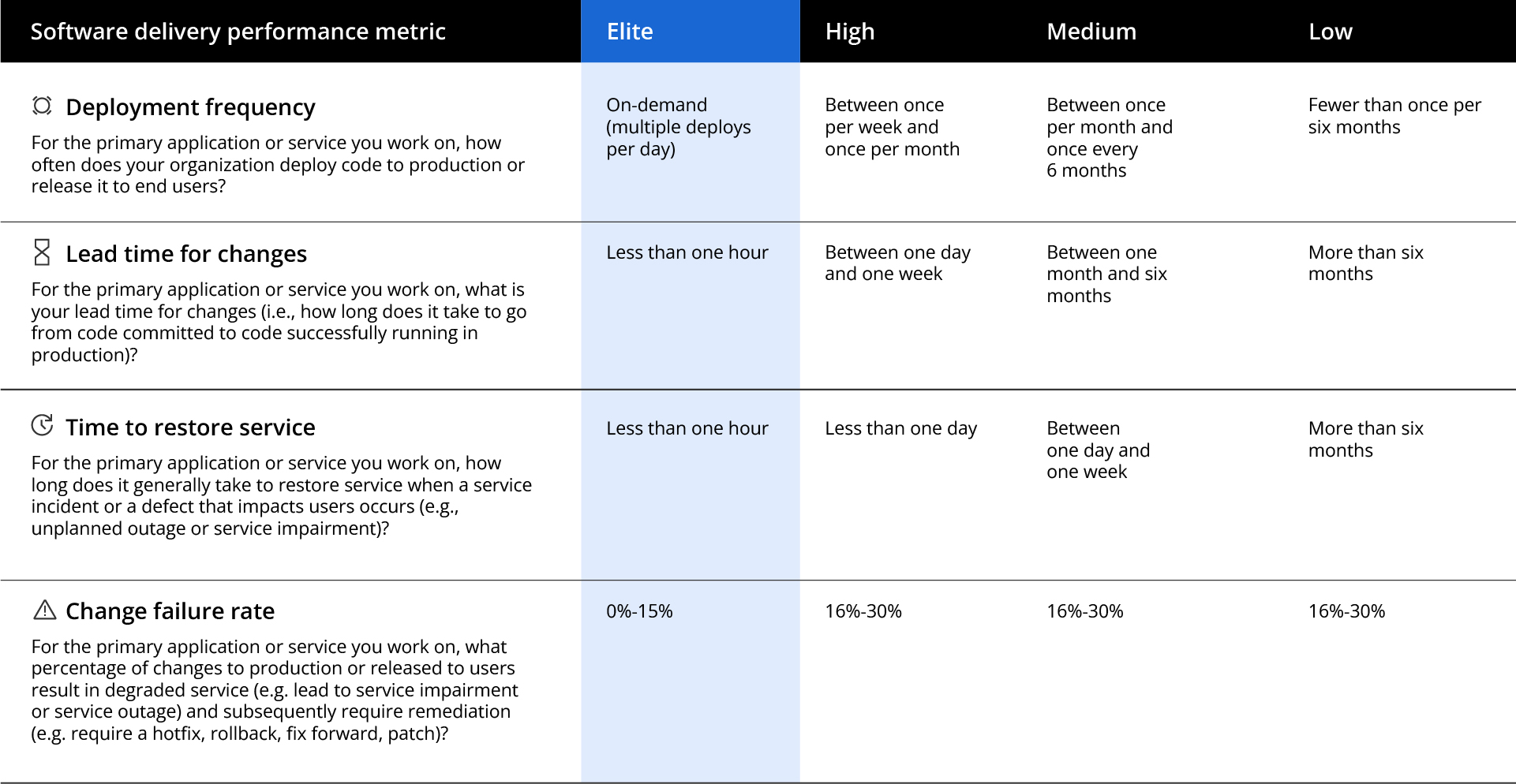
The source: google.cloud.com
Conclusion
Catch yourself when you wonder, “How can I increase my business performance?”. And in case adopting DevOps is one of the things to do on your list, it’s time to make it a higher priority task. Multiple studies and use cases have long ago revealed the impressive impact of DevOps on companies, which means that adding this robust, cutting-edge methodology to your business strategy is the only right solution. At Kanda, we believe that maintaining continuous delivery is essential to stay ahead of the competition. Learn more about the wide range of DevOps services Kanda provides to the customers and talk to our experts to take your first confident steps towards software delivery excellence.Related Articles

How to Turn Your Broken Data Workflows Into Scalable Data Pipelines: An Ultimate Guide
Key Takeaways Workflows break at scale not because of selecting wrong tools, but because project-level habits, manual handoffs, copy-pasted scripts become the operating model. The architecture patterns that enable scalability: decoupled storage and compute, deliberate data layering, and orchestration treated as a control plane. Pipeline reliability is a delivery problem too. Version control, CI/CD, and…Learn More
Why Using Edge AI for Real-Time Analytics Is Your Next Best Decision
Key Takeaways: Edge AI processes data locally in 1–10 ms, compared to 50–200 ms with cloud-based analytics, making it critical for time-sensitive operations. Organizations can cut data transmission costs by up to 43% and reduce cloud-bound traffic by over 90% by filtering data at the edge. Industries like manufacturing, healthcare, autonomous vehicles, and smart cities…Learn More
Why Human-in-the-Loop AI Is Necessary in the Age of Automation
AI is spreading through businesses much faster than most people anticipated. Data from a Fullview report shows that 78% of organizations now utilize artificial intelligence in at least one part of their operations, which is a significant jump from 55% back in 2023. At the same time, 71% of these companies are regularly using generative AI…Learn More
Comprehensive AI Security Strategies for Modern Enterprises
Over the past few years, AI has gone from a nice-to-have to a must-have across enterprise operations. From automated customer service to predictive analytics, AI technologies now handle sensitive data like never before. A Kiteworks report shows that over 80% of enterprises now use AI systems that access their most critical business information. This adoption…Learn More