February 06, 2025
Life Sciences
Single-Cell Atlas in Action: Three Applications for Custom Scientific Solutions
Single-cell genomics has profoundly expanded our comprehension of the life sciences, consistently revealing new insights. Single-cell atlas, a transformative technology, is changing how we collect, integrate, and analyze complex biological data, and it has the potential to significantly accelerate research.
A study published in Genome Biology discovered that single-cell atlas solutions can significantly cut preprocessing time while preserving accuracy. But what does this mean for researchers and organizations working to improve healthcare and biotechnology? The following will go over three practical uses for single-cell atlas systems, which demonstrate its expanding importance in modern scientific research.
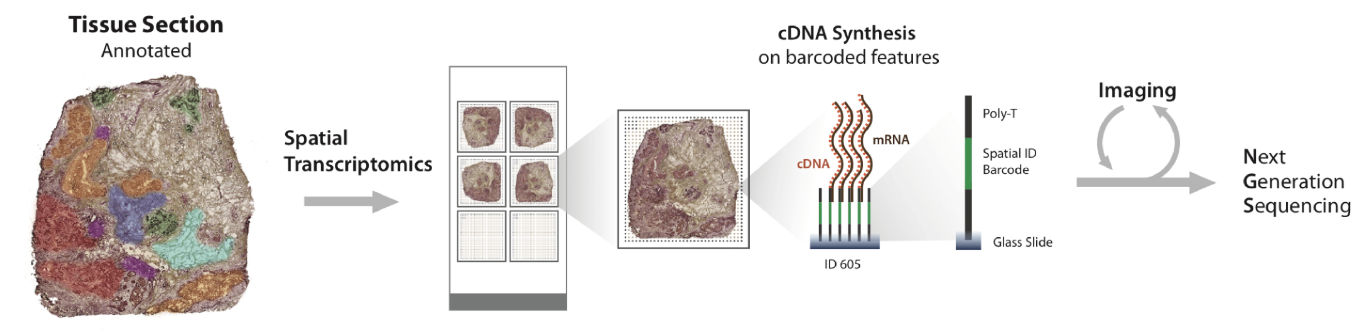 Source: SciLifeLab
For a wider view of how organizations are adopting emerging biotech, from gene editing to synthetic biology, see our article on advancements in biotech.
Source: SciLifeLab
For a wider view of how organizations are adopting emerging biotech, from gene editing to synthetic biology, see our article on advancements in biotech.
What makes single-cell atlas revolutionary?
Single-cell atlas provides a level of detail that is rarely achieved with conventional methods that average signals across entire cell groups. It identifies minor differences within tissues and systems by focusing on individual cells. Advanced sequencing technology and machine learning algorithms make it possible to manage massive, multidimensional datasets effectively. For example, spatial transcriptomics links gene expression to tissue structure. This reveals spatial patterns important for understanding diseases such as cancer. Also, enhanced computational tools now include transcriptome and proteomic data, overcoming previous problems in multi-omics research. These advancements improve and accelerate the discovery of useful insights, propelling development in sectors such as precision medicine and regenerative biology.
Source: SciLifeLab
For a wider view of how organizations are adopting emerging biotech, from gene editing to synthetic biology, see our article on advancements in biotech.
How are researchers harnessing single-cell insights?
Before getting into applications, it's important to understand why single-cell atlas is unique. The study of single cells exposes previously unknown behaviors in big datasets, providing insights into gene expression, cellular differentiation, and disease progression. This complete overview enables researchers to:- Discover uncommon cell types or states, such as stem cells or inactive cancer cells, which are crucial for focused treatments.
- Observe how cells change over time, offering insights into processes like embryogenesis or tissue regeneration.
- Create more accurate models for personalized medicine by adapting patient-specific cell data into treatment plans.
How can single-cell atlas solutions manage complex data?
Managing Data Integration and Scalability
Single-cell research generates vast and diverse datasets that include spatial, transcriptomic, and proteomic data. Integrating these diverse datasets frequently shows irregularities in their forms and requires significant computational resources, which may overwhelm existing systems. Implementing single-cell atlas technology eliminates the need for extensive data processing while maintaining accuracy. It allows researchers to concentrate on more fundamental biological issues without getting bothered by technical hurdles. These platforms are designed to manage complexities by merging data from various sources into adaptable frameworks. Researchers can:- Integrate datasets from numerous studies, facilitating extensive meta-analyses.
- Sustain compatibility with changing standards, lessening redundancy and improving interoperability.
- Preserve data integrity across comprehensive computational pipelines, upholding precision and reproducibility.
How are custom analytics changing research?
Creating Advanced, Custom Analytics Platforms
Standard analytics software often proves inadequate for the unique demands of life sciences research. These general tools might struggle to combine diverse data types, like those seen in multi-omics, or manage the sheer volume of data produced by single-cell sequencing. Such limitations can impede the discovery of uncommon cell types and the understanding of complex cellular interactions. Custom analytics platforms address these issues by providing solutions specific to scientific requirements. In a study published in Nature, single-cell TCR sequencing was used to investigate T-cell receptor dynamics in COVID-19 patients, revealing distinct receptors linked to severe illness outcomes. These platforms allow researchers to:- Display data in accessible formats, such as 3D models of tissue structures, clarifying spatial arrangements.
- Create specialized algorithms for particular tasks, like identifying gene networks involved in drug resistance.
- Speed up insight generation by automating data cleaning and analysis, providing more time for hypothesis testing.
Can cloud-based solutions democratize access?
Cloud-Based Solutions for Remote Collaboration
International research collaboration requires secure and easily accessible data. However, issues like maintaining privacy, differing regional regulations, and coordinating across time zones can complicate these collaborations. Cloud-based platforms, such as single-cell atlas solutions, help overcome these obstacles by utilizing strong encryption, complying with regulations like HIPAA and GDPR, and offering real-time collaboration features. This leads to effective research that also keeps data private and secure. These platforms enable teams to:- Collaborate on shared datasets in real-time from different locations.
- Employ scalable storage for mounting data requirements.
- Comply with strict data security mandates, safeguarding patient data.
How Kanda Can Help
Kanda specializes in creating custom software solutions that are suited to the specific requirements of life sciences organizations. Kanda provides companies with extensive knowledge in machine learning, data engineering, and healthcare integration. We have extensive expertise in the following.- We build advanced analytics pipelines that handle massive single-cell datasets with minimal preprocessing overhead.
- We integrate AI-driven tools into existing research frameworks, accelerating discovery timelines and boosting diagnostic precision.
- We develop cloud-native architectures, ensuring security, scalability, and compliance with relevant industry standards, including but not limited to HIPAA and GDPR.
Conclusion
Single-cell atlas products keep raising the bar for new technologies in biotech. With the power of international collaboration, powerful analytics, and granularity currently unparalleled, researchers are equipped with tools to make breakthroughs. Fully realizing the potential of these developing platforms requires sustained collaboration between developers and scientists to eventually change how we conduct research and provide patient care.Related Articles
Scaling Biotechnology Software Development: From Research Prototypes to Enterprise-Grade Solutions
Biotech never stops moving forward, but turning a lab breakthrough into a product ready for the market is anything but straightforward. A key piece of that transition, which is often missed, is the evolution of the software behind the science. The flexible, one-off tools used in early experiments, often a collection of ad-hoc scripts, shared…Learn More
The Future of Drug Development Runs on Omics Data Platforms
Traditional drug development is running into a serious efficiency problem. Getting a new medicine to market now takes more than ten years and costs well over $2 billion on average, according to a recent study. Even though scientific breakthroughs keep arriving, the expense of R&D keeps climbing faster than the number of new approvals, a…Learn More
Computational Neuroscience Simulations: Combining Science and Technology
The human brain is an astonishingly complex network of approximately 86 billion neurons forming trillions of synaptic connections, making it one of science's biggest puzzles. Understanding its intricate functions is a huge undertaking. Computational neuroscience simulations are now a central way to bring together advanced scientific research and the latest technology to approach this challenge.…Learn More
Applications of Computer Simulation Software in Medicine and Pharmaceuticals
Getting new treatments into the hands of patients is a scientific challenge, and a financial one too. According to a JAMA Network Open study, the average cost to develop a new drug in the U.S. was around $879 million between 2000 and 2018. The same study notes that other research places the R&D cost for…Learn More