

7 Ways RAG in AI Models Supports Modern Healthcare
If you’ve read our blog, then the challenges in healthcare IT are familiar ones. Data sits trapped in silos, clinicians lack quick information retrieval when it matters most, and AI tools might produce made-up answers without any warning. Large language models promised to change this, but hallucination remains a serious liability. Mayo Clinic demonstrated the scope of the problem in a 2024 study. ChatGPT and similar systems answered complex kidney care questions correctly less than 40% of the time. That level of unreliability isn't acceptable for clinical decisions.
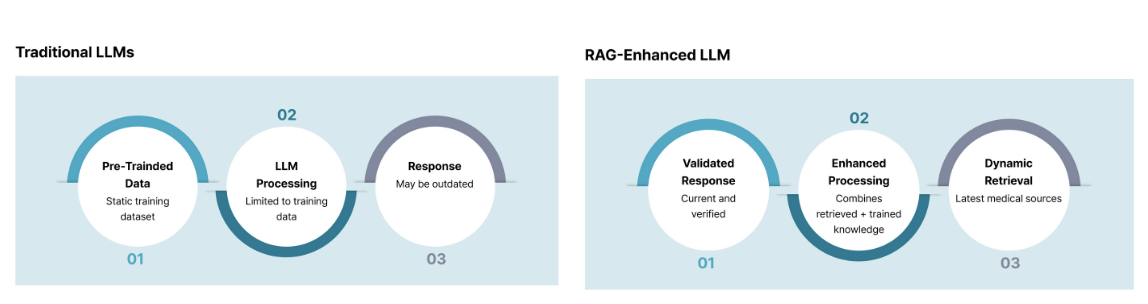
That's where Retrieval-Augmented Generation (RAG) comes in. Besides pulling information from whatever it learned during training, similar to traditional LLMs, RAG systems actually gather data from reliable external knowledge sources. These may include electronic health records, clinical guidelines, and recent medical research.
Below, we'll look at 7 concrete ways RAG in healthcare is driving real gains in clinical outcomes and operational efficiency.
 Source: Makebot
What is RAG in Healthcare and Why it Matters Now
Let's break down Retrieval-Augmented Generation healthcare technology in plain terms. Think of it as giving your AI a research assistant that never sleeps and has access to every medical document in your organization and outside of it. A RAG system has three core parts:- Retrieval module: Searches external data sources like EHRs, medical literature, and clinical guidelines
- Ranking mechanism: Sorts retrieved documents by relevance to the user query
- Generative model: Merges retrieved information with the LLM's pre-trained knowledge to generate accurate, contextually grounded responses with citations to source material.
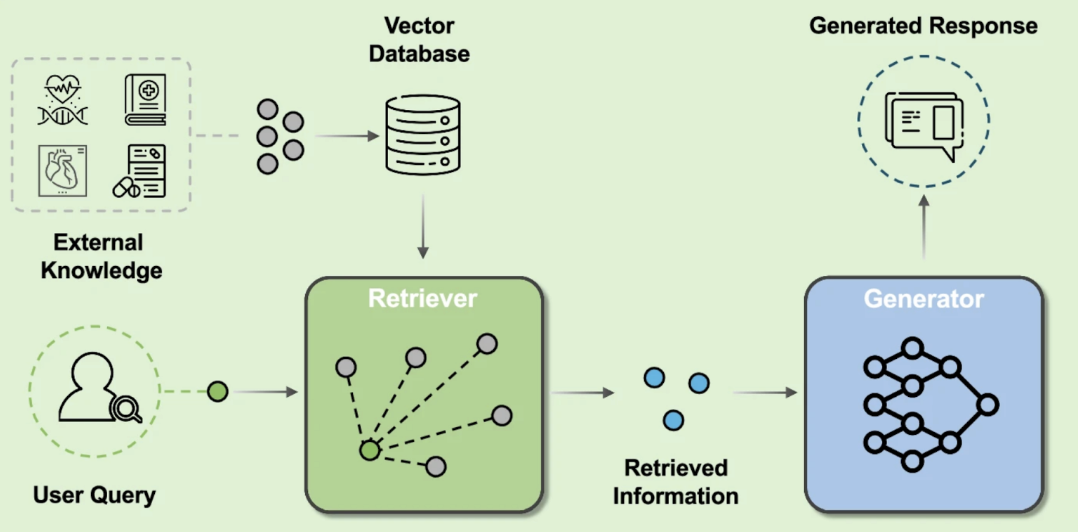 A typical Retrieval-Augmented Generation framework. Source: Nature
What makes this architecture so valuable in medicine? Source attribution. Instead of trusting a black box, clinicians can see exactly which medical guideline or patient record influenced a recommendation. You don't just get an answer from the system, you get to see the reasoning behind it. That transparency is pretty essential when you're doing clinical work, because trust isn't something you can skip. If a physician can track a recommendation back to the specific trial or guideline it came from, they can actually weigh whether it's the right call for their patient.
A typical Retrieval-Augmented Generation framework. Source: Nature
What makes this architecture so valuable in medicine? Source attribution. Instead of trusting a black box, clinicians can see exactly which medical guideline or patient record influenced a recommendation. You don't just get an answer from the system, you get to see the reasoning behind it. That transparency is pretty essential when you're doing clinical work, because trust isn't something you can skip. If a physician can track a recommendation back to the specific trial or guideline it came from, they can actually weigh whether it's the right call for their patient.
The pros of RAG over standalone LLMs
- Access to real-time, up to date information rather than static training data
- Source citations that let clinicians verify recommendations
- Significantly lower hallucination rates
- Ability to incorporate institution-specific protocols and patient data
1. Enhanced Diagnostic Accuracy with Real-Time Clinical Data
One of the most immediate payoffs of medical RAG solutions is better diagnostic precision. Traditional diagnostic support tools often depend on static rules or old databases. RAG handles patient histories, lab findings, and imaging data in real time, cross-referencing them with the latest medical research to surface insights that would otherwise require hours of manual searching.Supporting Differential Diagnosis with Evidence
Here's where RAG really shines: handling the "long tail" of medical diagnosis—those rare or tricky cases where standard approaches fall short. Say a patient shows up with hip pain. Distinguishing between gluteal tendinopathy and trochanteric bursitis requires specific pathophysiological details, which are exactly the kind of nuanced info RAG systems excel at finding. The retrieval system can find relevant documents, imaging criteria, and treatment protocols in seconds, giving the physician a complete picture. Hybrid information retrieval systems combining keyword and semantic search have hit Precision@5 scores of 0.68 or higher, helping surface differential diagnoses that a busy clinician might miss. And with specialized frameworks like "Self-Reflective RAG" cutting hallucination rates to as low as 5.8%, the diagnostic suggestions physicians get are becoming more and more reliable. This isn't about replacing clinical decision making, but backing it up with evidence that would otherwise be out of reach at the moment.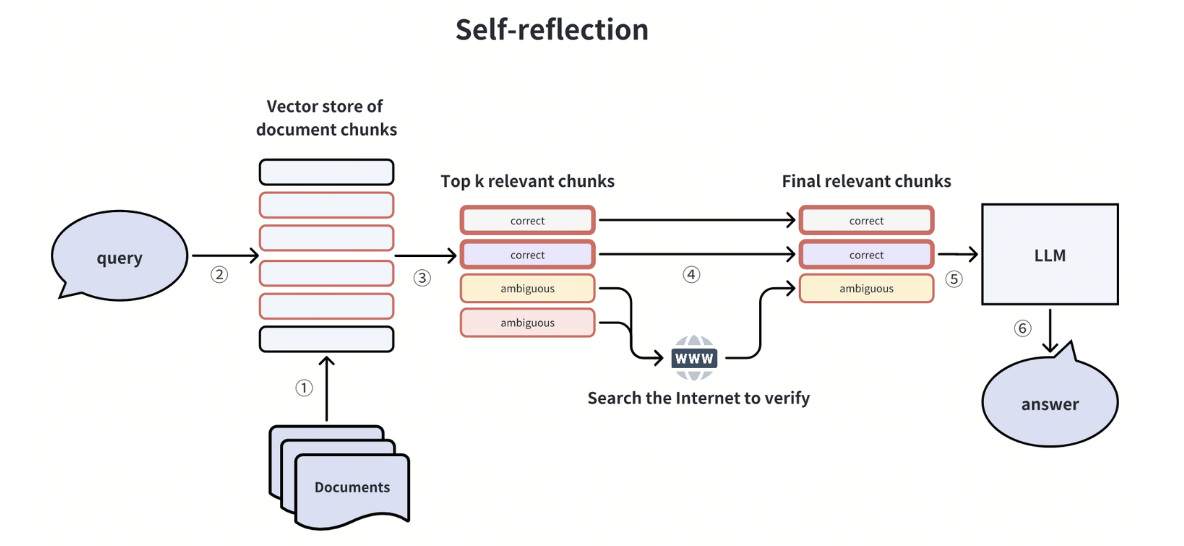 Self-reflection RAG pipeline. Source: Milvus
In light of these advances in clinical decision support, it's increasingly important for healthcare professionals to partner with healthcare software development teams to work together to build tools that function as reliable second opinions, not just glorified search engines.
Self-reflection RAG pipeline. Source: Milvus
In light of these advances in clinical decision support, it's increasingly important for healthcare professionals to partner with healthcare software development teams to work together to build tools that function as reliable second opinions, not just glorified search engines.
2. Eliminating the Black Box in AI Clinical Decision Support
Adoption of AI clinical decision support tools often stalls because medical professionals don't trust the "why" behind AI's recommendations. RAG bridges this trust gap by enforcing explainability at every step. Because every response is tied to specific retrieved documents, whether that's a clinical guideline, a peer-reviewed study, or a patient's own medical history, clinicians can verify the basis of any recommendation before acting on it. This transforms AI from an opaque oracle into a transparent research assistant.Personalized Treatment Recommendations with Literature Support
When a RAG model proposes a treatment plan, it doesn't just state a drug name. It can pull the specific clinical trial or treatment guideline that backs that choice. In precision oncology, for example, RAG systems capture molecularly driven treatment relationships, retrieving evidence tailored to a patient's unique genetic profile. So a recommendation isn't just "take this medication"—it's "take this medication because three clinical trials with similar patient profiles showed improved patient outcomes." Research on chronic kidney disease management showed that RAG models using patient-specific guidelines came up with more accurate, personalized treatment plans than generic AI models did. The difference comes down to personalization: rather than applying population-level stats to an individual, RAG finds evidence that matches each patient's specific circumstances. By weaving these capabilities into data and analytics platforms, providers can offer care plans that are defensible and grounded in the latest science.3. Reducing Administrative Burden and Clinical Documentation Time
Physician burnout is often fueled by the administrative mountain that comes with modern care delivery. Healthcare RAG systems are proving to be powerful tools for automating clinical documentation, medical coding, and the notoriously painful prior authorization process.Streamlining Prior Authorization Processes
Prior authorization is a major bottleneck. If you've ever dealt with it, you know exactly what we mean. Nearly 90% of physicians say regulatory burdens have increased, pulling focus away from patient care. Authorization workflows done manually are error-prone and inefficient, commonly causing claim denials and treatment delays that directly impact patient outcomes. RAG agents handle this automatically by collecting current payer policies and patient clinical data to create proper authorization requests on the first attempt. When voice AI agents use RAG, they can manage complex queries from payers and pull the most recent policies right away. The data shows denial rates falling by as much as 30% and approvals happening much quicker. This means patients receive necessary care without delays. For organizations focused on health insurance software development, adding RAG capabilities can shift the revenue cycle from a major obstacle to a streamlined system.4. Empowering Patients Through Personalized Health Information
Patients today expect more than a pamphlet. They want quick, personalized answers to their medical questions, and those answers need to be accurate. RAG makes this possible through patient portals that pull information from a patient's own medical record along with verified educational materials. The system adjusts how complex the response is based on the patient's health literacy level. Recent studies on RAG chatbots for orthopedic patients show strong results: accuracy ratings averaged 4.55 out of 5, with helpfulness at 4.61 out of 5. Instead of a generic web search that brings up conflicting or misleading information, these chatbots deliver contextually relevant responses based on national orthopedic guidelines. Patients get safe, medically sound information that fits their specific situation. This matters a lot for chronic disease management, where patients need to actually understand their treatment plan if they're going to stick with it. RAG tools pull from trusted medical sources and turn that information into plain language explanations, which helps with health literacy and patient education. Instead of confused patients, you get people who understand what's happening and can actively participate in their care.5. Accelerating Medical Research and Clinical Trial Matching
Medical literature is doubling every few months, which means researchers have no realistic way to keep up on their own. RAG models help by handling systematic literature reviews automatically and matching patients to clinical trials faster and more accurately than manual methods ever could. They're basically multiplying what researchers can accomplish. In clinical trial screening, RAG systems can parse unstructured data from clinical notes and match them against complex inclusion and exclusion criteria. This is a game-changer for trials struggling with recruitment as well as for patients who might benefit from cutting-edge treatments but never hear about them. Researchers can also use RAG to synthesize insights from millions of studies, speeding up discovery and spotting patterns hidden in fragmented datasets. This opens up new future research directions and accelerates medical research across the board.6. Population Health Management with Individual Context
Effective population health means analyzing broad datasets without losing sight of the individual patient. Healthcare RAG systems let organizations query population-level medical data to identify at-risk groups while also retrieving individual context for intervention, bridging the gap between big-picture trends and personalized care for health systems. For example, RAG can query localized clinical guidelines or public health data to provide context-aware care suggestions. In low-resource settings, modular RAG frameworks have been used to analyze social media data to track substance use trends and public health concerns, enabling proactive rather than reactive public health services. This ability to toggle between macro-level trends and micro-level patient details makes RAG a key component of modern predictive modeling in healthcare.7. Maintaining Security, Privacy, and Regulatory Compliance
RAG systems offer meaningful benefits for security and compliance in healthcare. With cloud-based AI services, sensitive healthcare data leaves your infrastructure entirely. RAG architectures can be deployed on-premise, keeping all retrieval within your controlled environment. The retrieval process creates built-in audit points. Each query and its source documents can be tracked, generating the documentation trail required by compliance teams and regulators. Properly designed RAG systems become a way to improve your security approach rather than introduce vulnerabilities.Building HIPAA-Compliant RAG Architecture
Modern secure RAG frameworks layer multiple protections:- AES-256 encryption: Protecting data at rest and in transit
- Provenance tagging: Tracking the origin of every piece of retrieved knowledge
- Immutable audit logs: Recording every query and response for compliance review
- On-device anonymization: Stripping PHI from queries before they reach external systems
- Policy-based access controls: Making sure users only retrieve relevant data they're authorized to see
Real-World Impact: RAG in Action
The benefits of RAG aren't theoretical, organizations are already seeing real results across multiple use cases:Clinical Documentation
Mid-sized healthcare providers using RAG for documentation say that automating prior authorization calls by itself can handle what would normally take over 100 full-time staff to do. Sure, there's a cost benefit there, but the bigger deal is that it frees up clinicians to actually spend time with patients instead of paperwork.Patient Engagement
RAG-powered patient portals have shown accuracy ratings over 90% for answering patient questions, with patients rating the responses as highly helpful and easy to understand.Revenue Cycle
According to McKinsey research, effectively deploying AI and automation in healthcare could eliminate $200 billion to $360 billion in spending industry-wide, with revenue cycle management representing a significant portion of that opportunity.Overcoming RAG Implementation Challenges in Healthcare Settings
While the benefits are clear, deploying RAG isn't without hurdles. Organizations have to tackle data fragmentation, regulatory uncertainty, and the computational cost of running these models. The good news? None of these challenges are insurmountable with the right approach.- Data fragmentation: Healthcare data lives in silos, in EHRs, imaging systems, lab databases, legacy platforms, and more. RAG systems need clean, unified access to these sources, but getting data to "talk" across systems remains one of the biggest technical obstacles.
- The "garbage in, garbage out" problem: If your retrieval database contains outdated clinical guidelines, redundant documents, or poorly structured data, the AI's output will suffer. Successful implementations require significant upfront investment in data cleaning and standardization before RAG can deliver reliable results.
- Regulatory uncertainty: The FDA's stance on AI clinical decision support is still evolving. Organizations must navigate unclear boundaries around what requires regulatory approval versus what qualifies as a clinical support tool, and these rules differ across jurisdictions.
- Computational costs: Running RAG at scale requires substantial infrastructure. Real-time retrieval across millions of documents, combined with large language model inference, demands either significant on-premise hardware or carefully managed cloud spending.
- Clinician adoption resistance: Technology only works if clinicians actually use it. Getting RAG into existing clinical workflows without creating extra steps, and building trust in AI-generated recommendations, takes careful change management and proper training.
Integration Strategies for Existing EHR Systems
Tools that support standard APIs (like FHIR) and interoperability are essential for allowing RAG agents to work seamlessly with core systems like EHRs and pharmacy management platforms. Start by mapping your current data architecture, identifying gaps, and prioritizing which data sources will deliver the highest-value retrieval results.Pharmaceutical Research Case Study
One of the world's largest pharmaceutical companies faced a classic bottleneck: their computational biologists were spending weeks, sometimes months, manually searching across fragmented databases like PubMed, UniProt, and multiple internal repositories just to piece together answers to complex biological questions. Standard LLMs weren't an option; static training data and hallucination risks made them unsuitable for serious drug discovery work. Kanda built an agentic RAG research assistant that changed the equation entirely. The system uses an intelligent "toolkit" approach. It treats each data source as a specialized tool the AI can tap into, from vectorized internal databases to live API adapters that translate natural language queries into precise database requests. A transparent "stream of thoughts" interface lets researchers follow the AI's reasoning step by step, and every answer links directly to its source documents for verification. The results have been striking: a hypothesis-generation task that used to take two months of manual effort now takes roughly an hour. Since mid-2024, the platform has saved researchers over 40 days of manual literature searches. More importantly, scientists report that the tool has fundamentally changed how they approach complex research questions, not just faster, but with higher scientific rigor and better documentation.The Future Trajectory of RAG in Healthcare
The next wave of RAG isn't going to be limited to text. Multimodal RAG systems are starting to show up that can handle images, time-series data, and audio on top of clinical notes. Picture a system that looks at a patient's X-ray, checks it against their history, and pulls up relevant information from radiology guidelines, all in one go, and all within seconds. We're also seeing the rise of "Agentic RAG," where artificial intelligence systems break down complex medical questions into multi-step reasoning tasks, mimicking how a clinician thinks through a tough case. RAG is likely headed toward being the normal interface for medical knowledge as healthcare software evolves, less of a cutting-edge tool and more of something hospitals just expect to have in their tech setup.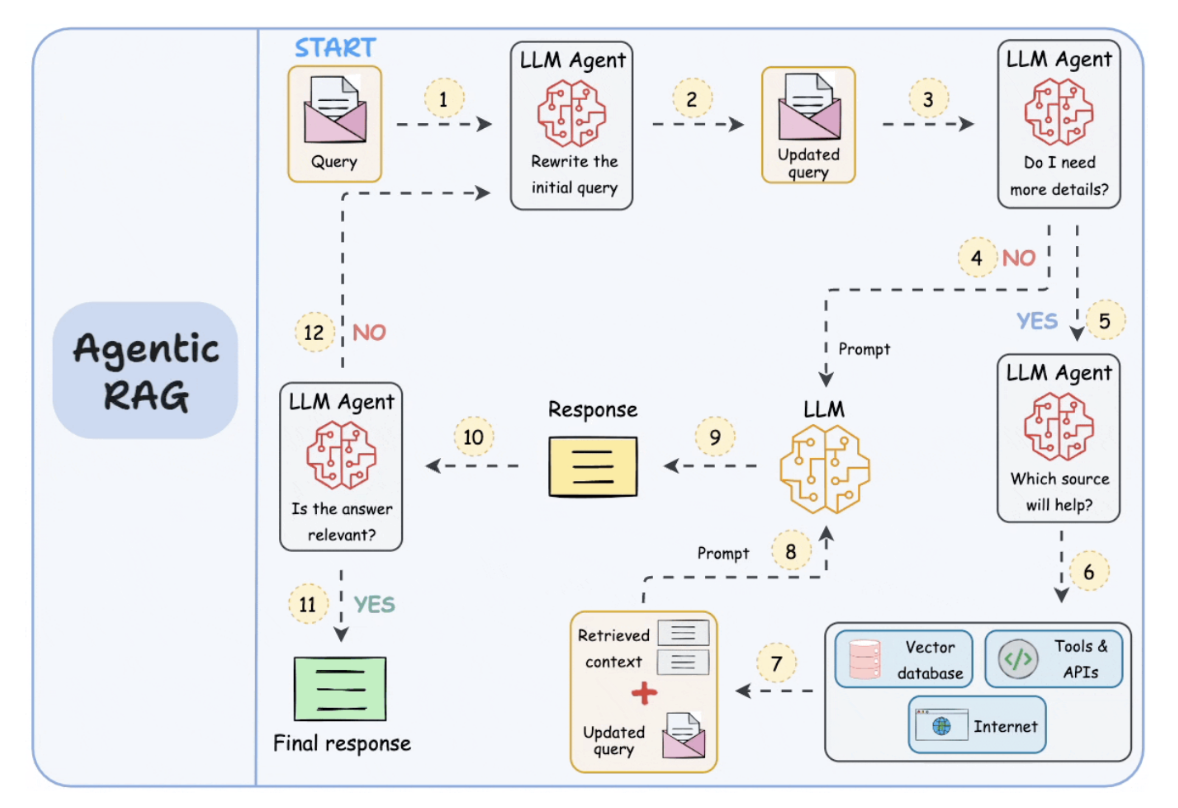 Agentic RAG workflow. Source: Medium
Taking the First Steps Toward RAG Implementation
For healthcare organizations, you want to start by finding use cases that offer good value without much risk. Consider beginning with internal knowledge bases, things like HR policy search or IT support, and then work your way up to clinical decision support once you've got those down. Check your data readiness: Is your clinical data structured? Is it accessible via API? Do you have the governance frameworks in place to manage AI-generated recommendations?Key questions for leadership:
- Which clinical workflows are currently bottlenecked by information retrieval?
- Do we have the infrastructure to support vector databases and semantic search?
- How will we validate the accuracy of retrieved documents before they reach clinicians?
How Kanda Can Help
The hard part about RAG in healthcare isn't usually the AI itself, it's making sure it actually fits into how doctors and nurses work, while staying compliant. We've helped other healthcare organizations work through that gap between what's technically possible and what's practical.- Custom RAG Architecture: We design HIPAA-compliant RAG pipelines tailored to your specific data ecosystem.
- EHR Integration: Our teams specialize in seamless integration with major EHR platforms, making sure your AI tools fit naturally into provider workflows.
- Data Security & Compliance: We build robust security frameworks, including on-premise deployment options and rigorous audit trails.
- Scalable AI Solutions: From pilot programs to enterprise-wide deployment, we help you scale AI in healthcare initiatives that deliver measurable ROI.
Conclusion
Applying RAG in healthcare means there will be a real shift in how we access and use clinical and medical knowledge. By pairing the reasoning abilities of a large language model with the reliability of verified medical records, RAG systems are tackling the accuracy and trust problems that have kept AI from taking off in medicine. The applications range from improving diagnostic accuracy and tailoring patient education to cutting down on administrative work, and the results are tangible. But making it work takes a careful approach to data management, security, and integration.Related Articles

Healthcare Web Development: The Fastest Route to Scalable Patient Care
Outdated medical software is becoming a rising problem for healthcare facilities across the US, yet the push for digital patient experiences continues to grow. A CDC study found that 47.7% of adults ages 30-44 use the internet to communicate with a doctor or doctor's office. However, still existing paperwork, manual processes and legacy systems prolong…Learn More
RPA in Healthcare: Smarter Operations for Better Patient Care
The healthcare industry today is not only struggling with growing administrative spending but also with the increasing rates of staff burnout in healthcare facilities due to the high volume of repetitive tasks. As per Statista, 58% of registered nurses report burnout on most days, which results from both excessive emotional stress, the growing workload and…Learn More
Conversational AI for Healthcare: Changing How Patients Experience Care
The U.S. healthcare system has a serious problem with communication and management. Much of the strain comes from staggering administrative burdens. Research shows that physicians may spend nearly half of their clinic day devoted to documentation and non-clinical work. This imbalance damages the quality of care, makes it harder for people to access help, and…Learn More
Health Insurance Software Development: AI for Prior Authorization
Prior authorization (PA) was supposed to serve as a safety net, checking that patients get the right treatment while keeping costs in check. In reality, it now sits among the biggest administrative hurdles in healthcare. The contrast is stark when you consider how fast the market is growing. The U.S. healthcare software-as-a-service sector was worth…Learn More