
May 12, 2026
Retail and eCommerce
5 Technological Pillars of Real-Time Retail
Key Takeaways:
 This is also where architecture discipline matters. Real-time systems need data pipelines, APIs, event streaming, security controls, observability, and release practices that support distributed workloads. With the right tools, teams can turn data into actionable insights, improve operational efficiency, support rapid experimentation, and measure retail performance more clearly.
- Real-time retail depends on reducing the delay between what happens in the business and how quickly teams can act on it.
- AI, IoT, RFID, mobile, omnichannel systems, and retail media work best when they are connected through shared data, not treated as separate projects.
- Inventory visibility is often the best starting point because it supports better fulfillment, fewer stockouts, stronger BOPIS, and more reliable customer experiences.
- Retail media networks are becoming a technology decision, not just a marketing opportunity, because they depend on clean data, identity, measurement, and attribution.
- The strongest retail digital transformation efforts start with one practical use case, prove value, and then expand into a broader real-time operating model.
What Is Real-Time Retail?
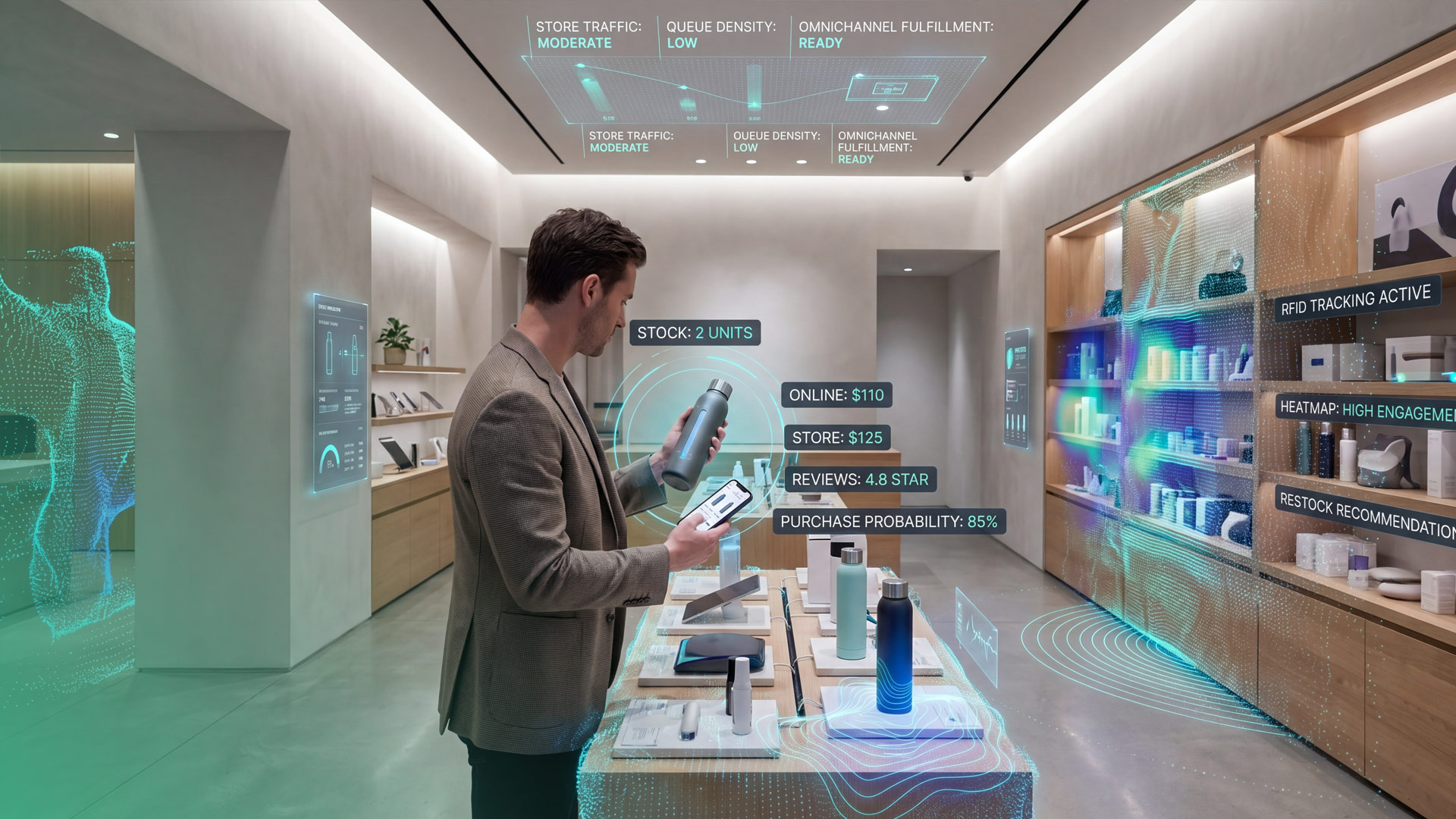
Real-time retail is an operating model where systems do more than record what already happened. They help teams respond while there is still time to change the outcome. A traditional retail setup often depends on end-of-day sales reports, periodic inventory counts, scheduled exports, and manual reconciliation between POS, ecommerce, ERP, and warehouse tools. That can work for reporting, but it slows decisions. In a real-time retail setup, sales, stock, order, loyalty, payment, and device signals move through integrated systems quickly enough for the business to act. A store can reserve available stock for BOPIS before it disappears, alert a team to a shelf gap before it turns into a lost sale, adjust a markdown before margin erodes, or trigger a relevant mobile offer while customer intent is still fresh.Pillar 1: AI and Machine Learning
What AI Actually Does in Retail Operations
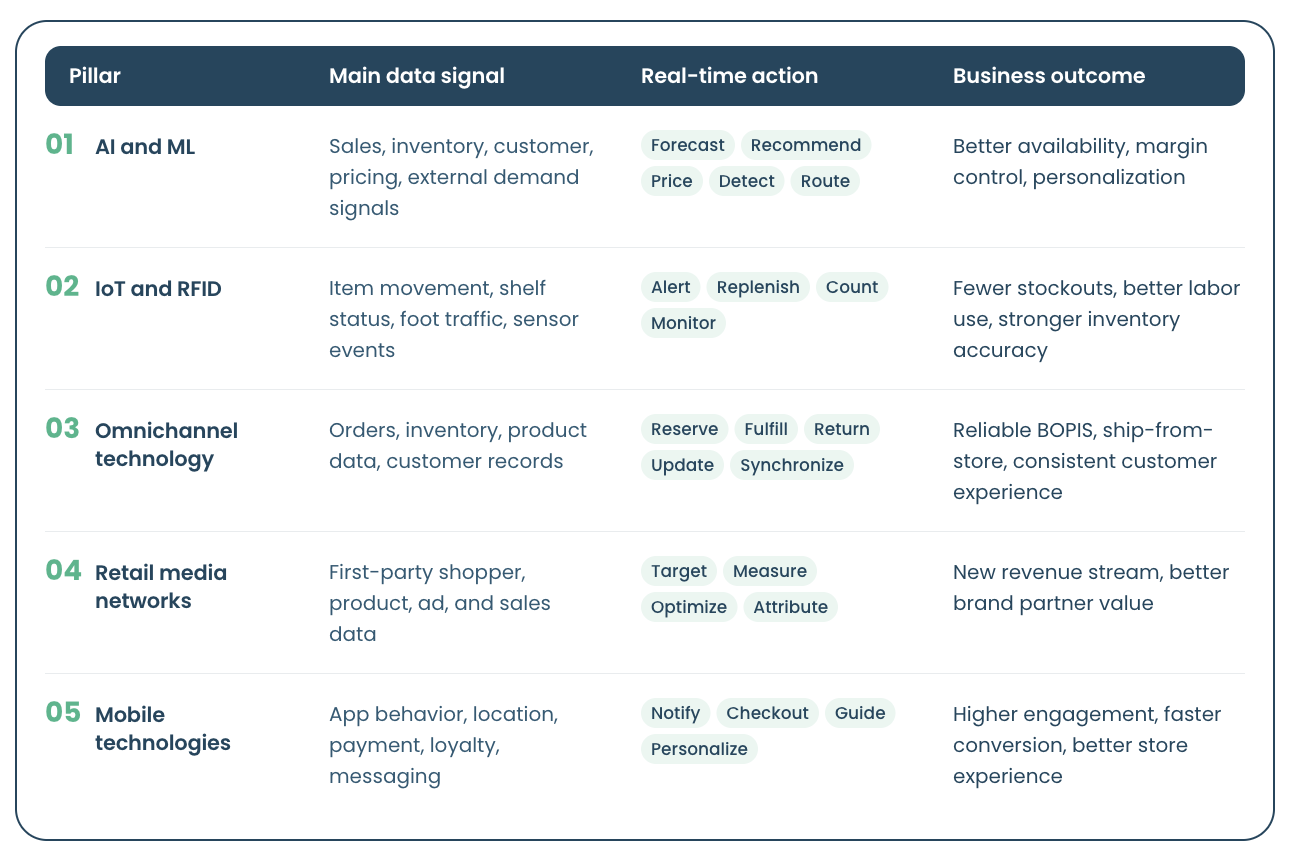
AI in retail is useful when it moves decisions closer to the moment they matter: predicting demand, adjusting prices, recommending products, flagging fraud or loss prevention issues, or helping service teams answer faster. The goal is not to chase artificial intelligence as a trend, but to use the right data to make better decisions. The shift is from fixed rules to models that keep learning from new signals. Instead of reordering below a threshold, a machine learning model can analyze data from sales velocity, weather, promotions, returns, ecommerce traffic, supplier lead times, and store inventory before suggesting a reorder. The model is still only as good as the customer, product, and operational data it receives, which is why AI and real-time data processing belong in the same architecture conversation. McKinsey notes that AI can reduce inventory levels by 20% to 30% by improving demand forecasting and inventory optimization. For retailers, that shows up in practical places: fewer emergency transfers, less dead stock, better on shelf availability, and fewer markdowns caused by late decisions.Key Applications Driving Real-Time Decisions
- Eliminate guesswork in demand forecasting: AI reduces the risk of overstock and stockouts by forecasting sales velocity and expected demand by product, location, season, promotion, weather, and local behavior. That gives teams a stronger basis for replenishment decisions before shelves go empty or inventory turns into markdown risk.
- Make pricing decisions faster: AI-powered pricing engines can recommend price changes based on real-time inventory levels, sell-through speed, margin targets, competitor moves, and demand signals. This helps reduce the margin loss that comes from late, manual, or inconsistent pricing calls.
- Keep personalization relevant: AI uses browsing history, basket behavior, loyalty data, customer behavior, and store context to tailor recommendations, search results, and offers in real time. Instead of sending the same promotion to every shopper, retailers can respond to what each customer is likely to need next.
- Spot loss and store execution issues sooner: Computer vision can monitor checkout activity, shelf gaps, queue growth, and suspicious behavior as they happen. That is more useful than reviewing end-of-day footage after the loss, delay, or missed sale has already happened.
- Scale customer service without losing context: AI assistants can handle routine questions such as order status, returns, FAQs, and basic troubleshooting, then pass complex cases to human agents with the relevant customer and order context already attached.
Where to Start
If AI isn't part of your operation yet, the starting point is simpler than most vendors will admit: an honest audit of your data. Most retailers should start with one use case tied to clear business objectives, not a broad AI platform promise. Demand forecasting is often the safest entry point because the value is easy to see. Personalization can also work when ecommerce or loyalty data is strong. The main dependency is data quality. If product, customer, inventory, and order data are fragmented across data silos, the first AI project becomes a data integration project whether the team planned for it or not. Avoid starting with a broad "AI strategy." Start with a specific problem, a defined dataset, and a metric you'll use to judge whether it's working. That first project will tell you more about your readiness for the next one than any planning exercise will. For help choosing your first retail AI use case, explore our AI Consulting services to assess data readiness, estimate business value, and define a focused pilot with clear success metrics.Pillar 2: IoT and RFID
How Connected Devices Create a Real-Time Store
Physical stores still create blind spots. POS systems can show what was sold, but not always what is on the shelf, in the back room, misplaced, or causing a queue. IoT and RFID close that gap by turning store operations into a live source of real time data. IoT covers devices such as shelf sensors, temperature monitors, cameras, scanners, foot traffic counters, signage, and smart checkout equipment. RFID uses radio tags and readers to identify items without line-of-sight scanning. Together, they give teams real time visibility into inventory management and the in store experience. Red Hat describes how edge systems can support real-time inventory monitoring, traffic analysis, and staffing optimization inside stores. That local processing is useful for smart shelves, checkout, cameras, and other edge solutions where latency, uptime, and distributed environments matter.Use Cases Across the Store and Supply Chain
- Smart shelves and automated stock alerts: Shelf sensors detect low stock in real time and alert store teams before the gap affects sales, eliminating the need for manual inspection.
- RFID-based cycle counts: Instead of manual barcode scanning, RFID allows store teams to count item-level inventory in a fraction of the time and with significantly fewer errors, making cycle counts a routine operation rather than a disruptive one.
- Frictionless and faster self-checkout: RFID, computer vision, and sensor combinations reduce manual scanning steps, surface exceptions automatically, and shorten queue times without requiring a full store redesign.
- Foot traffic sensors: store managers can adjust staffing, layouts, queue coverage, and promotional placement based on actual movement patterns.
- Cold chain monitoring: temperature sensors help protect grocery, pharmacy, and healthcare-adjacent retail products from spoilage and compliance risk.
- Supply chain visibility: RFID and IoT events can track inventory from distribution center to store shelf, not just through scheduled system updates.
Where to Start
For most retailers, RFID for inventory accuracy is the most practical first step. It creates the data foundation for BOPIS, ship-from-store, smart replenishment, self-checkout, and better allocation. Smart shelving and traffic analytics can follow once connectivity, device management, and data ingestion are stable. The mistake is treating devices as separate store gadgets. They need to feed the same inventory and analytics layer as ecommerce, POS, and supply chain systems.Pillar 3: Omnichannel Technology
What Omnichannel Actually Requires on the Backend
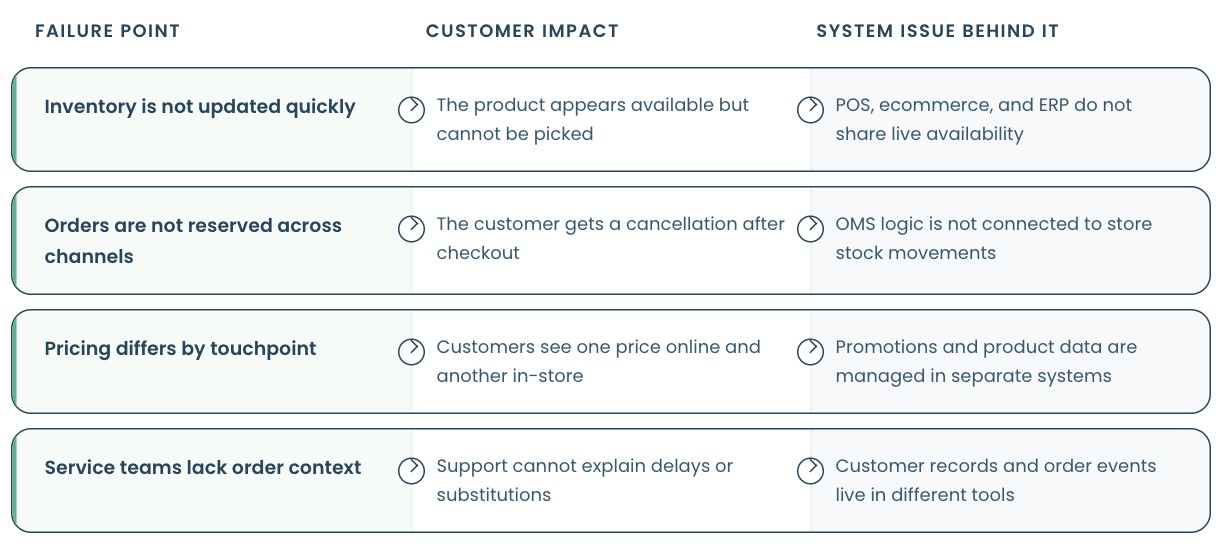
Omnichannel retail sounds like a customer experience topic, but most of the hard work happens in the backend. A customer sees a single brand, while the retailer has to connect inventory, pricing, promotions, product content, orders, returns, payments, loyalty, and service records. SAP describes unified (or omnichannel) commerce as connecting customer-facing and back-end systems through one integrated platform. In practice, that usually means an order management system, ecommerce platform, POS, ERP, product information management system, customer data platform, payment systems, warehouse systems, and analytics layer all sharing clean, timely data. The business value is reliability. Customers see accurate availability. Associates access inventory and order status from the same view as service teams. Pricing and promotions stay aligned, and returns can be accepted where the customer is. That visibility supports a seamless transition between online purchases, mobile interactions, and physical stores.Where Legacy Systems Break the Experience
A simple BOPIS order shows why disconnected systems create revenue risk. A shopper sees a product available online and selects pickup at a nearby store. The ecommerce platform accepts the order, but the inventory file is three hours old and the item was sold in-store twenty minutes earlier. The OMS reserves stock too late, and the customer receives a cancellation.
Where to Start
Unified inventory visibility is the foundation. Once the retailer can trust inventory across stores, warehouses, ecommerce, and in-transit stock, it becomes easier to add order routing, ship-from-store, endless aisle, returns anywhere, and customer data unification. Confluent’s real-time inventory guidance makes the same point from a data streaming perspective: retailers need a consistent, real-time view of inventory across online and physical stores to optimize fulfillment.Pillar 4: Retail Media Networks
What a Retail Media Network Is and Why It Is a Technology Decision
A retail media network is an advertising platform built on a retailer’s first-party shopper data. Brands buy placements across digital properties, in-store channels, and sometimes offsite media. The retailer earns media revenue, while brands reach high-intent shoppers with more relevant offers. IAB Europe separates retail media opportunities into onsite, offsite, and in-store environments, with targeting, optimization, and measurement built into the model. Forrester projects global retail media spending will grow from $184 billion in 2025 to $312 billion by 2030. That is why retail media is no longer only a marketing idea. It plays a critical role in data, identity, measurement, and platform strategy across the retail sector. The technical work can include a CDP, consent management, segmentation, campaign tools, onsite search ads, sponsored product placements, clean rooms, dashboards, and closed-loop attribution. Retailers also need governance so monetization does not damage trust or overload the experience.Where to Start
Retailers with mature loyalty programs, strong traffic, and clean product data have the easiest path. The first version does not need to be a full media network. Many retailers begin with onsite sponsored product placements in search and category pages, then expand into offsite campaigns, in-store digital signage, and deeper brand reporting. The key is to build measurement early. Brands will not keep spending if they cannot see incremental sales, reach, and return on ad spend clearly.Pillar 5: Mobile Technologies
Why Mobile Is Now the Primary Retail Channel
Mobile is often the first screen of the customer journey, the loyalty card, the promotion engine, the payment device, the store guide, and the service channel. Even when the purchase happens in a store, the phone may have shaped the decision first. Capital One Shopping estimates that worldwide mobile ecommerce sales reached $2.51 trillion in 2025. Adobe’s 2025 holiday shopping report shows mobile devices accounted for 56.4% of U.S. online holiday spend from November 1 to December 31, 2025. Adobe’s AI traffic analysis also reported that AI-driven traffic to retail sites rose 693% year over year during the same holiday period, reinforcing how digital discovery, decision-making, and purchase journeys are becoming more immediate.Technologies Driving Real-Time Mobile Retail
- Retail apps and push notifications: apps give retailers an owned channel to support customer engagement with offers, loyalty, pickup updates, and service alerts, reaching the customers in real time.
- Location-based and geofenced offers: customers can receive relevant messages based on store proximity, local inventory, or browsing intent, which increases the likelihood of a store visit.
- Mobile POS: associates can check out shoppers anywhere in the store, reduce queues, and access customer context while helping them.
- Mobile wallets and one-tap checkout: less payment friction usually means fewer abandoned baskets and faster in-store interactions.
- Social and live commerce: shoppable content, creator storefronts, and livestream selling pull discovery and purchase closer together.
- Augmented reality and smart mirror experiences: product visualization and try-ons can be useful, but only when connected to inventory, profile, and checkout data.
Where to Start
Retailers without a native app should assess whether one would support loyalty, repeat purchase, in-store service, or high-frequency categories. For retailers with an existing app, the best returns often come from push personalization, mobile checkout, wallet integration, and pickup or order-status flows. Mobile POS is also a strong store-side investment because it improves labor flexibility and customer experience. For retailers modernizing payments, Kanda’s guide to distributed architecture for payment systems is a useful reference for thinking about secure, scalable transaction processing.Building the Stack: How the Five Pillars Connect
These pillars should not become five separate roadmaps. IoT and RFID generate operational signals. Mobile generates customer intent, engagement, payment, and service signals. AI turns those signals into recommendations and automated decisions. Omnichannel technology pushes those decisions across touchpoints. Retail media networks monetize the first-party data asset those pillars help create. The sequencing question is usually more important than the tool question. A retailer with unreliable inventory should not start with advanced personalization. A retailer with strong loyalty data but weak ecommerce integration may get more value from unified customer and product data before launching a larger retail media program.
This is also where architecture discipline matters. Real-time systems need data pipelines, APIs, event streaming, security controls, observability, and release practices that support distributed workloads. With the right tools, teams can turn data into actionable insights, improve operational efficiency, support rapid experimentation, and measure retail performance more clearly.
How Kanda Can Help
Kanda helps retailers and technology teams move from disconnected systems toward practical, scalable retail digital transformation.- Assessing the current retail technology stack to identify the highest-impact starting point across AI, inventory, omnichannel, mobile, or retail media.
- Designing data and analytics architectures that support real-time data processing, streaming platforms, and operational decision-making across multiple sources.
- Integrating POS, ecommerce, OMS, ERP, CDP, payment, inventory, and supply chain systems so teams work from consistent data.
- Building AI and retail automation systems that are narrow enough to prove value, but structured enough to scale.
- Modernizing customer-facing channels, including mobile apps, checkout flows, dashboards, and digital store tools.
- Applying retail data expertise to turn customer, inventory, and operational data into business value without creating another silo.
Conclusion
Retailers winning on real-time operations tend to make platform-level decisions early. They build the data and integration layer that lets AI, RFID, mobile, omnichannel, and retail media reinforce one another. The starting point will vary. Some retailers need inventory accuracy first. Others need mobile engagement, order orchestration, demand forecasting, or retail media measurement. The goal is the same: reduce the delay between what is happening in the business and what the business can do about it. New technology matters only when it makes that delay smaller.Related Articles
Increasing Conversions and User Engagement in Retail With Conversational AI
Key Takeaways: Shoppers who interact with AI are almost four times more likely to buy, and proactive AI recovers around 35% of abandoned carts. Conversational AI has moved well beyond chatbots – now helps people find products, guides purchases, generates content, and handles service across every channel. Agentic AI goes a step further, managing returns,…Learn More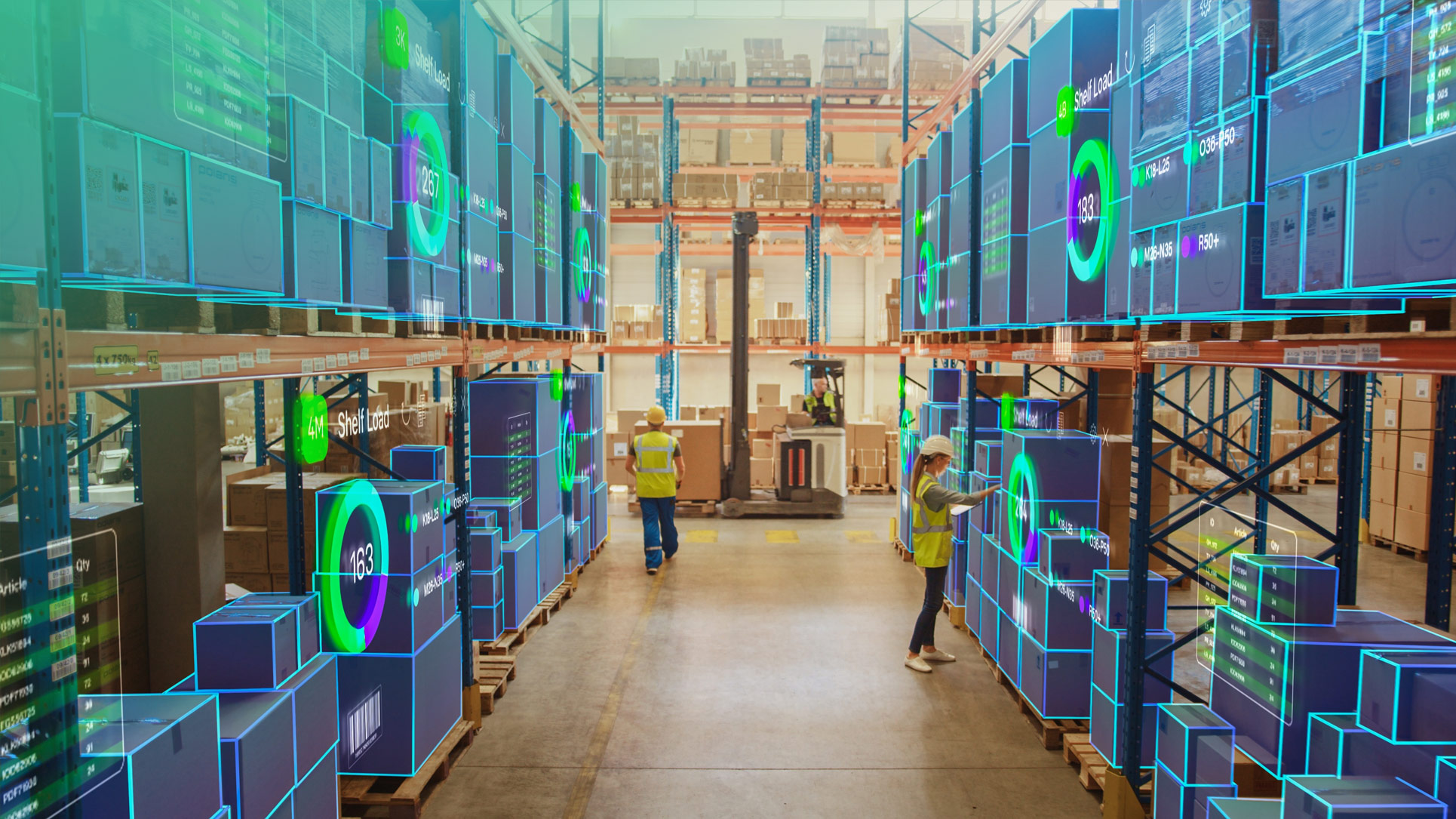
IoT in Retail Execution: How Real-Time Data Drives Precision
Key Takeaways IoT systems deliver real-time inventory visibility with up to 98% accuracy compared to 65-75% with manual methods, eliminating stockouts and overstock. Proven cost savings include 10-30% energy reduction, 18% less shrinkage, and 10-15% reduction in inventory labor hours. The global IoT retail market is projected to grow from $70 billion (2025) to $482…Learn More
How Big Data Analytics is Transforming the Customer Experience for Online Retailers
Online retail is becoming increasingly competitive. Customers can shop anywhere they want, and they expect their experience to be smooth, personal, and easy to navigate. Every click, every transaction, every interaction generates data. And retailers are drowning in it. That flood of data creates problems, but it also creates opportunities. The retailers who know how…Learn More
Transforming Retail and Consumer Packaged Goods (CPG) with Generative AI
With a high level of competition, lower R&D budgets compared to other industries, and the constant need to produce new goods, the retail and consumer packaged goods (CPG) sector is challenging to innovate within. However, the rapid evolution of generative AI is impacting all industries, including retail and CPG, demonstrating that early adoption of innovation…Learn More