

March 31, 2026
Retail and eCommerce
Increasing Conversions and User Engagement in Retail With Conversational AI
Key Takeaways:
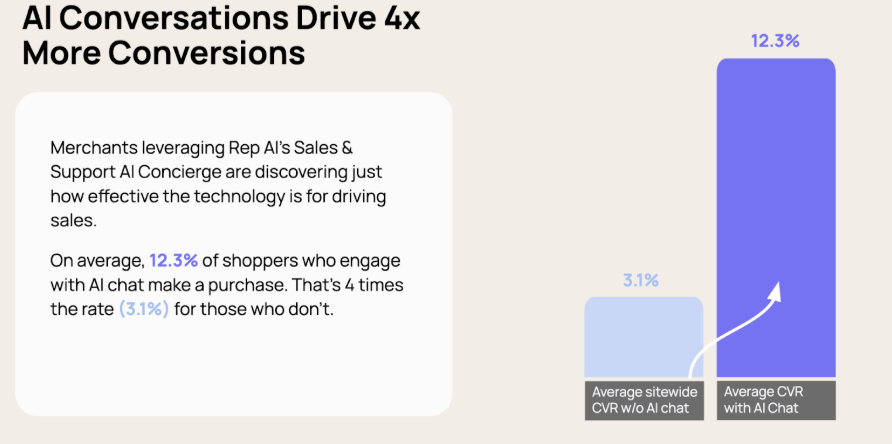 Source: Rep AI Report
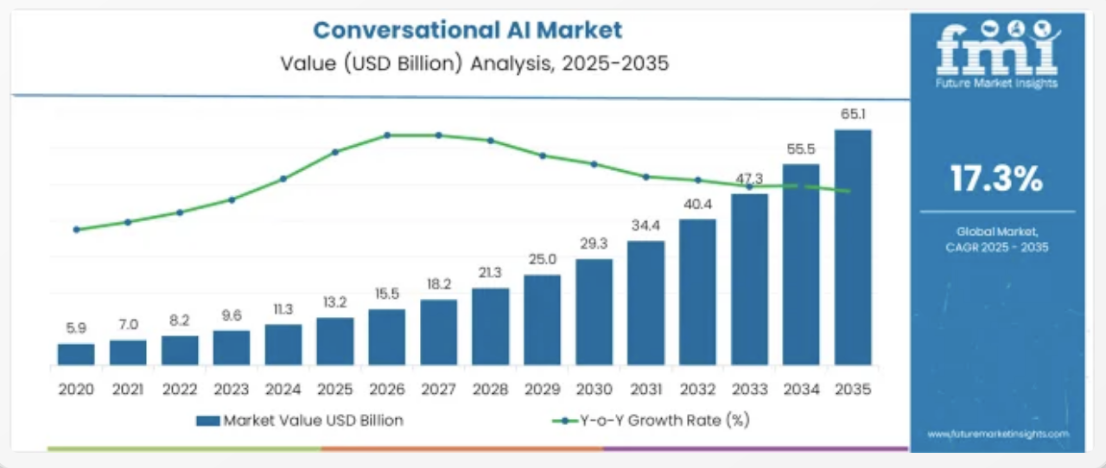 Source: Future Market Insights
 Consistency across channels matters. Whether a customer reaches out via web chat, SMS, voice, or Instagram, they should get the same experience — with the same access to their order and product data. That means connecting your AI to your POS, CRM, CDP, and commerce platforms. Retailers who get this right build loyalty. Those who don't end up with fragmented interactions that erode trust.
- Shoppers who interact with AI are almost four times more likely to buy, and proactive AI recovers around 35% of abandoned carts.
- Conversational AI has moved well beyond chatbots – now helps people find products, guides purchases, generates content, and handles service across every channel.
- Agentic AI goes a step further, managing returns, inventory checks, discounts, and shipping all within a single conversation.
- 69% of retailers say AI has directly boosted revenue, and AI-powered service is on track to resolve 80% of common issues by 2029.
- The results only follow if the foundation is right: clean data, good integrations, and disciplined implementation.
Source: Rep AI Report
What Conversational AI Means for Modern Retailers
A basic chatbot follows a script – a customer clicks a button and gets a pre-written answer. Conversational AI is fundamentally different. It uses natural language processing (NLP), dialog management, and machine learning to understand what a customer is actually saying—even when phrasing is messy or intent shifts mid-conversation. It holds context across multiple turns, adapts to customer behavior in real time, and handles complex customer queries that a scripted bot simply couldn't manage. For retailers, that means deploying AI-powered intelligent assistants that can address customer needs across:- Websites and mobile apps
- Social channels (WhatsApp, Instagram, Facebook Messenger)
- Voice interfaces and smart assistants
- In-store shopping kiosks and digital signage
Source: Future Market Insights
Generative AI Use Cases in Retail That Drive Revenue
Generative AI use cases in retail go well beyond chatbot conversations. Here are the areas with the most traction.Personalized Product Recommendations at Scale
Generative AI analyzes browsing behavior, purchase patterns, and real-time customer data to deliver personalized recommendations that actually match customer preferences. Sephora’s Virtual Artist recommends products based on skin tone and preferences. Amazon’s recommendation engine drives an estimated 35% of its total revenue. Data from Envive AI shows AI-powered personalization can boost conversion rates by up to 23%. For a deeper look, Kanda covered this in Transforming Retail and CPG with Generative AI.AI-Powered Virtual Shopping Assistants
Think of it as a knowledgeable sales associate available on every page, for every customer, simultaneously. AI assistants guide customers from discovery through checkout — answering sizing questions, comparing options, offering personalized suggestions, and handling objections in a single conversation thread. According to Insider One, shoppers interacting with AI-led assistants complete purchases 47% faster because the assistant reduces decision-making friction. Rep AI’s data adds that returning customers who use AI chat spend 25% more per session – a direct lift in average order value (AOV) that compounds quickly.Automated Content Generation for Product Descriptions and Campaigns
Marketing teams are using generative AI to produce product descriptions, email campaigns, targeted promotions, and social content tailored to specific customer segments. Instead of one copywriter handling 50 descriptions a week, an AI system generates hundreds—each tailored by tone, audience, and channel. This frees creative teams to focus on brand strategy and high-value campaigns while keeping content production running at scale. More on this in Kanda’s article on the generative AI revolution and its impact on software development.Agentic AI in Retail: Going Beyond the Chatbot
What Makes Agentic AI Different
Standard chatbots are reactive. Generative AI produces single-turn outputs. Agentic AI goes further: autonomous, goal-directed AI agents capable of completing multi-step tasks without constant human oversight. It processes a customer request like a return, offers an exchange, checks inventory management systems, applies a loyalty discount, and confirms a new shipment—all within one conversation, replacing tasks that previously required human employees. The projections reflect this shift:- Gartner predicts 60% of brands will use agentic AI for one-to-one interactions by 2028.
- McKinsey estimates agentic AI will influence $3–$5 trillion in global retail commerce by 2030.
- Gartner also warns that over 40% of agentic AI projects will be canceled by 2027 due to unclear value or poor controls—so discipline matters.
Real-World Agentic AI Workflows in Retail
Amazon’s Rufus is one of the most visible examples. According to Meridian, Rufus is projected to generate over $12 billion in incremental annualized sales, and shoppers who engage with it are 60% more likely to complete a purchase. Walmart’s Sparky assists with occasion planning—bridging the gap between a casual question and an actual shopping list tied to SKUs. These aren’t novelty features. They’re production systems integrated with inventory, CRM, and fulfillment—designed to streamline retail operations at scale. Building these workflows requires strong AI and machine learning engineering.Conversational AI for Sales: Turning Browsers Into Buyers
Guided Selling and Upsell Automation
Conversational AI for sales reads intent signals, browsing context, and real-time inventory to recommend products during a live conversation—delivering the kind of personalized service that meets modern customer expectations. A customer lingering on a running shoe page gets a suggestion for matching socks and a hydration pack. Someone comparing two laptops gets a clear breakdown of the differences, plus an accessory bundle that makes sense for their use case. Envive AI reports that retail chatbots increase sales by 67%. And according to Neuwark, brands integrating AI and automation consistently achieve conversion rates 25–30% higher than industry averages. For any retail business looking at where to invest, conversational AI for sales delivers some of the fastest, most measurable ROI available.Reducing Cart Abandonment With Proactive Engagement
Cart abandonment is retail’s biggest revenue problem. Baymard Institute’s analysis of 50 studies puts the average rate at 70.22%—roughly $18 billion in lost annual revenue for U.S. e-commerce. Conversational AI tackles this with exit-intent detection, real-time discount nudges, and AI-powered follow-up flows. Rep AI’s data shows a 35% recovery rate from proactive AI conversations vs. 5–15% for traditional methods. Kanda’s work in big data analytics in the retail industry covers how data infrastructure powers these interventions.AI Customer Service in Retail: Speed, Accuracy, and Loyalty
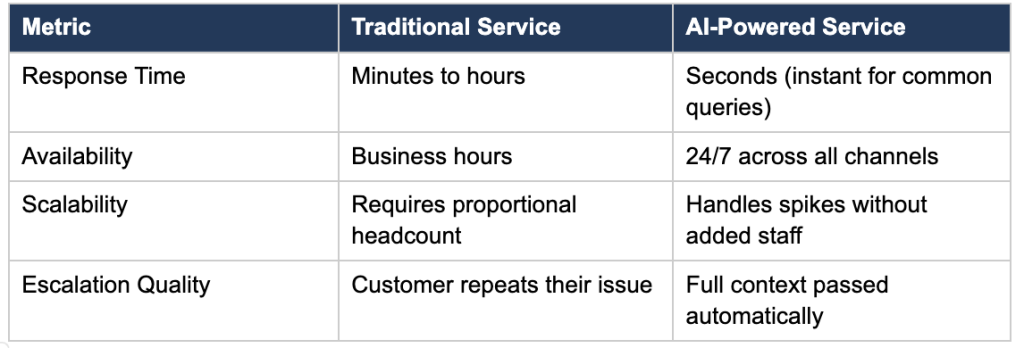
AI customer service in retail handles order tracking, returns, sizing guidance, FAQs, and post-purchase support—giving retail customer service teams the ability to handle customer inquiries at scale with instant responses to routine questions. According to Gartner, agentic AI will autonomously resolve 80% of common service issues by 2029, cutting operational costs by 30%. Master of Code adds that retailers deploying conversational AI see a 30% drop in support costs overall – freeing resources for higher-value work. The best systems also know when to step back. If someone is getting frustrated or the problem is too complex, the conversation gets escalated to a human agent with the full conversation history. No repeating yourself, no starting over. Here's how AI-driven service compares to traditional approaches:
Consistency across channels matters. Whether a customer reaches out via web chat, SMS, voice, or Instagram, they should get the same experience — with the same access to their order and product data. That means connecting your AI to your POS, CRM, CDP, and commerce platforms. Retailers who get this right build loyalty. Those who don't end up with fragmented interactions that erode trust.
Implementation Roadmap: From Pilot to Production
Choosing the Right Technology Stack
A few key decisions to work through here:- NLP engines: Google Dialogflow, Amazon Lex, and Rasa are the main contenders, along with a handful of solid open-source alternatives depending on how much you want to manage yourself.
- LLM providers: OpenAI, Anthropic, or self-hosted models all work, but they come with real trade-offs around cost, latency, and how comfortable you are with your data leaving your environment.
- Deployment: Cloud is the path of least resistance, but on-prem or edge may make more sense if you need deep integration with existing POS, CRM, ERP, or CDP systems.
- RAG architecture: Instead of relying solely on what the model already knows, retrieval-augmented generation pulls answers directly from your product catalog and support docs, significantly reducing hallucinations.
Data Requirements and Training
Good conversational AI needs good data: transaction logs, support transcripts, product catalogs with accurate attributes, and real conversation data from existing channels. Analyzing customer data and behavior patterns is what makes AI responses relevant rather than generic. Privacy is non-negotiable—especially for retailers handling payment info under PCI-DSS or customer data under CCPA and GDPR. The architecture needs to be designed with compliance from day one. For most teams, RAG is the faster, more cost-effective starting point compared to fine-tuning, since it lets you update product info and policies in real time.KPIs and Measuring ROI
The metrics that matter for conversational AI in retail:- Containment rate: conversations resolved without human escalation.
- Conversion rate lift: AI-assisted vs. non-assisted purchase completion.
- AOV change: whether AI recommendations increase basket size.
- CSAT/NPS lift: customer satisfaction improvements post-deployment.
- Cost per resolution: AI-handled vs. live agent cost comparison.
- Cart recovery rate: abandoned carts recovered through AI outreach.
Common Pitfalls and How to Avoid Them
Plenty of conversational AI projects fail not because the AI technology is bad, but because the implementation is poorly executed. Here are the most common mistakes:- Launching without a clear use case. Start with one well-defined workflow (cart recovery, order status) and prove value before expanding.
- Overlooking catalog edge cases. AI that can't handle discontinued items, size variations, or regional availability will frustrate customers.
- Underestimating integration complexity. Connecting AI to POS, CRM, and inventory is where most engineering effort lives. Plan for it.
- Failing to keep the AI updated. Customer language evolves, catalogs change, edge cases emerge. An AI that isn’t updated will degrade.
Retail AI in Practice: Real-World Results
Kanda worked with Rue Gilt Groupe, the company behind Rue La La, for over eight years, supporting multiple technology stacks and deployment environments across their online flash fashion business. Key areas of involvement included:- Storefront web and mobile development (iOS and Android)
- Data-driven website behavior tracking and personalization
- Recommendation engine development, forecasting, and A/B testing
- Retail platform management including the full post-purchase flow
- Infrastructure modernization across the full stack
How Kanda Can Help
Deploying conversational AI in retail requires solid engineering, deep integration with existing systems, and a clear understanding of your customers’ needs. Kanda has decades of experience helping retail teams build custom software solutions for retail and e-commerce, and our AI and machine learning team specializes in exactly this kind of work. We can help with:- Evaluating whether conversational AI fits your specific retail workflows and goals.
- Designing and building AI assistants integrated with your POS, CRM, CDP, and e-commerce platforms.
- Implementing RAG-based architectures to keep AI responses grounded in your actual product data.
- Setting up measurement frameworks to track conversion lift, containment rates, and cost savings.
- Scaling from a focused pilot to a production-grade, omnichannel deployment.
Conclusion
Conversational AI in retail lifts conversions, recovers abandoned carts, cuts service costs, and increases average order value – delivering faster, more efficient service at every touchpoint. The companies seeing the best results treat it like a real engineering project—starting with a focused use case, measuring rigorously, and building the right integrations from the start. The technology is mature enough to deliver real ROI today, and the trajectory points to even more capable systems with agentic AI and multimodal interfaces. For retail leaders, the decision isn’t whether to adopt conversational AI. It’s how fast they can do it well—and whether they have the right engineering partner to make it happen.Related Articles
5 Technological Pillars of Real-Time Retail
Key Takeaways: Real-time retail depends on reducing the delay between what happens in the business and how quickly teams can act on it. AI, IoT, RFID, mobile, omnichannel systems, and retail media work best when they are connected through shared data, not treated as separate projects. Inventory visibility is often the best starting point because…Learn More
IoT in Retail Execution: How Real-Time Data Drives Precision
Key Takeaways IoT systems deliver real-time inventory visibility with up to 98% accuracy compared to 65-75% with manual methods, eliminating stockouts and overstock. Proven cost savings include 10-30% energy reduction, 18% less shrinkage, and 10-15% reduction in inventory labor hours. The global IoT retail market is projected to grow from $70 billion (2025) to $482…Learn More
How Big Data Analytics is Transforming the Customer Experience for Online Retailers
Online retail is becoming increasingly competitive. Customers can shop anywhere they want, and they expect their experience to be smooth, personal, and easy to navigate. Every click, every transaction, every interaction generates data. And retailers are drowning in it. That flood of data creates problems, but it also creates opportunities. The retailers who know how…Learn More
Transforming Retail and Consumer Packaged Goods (CPG) with Generative AI
With a high level of competition, lower R&D budgets compared to other industries, and the constant need to produce new goods, the retail and consumer packaged goods (CPG) sector is challenging to innovate within. However, the rapid evolution of generative AI is impacting all industries, including retail and CPG, demonstrating that early adoption of innovation…Learn More