
Why Human-in-the-Loop AI Is Necessary in the Age of Automation
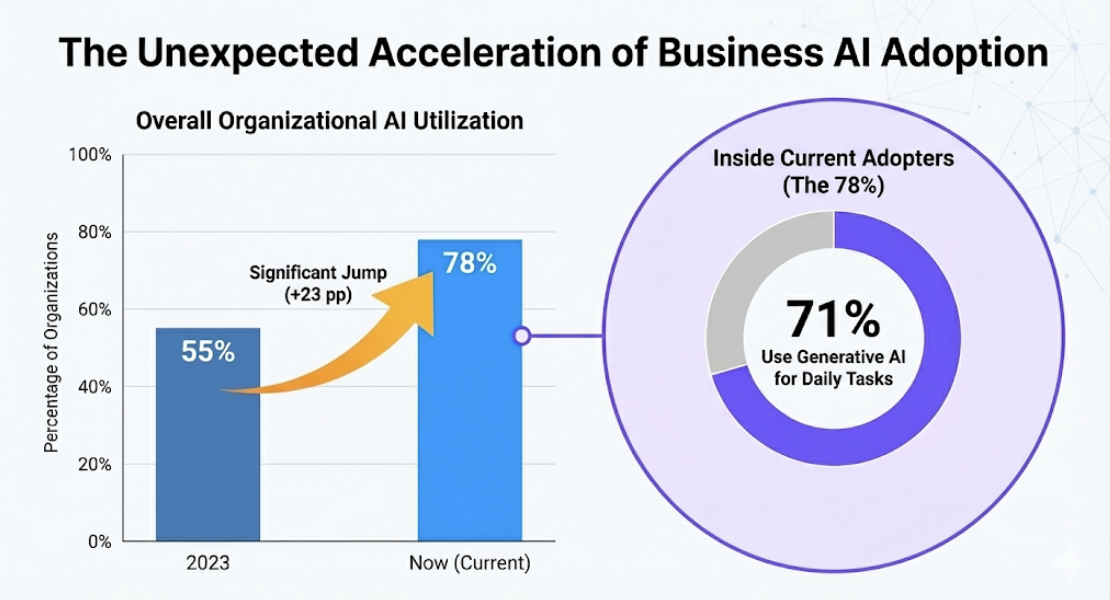
AI is spreading through businesses much faster than most people anticipated. Data from a Fullview report shows that 78% of organizations now utilize artificial intelligence in at least one part of their operations, which is a significant jump from 55% back in 2023. At the same time, 71% of these companies are regularly using generative AI for daily tasks, more than doubling the usage rate from just one year ago.
But there is a major hurdle. Research conducted by MIT and the RAND Corporation indicates that between 70% and 85% of AI and machine learning projects fail to reach their intended goals. A particularly telling statistic is that 42% of companies walked away from the majority of their AI efforts in 2025. This is a sharp increase compared to the 17% abandonment rate seen in 2024. While leaders are in a hurry to implement these tools, many are realizing that launching AI without proper safety nets leads to results that are underwhelming or potentially damaging.
This highlights the importance of human-in-the-loop AI, or HITL. This concept isn't about slowing down progress or being afraid of new technology. Instead, it's about ensuring AI systems function reliably and ethically so they provide actual value.
What Is Human-in-the-Loop?
HITL describes a system where people stay actively involved in running, watching over, or making decisions within an automated workflow. IBM describes it as a way to bring human input into a continuous feedback loop where human interaction with AI systems helps both sides learn and improve. The objective is simple. Organizations want the speed of automation without losing the accuracy and human judgment that only people can offer. Even high-end deep learning models often stumble when faced with confusing situations, potential biases, or edge cases that weren't in their training data. Humans provide the feedback needed to sharpen these models and act as a safety net when the technology fails. Think of it as a team effort. AI does the heavy lifting by sorting through massive amounts of data and handling boring, repetitive tasks. Meanwhile, human intelligence provides the context and judgment required for the decision making that truly matters.How HITL Works
HITL functions through a constant feedback loop. It usually starts when human experts sort through raw data and create labeled data to build high-quality training sets. The AI then learns from this information. After the initial training, humans test the model's guesses and fix any errors. Even after the system is live, human operators keep watching its performance through real time monitoring, catching issues and feeding those fixes back into the system so it gets better over time.Types of HITL Interactions
The way human involvement changes depending on the system. Analysis from WorkOS shows three primary moments where human intervention happens: Pre-processing. People give AI its starting point. This often involves labeling data, setting rules, or writing the initial instructions that guide the task. For instance, a person might annotate training data for a machine learning model or filter which tools an AI assistant is allowed to access before it starts working. In-the-loop (blocking execution). In this setup, the AI stops what it's doing and waits for a person to give the approval before it continues. You see this a lot in high stakes applications like banking or other regulated areas. A financial tool might pause a transaction and wait for a staff member to verify it, or an AI agent might show a plan and wait for approval before taking any action. This ensures human control at critical moments. Post-processing. After the AI finishes its work, a human reviews the result to edit or approve it before it goes any further. This is standard for things like writing articles, where an editor checks an AI-written draft before it is published, or in customer support, where a person reviews a suggested reply before a customer sees it.Why HITL Matters Now More Than Ever
The Hallucination Problem
AI hallucinations happen when a model creates false information but presents it as fact. This happens because these systems don't possess actual knowledge or real world contextual understanding. Instead, they operate by predicting which word should follow another based on patterns they found in their training data. If a model faces a question it wasn't trained for or deals with a confusing situation, it might produce an answer that sounds reasonable but is totally wrong. The intention isn't to deceive anyone. The AI is just filling in the blanks with text that seems statistically probable. This remains a massive hurdle for companies trying to use the technology. The Fullview report mentioned earlier notes that 77% of businesses are worried about these errors. On top of that, 47% of people using AI for work admitted that they made at least one major business decision based on fabricated information in 2024. To combat this, 76% of enterprises have added human-in-the-loop checks to ensure accuracy before errors cause problems. This approach goes beyond simple caution. It is a fundamental part of how companies manage the risks associated with automation.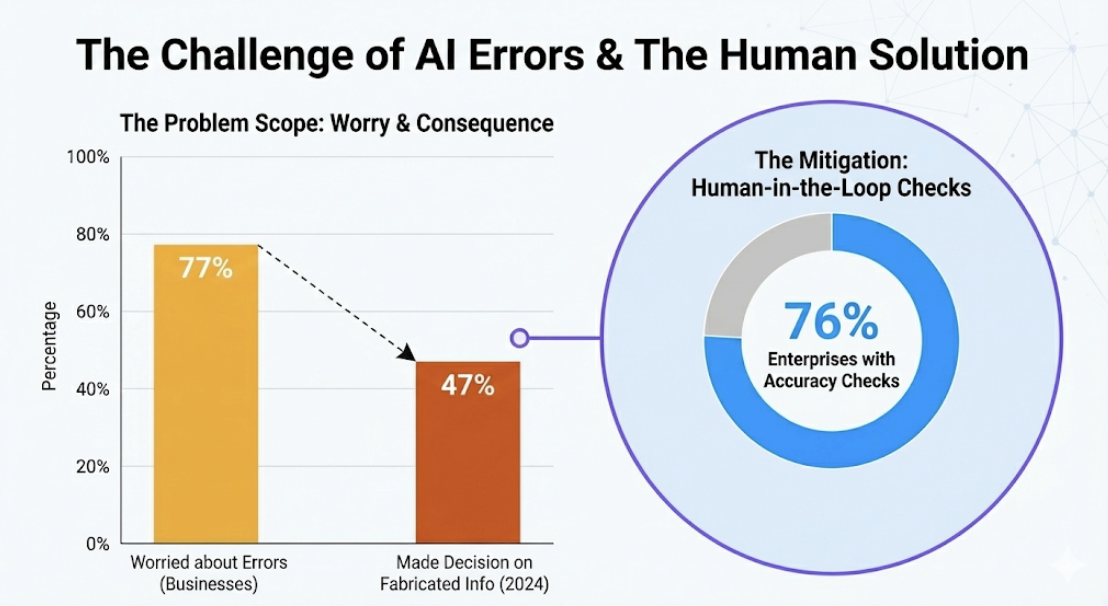
Bias in AI Systems
Bias in AI systems is a very real problem with genuine consequences. A 2024 study in PLOS Digital Health showed that over half of published clinical AI models rely on data specifically from the US or China. This leads to worse outcomes for people from other regions or backgrounds. When these systems learn from lopsided data, they can make existing inequalities in healthcare even worse instead of producing better outcomes for everyone. This issue shows up in every industry. A 2024 IBM report mentioned by AllAboutAI found that 42% of organizations using AI admitted they prioritized speed and performance over fairness. These companies knowingly deployed biased systems for hiring, banking, and medical care. This isn't some accidental glitch. It is a specific business choice that ignores ethical considerations—one that human oversight is designed to catch and prevent.Automation Bias: The Risk of Over-Reliance
One of the biggest dangers isn't that people will reject AI, but rather that they will trust it blindly. Automation bias is the habit of following an automated suggestion even when there are clear signs it might be wrong. Research in Springer found that human-in-the-loop setups can fail if they become "quasi-automated." This happens when the person involved stops paying attention and contributes nothing, which creates a false sense of safety. A 2024 PubMed study regarding medical decision tools found that people who aren't experts are the most likely to fall into this trap. This creates a difficult situation where the individuals who need the most help from AI are also the most likely to believe a wrong answer without checking it. Setting up HITL correctly means keeping humans focused and ensuring they have the expertise to actually find errors.When HITL Makes the Difference
Not every situation needs the same amount of human eyes. The key is to find the right balance and match the level of oversight to how much is at stake.Healthcare: Where Stakes Are Highest
Healthcare is one area where the stakes are as high as they get. By May 2024, the FDA had cleared 882 AI-based medical devices, according to Npj Digital Medicine. Most of these are used in radiology (76%), followed by heart health (10%) and neurology (4%). However, getting FDA approval does not mean the machine works alone. These tools are meant to support a doctor's decision making, not replace it. Take AI for medical scans as an example. These programs can look at thousands of images much faster than a person can, and they are great at spotting potential issues. But the final call has to come from a physician who understands the patient's history and the small details that a computer might miss. Research from Rutgers University shows that healthcare algorithms often have blind spots that can hurt the quality of care for Black and Latinx patients. Human expertise in oversight is about more than just catching errors; it is about making sure everyone gets fair treatment. A major example of this happened in 2023. A lawsuit accused UnitedHealth of using an algorithm to wrongly deny medical care to elderly patients. The AI's suggestions didn't match what the patients actually needed, which is something human reviewers likely would have noticed.Finance: Balancing Speed and Judgment
Banking and finance face a different set of hurdles. In this world, AI is great at checking huge numbers of transactions instantly. This is vital for stopping fraud where every millisecond counts. However, mistakes have big consequences. A false alarm can annoy a customer, while a missed fraud attempt costs money. You need human judgment to handle these edge cases. PayPal's Fraud Protection Advanced system is a good example of striking the right balance. The AI looks at every transaction and gives it a risk score and a suggestion. However, the risk management staff makes the final decision on the tricky cases. They look at the details on a dashboard before acting. The AI manages the massive volume, and the humans handle the subtle details.Agentic AI Systems: Knowing When to Pause
We are seeing the rise of "agentic AI," which refers to systems that can use tools and take actions on their own. This makes human oversight even more vital. When an AI can book a flight, send an email, or change a database, the risk of something going wrong goes up. This is similar to the challenges facing autonomous vehicles, where split-second decisions can have major consequences. The best way to handle this is to build workflows that stop at important moments. If you are just asking about the weather, the AI can run on its own. If you are deleting files or spending money, the system should stop and ask a person for permission. Tools like AutoGen, CrewAI, and LangGraph help developers build these checkpoints into the process. The rule is simple: if an action costs a lot of money or affects the safety of data, human control is non-negotiable and someone needs to hit the "go" button.Preserving Critical Decision-Making Skills
There is a strange contradiction with AI. As the technology gets better, human capabilities actually become more important, but they also become harder to keep sharp. If an AI makes most of the decisions correctly, people might lose the practice they need to handle the rare times the AI fails. A 2025 Deloitte report pointed this out, noting that as systems get more complex, the workers running them become more essential. Even as machines get smarter, we need skilled people to keep an eye on them. Good HITL isn't just about rubber-stamping what the computer says. It's about giving people real power over human decisions and building transparency into the process. Some companies are trying "human-first" setups where the person makes the initial choice and the AI acts as a second opinion, alerting them if it thinks they missed something. Training is also a big factor. The EU AI Act started in August 2024, and it requires companies to make sure their staff has "AI literacy." This means employees need to understand how these tools work and what their limits are.The Regulatory Push for Human Oversight
Having humans in the loop is moving from a "good idea" to a legal requirement. The EU AI Act says high-risk AI systems must be built so they can be watched by real people while they are being used. Oversight staff must be able to understand what the AI can and can't do, spot errors, and decide to override the machine when necessary. For very sensitive tasks, some rules even require two different people to verify an AI's choice. This is happening everywhere. A Parseur analysis found over 700 AI bills introduced in the US in 2024, with dozens more arriving in early 2025. Companies that set up human oversight now are getting ready for a future where the law will demand it.Deciding When to Use HITL
Different AI tasks require different levels of human involvement. Knowing where to involve people, and where it isn't necessary, helps companies use their time and resources more effectively. Use HITL when:- The stakes are high or choices are hard to undo. High stakes applications like medical diagnoses, bank loan approvals, or legal decisions need a person to verify the work before any action is taken.
- The task requires subtle judgment or ethics. Handling customer complaints, making hiring choices, or moderating online content often involves contextual understanding that AI is likely to miss.
- The law requires it. In industries like healthcare and finance, regulations are increasingly demanding that human reviewers sign off on automated decisions.
- The AI model is still new. When a tool is first launched, it needs close monitoring to catch unexpected glitches and gather the human feedback needed to make it better.
- You need to build trust. If customers or employees are nervous about using AI, having a visible human oversight process can help them feel more confident in the system.
- Tasks are low-risk and easy to fix. Things like sorting spam or putting emails into basic categories usually don't need a person to check every single result.
- Speed is the priority and small errors don't hurt. Recommendation engines for movies or products need to work instantly for end users. If they make a mistake, the consequences are minor.
- The AI has a long, proven track record. If a model has been working accurately in a stable environment for a long time, it likely doesn't need constant supervision.
- Human review doesn't actually add value. If the people in charge of oversight are just clicking "approve" without really looking at the data, the process is just creating a bottleneck without providing any real protection.
Implementing HITL Effectively
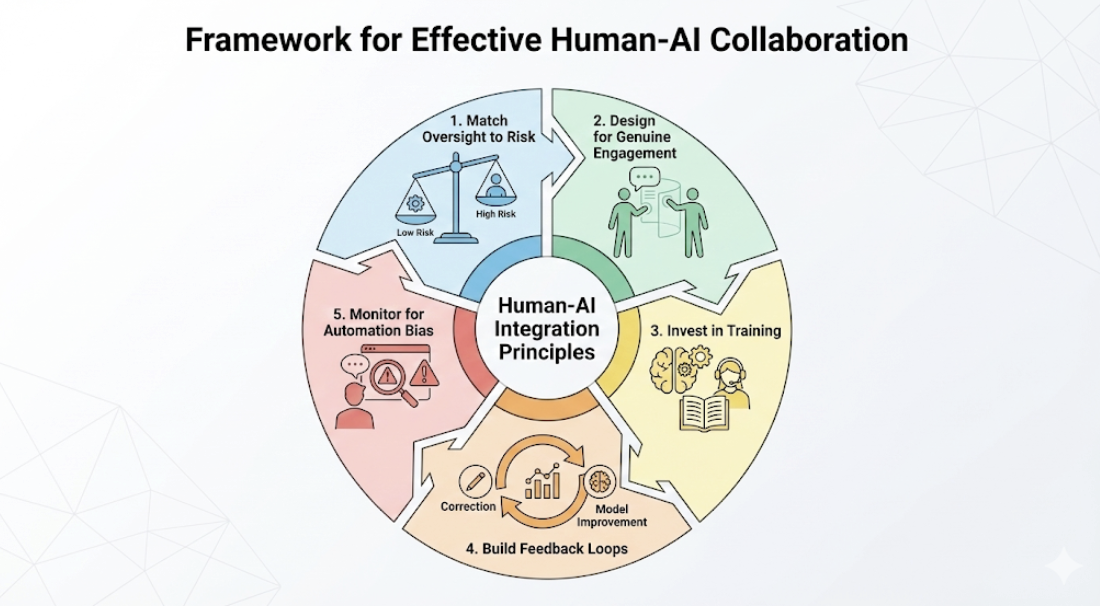
Setting up HITL effectively involves more than just adding a "confirm" button. It requires a system that keeps people interested and useful.- Match oversight to risk. Not every AI output needs a human to look at it. Figure out which choices carry the most risk based on cost and safety. Easy, low-stakes tasks can happen automatically, but big decisions need a human checkpoint.
- Design for genuine engagement. Don't create a system where people just click "approve" over and over. Give them the context they need. Explain why the AI flagged a certain item and what it was thinking so the person can add real value.
- Invest in training. People need to understand the AI and the specific field they work in. This requires constant learning about how the system functions and where it usually fails.
- Build feedback loops. When a person catches an AI mistake, that correction should flow back into the model. Correcting mistakes and capturing that data is how you create a real feedback loop for continuous improvement.
- Monitor for automation bias. Keep an eye on how often people actually disagree with the AI. If they never disagree, they might just be trusting the machine too much. You can use design elements that require a user to stop and think before they move forward.
How Can Kanda Help
Creating AI that strikes the right balance between automation and human control takes a lot of experience. At Kanda Software, we focus on building AI and machine learning tools that help businesses grow while keeping humans in charge. Our services cover everything from basic to complex setups:- Custom AI solutions built with human oversight steps included from the start to meet your specific needs.
- Healthcare AI development that helps with diagnosis and patient care while following all legal rules.
- Generative AI and NLP tools that include safety guardrails and human review mechanisms.
- Process automation that knows when to work alone and when to wait for a person to check in.
- Anomaly detection systems that find problems and predict trends with clear data that humans can act on.
Conclusion
AI is already changing how industries work. The real question is whether that change will actually solve problems or just create new ones. Human-in-the-loop isn't about being a skeptic. It's about being realistic and building systems that balance efficiency with safety, using the best of both worlds. It is about keeping human skills relevant as technology moves forward and building trust with the public. Organizations that get this right won't just avoid lawsuits and errors; they will build tools that actually deliver on their promises. In a world full of automation, human oversight is still a major necessity and the combination is where the real advantage lies.Related Articles
How to Turn Your Broken Data Workflows Into Scalable Data Pipelines: An Ultimate Guide
Key Takeaways Workflows break at scale not because of selecting wrong tools, but because project-level habits, manual handoffs, copy-pasted scripts become the operating model. The architecture patterns that enable scalability: decoupled storage and compute, deliberate data layering, and orchestration treated as a control plane. Pipeline reliability is a delivery problem too. Version control, CI/CD, and…Learn More
Why Using Edge AI for Real-Time Analytics Is Your Next Best Decision
Key Takeaways: Edge AI processes data locally in 1–10 ms, compared to 50–200 ms with cloud-based analytics, making it critical for time-sensitive operations. Organizations can cut data transmission costs by up to 43% and reduce cloud-bound traffic by over 90% by filtering data at the edge. Industries like manufacturing, healthcare, autonomous vehicles, and smart cities…Learn More
Comprehensive AI Security Strategies for Modern Enterprises
Over the past few years, AI has gone from a nice-to-have to a must-have across enterprise operations. From automated customer service to predictive analytics, AI technologies now handle sensitive data like never before. A Kiteworks report shows that over 80% of enterprises now use AI systems that access their most critical business information. This adoption…Learn More
Building Trust in AI Agents Through Greater Explainability
We’re watching companies leap from simple automation to an entirely new economy driven by self-governing AI agents. According to Gartner, by 2028 nearly a third of business software will have agentic AI built in, and these agents will be making at least 15% of everyday work decisions on their own. While that can significantly streamline…Learn More