
February 19, 2026
General
Why Using Edge AI for Real-Time Analytics Is Your Next Best Decision
Key Takeaways:
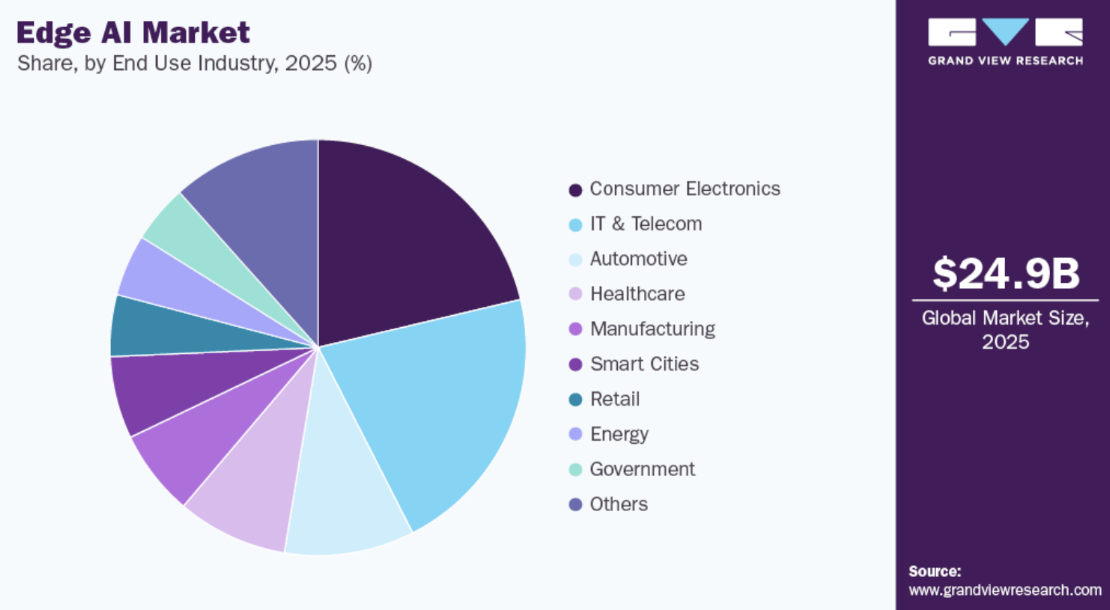 Source: Grand View Research
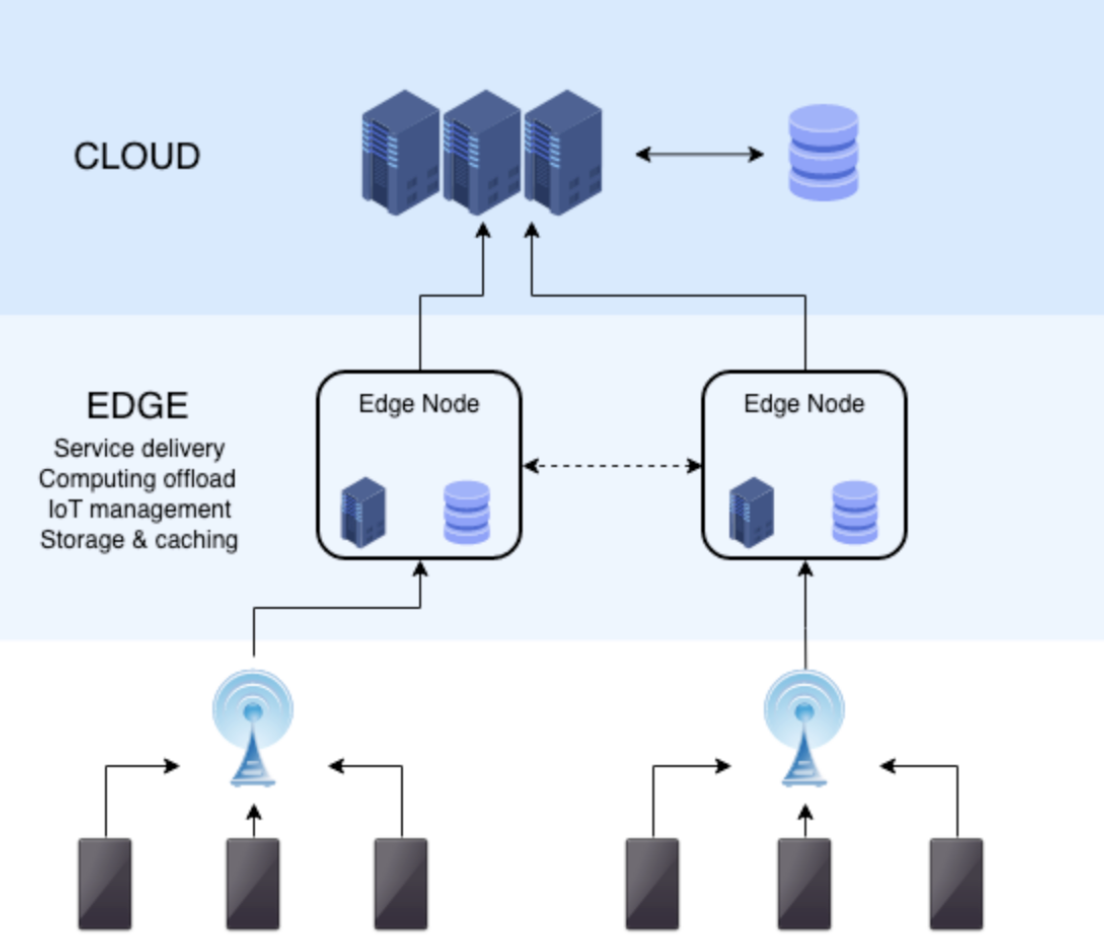 The edge computing infrastructure. Source: Wikipedia
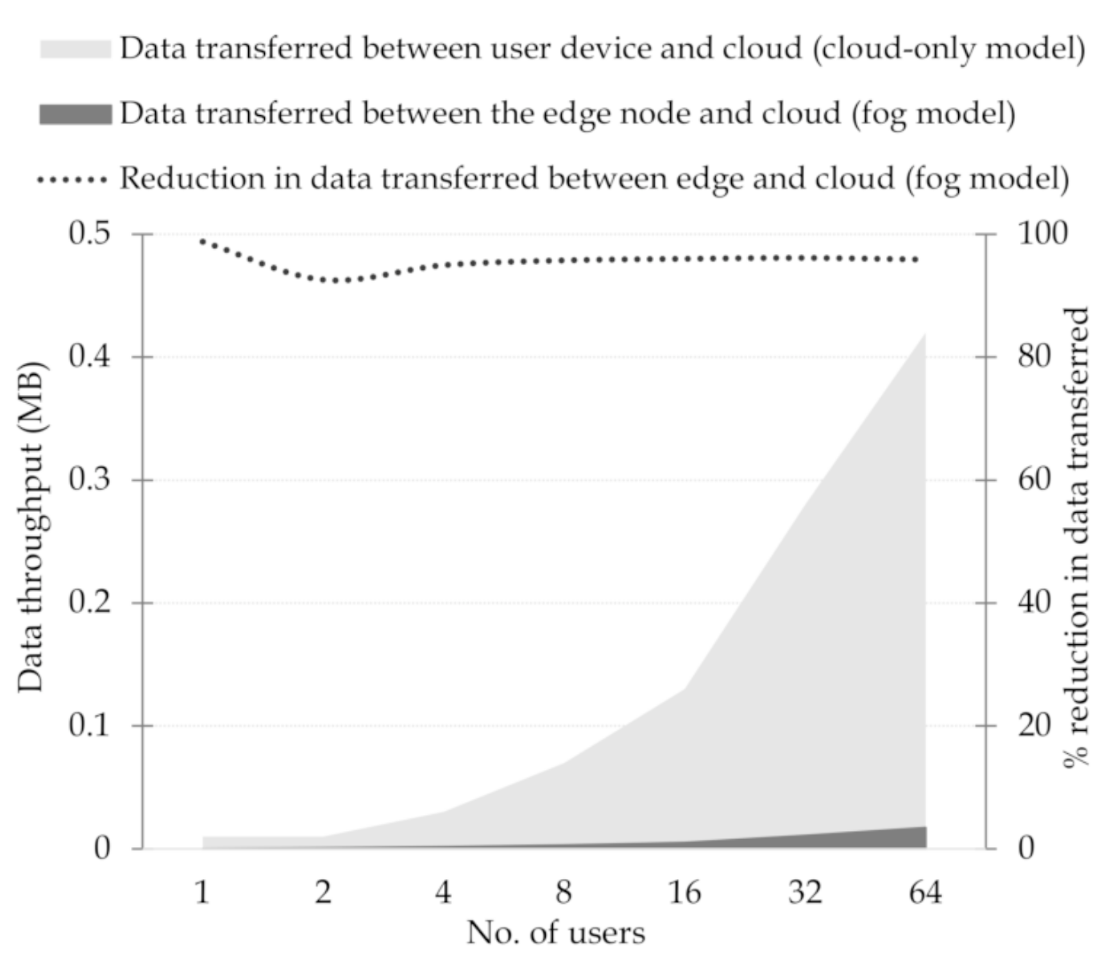 Percentage reduction in the data traffic between edge nodes and the cloud to highlight the benefit of using the fog computing model. Source: ResearchGate
Financial institutions using edge computing report an average 43% reduction in data transmission costs, according to Number Analytics. For large multinational banks, that translates to $15-20 million in annual savings on network infrastructure and cloud infrastructure.
Percentage reduction in the data traffic between edge nodes and the cloud to highlight the benefit of using the fog computing model. Source: ResearchGate
Financial institutions using edge computing report an average 43% reduction in data transmission costs, according to Number Analytics. For large multinational banks, that translates to $15-20 million in annual savings on network infrastructure and cloud infrastructure.
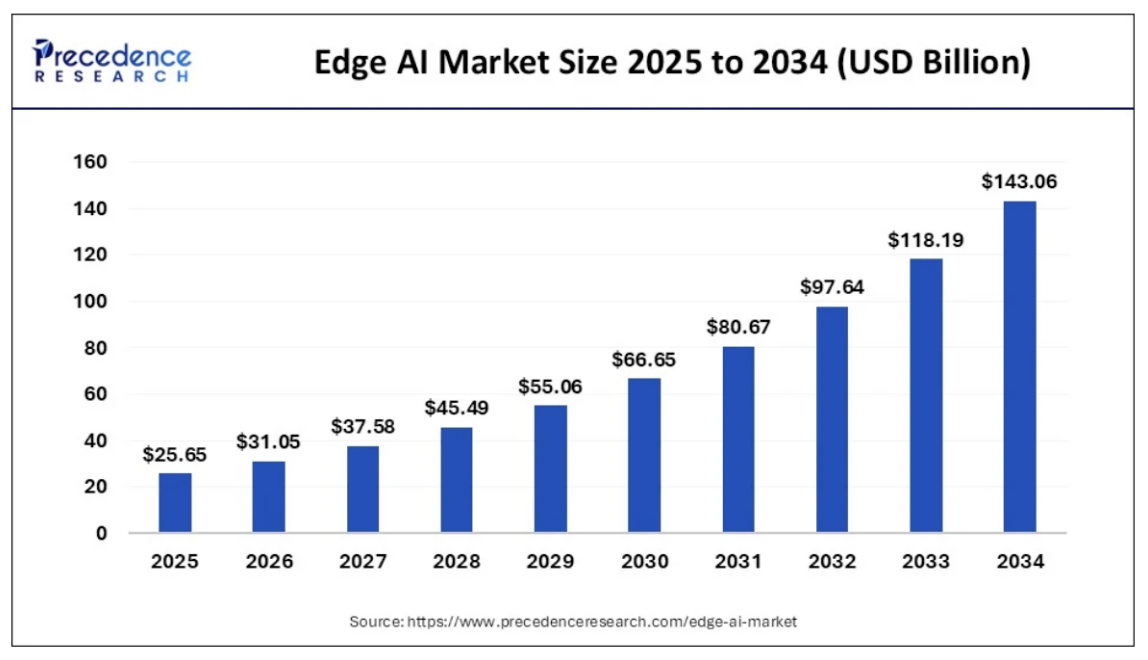 Source: Precedence Research
- Edge AI processes data locally in 1–10 ms, compared to 50–200 ms with cloud-based analytics, making it critical for time-sensitive operations.
- Organizations can cut data transmission costs by up to 43% and reduce cloud-bound traffic by over 90% by filtering data at the edge.
- Industries like manufacturing, healthcare, autonomous vehicles, and smart cities are already seeing measurable gains in safety, uptime, and efficiency.
- Edge AI complements rather than replaces the cloud—hybrid architectures handle real-time decisions locally while leveraging the cloud for training and long-term analytics.
- Keeping sensitive data on-site simplifies compliance with regulations like HIPAA and data sovereignty laws.
Source: Grand View Research
What Is Edge AI for Real-Time Analytics?
Defining Edge Computing and AI Integration
The concept of edge computing is pretty straightforward: it’s all about moving the work closer to the source. Instead of sending every bit of information through a far-off data center, the data is processed on edge devices, like gateways or servers sitting right on your own network. Add AI to that setup and you get edge AI, or machine learning models running on local hardware and enabling real-time data processing and decision-making. The “edge” might be an industrial computer sitting on a factory floor, a smart camera in a store, or an onboard computer in a connected vehicle. Here’s a number that puts this in perspective: according to Gartner, only about 10% of enterprise data was created and processed outside traditional data centers back in 2018. By 2025, that’s expected to hit 75%. That’s a massive shift in how organizations think about where computation should happen.
The edge computing infrastructure. Source: Wikipedia
How Edge AI Is Different from Cloud-Based Analytics
It really comes down to three things: where the data lives, how fast it moves, and what happens to it. In a cloud-based setup, data has to travel from a sensor over the internet to centralized cloud servers in a distant data center. These servers run the computations and send the answer back. This whole trip usually takes between 50 and 200 milliseconds, and it can take even longer if the network is crowded or the server is busy. With local processing, the data is handled on-site, usually in just 1 to 10 milliseconds. This low latency response is crucial in industries where a split-second matters. Look at a security camera as an example. A camera using the cloud might take 100 milliseconds to see a threat and flag it. An edge AI camera can do that in under 10 milliseconds. In a safety-critical situation, those 90 milliseconds could be the difference between stopping an accident and just recording it as it happens. Beyond the speed, edge AI is better for your budget and data privacy. You aren't congesting your network by sending raw data like video streams or massive files to the cloud, you only send the important insights. Plus, sensitive data stays on your site, which is important for hospitals, banks, or any company with sensitive data.Business Cases for Real-Time Data Processing at the Edge
Latency Reduction and Instantaneous Insights
Edge AI systems reduce latency dramatically and deliver real-time insights. For many businesses, that delay is actually a hidden cost. High-frequency trading is a good example. These algorithms move in microseconds. A 10-millisecond delay can be the difference between a profit and a loss. That’s why some financial firms put their edge systems right next to stock exchanges—they want results in 15 to 20 milliseconds. Manufacturing is similar. When a production line is running at full speed, a one-second delay in spotting a mistake can mean that 30 defective products make it through. Edge AI lets quality control systems catch errors while running at speeds of over 100 parts per minute. Healthcare is another area where milliseconds count. St. Mary’s Hospital in Denver used edge systems for heart monitoring. They cut their alert processing time from 35 milliseconds down to just 3. That change led to a 15% drop in preventable cardiac events.Bandwidth Optimization and Cost Savings
If you’re generating massive amounts of data, data transmission to the cloud gets expensive and the bandwidth usage can strain your network quickly. Consider this: a single autonomous vehicle can collect data at a rate of around 4 terabytes per day, according to the Automotive Edge Computing Consortium. A manufacturing plant with 2,000 pieces of equipment can produce 2,200 terabytes monthly. Transmitting all of that raw data to cloud servers would require enormous bandwidth and incur significant cloud storage and infrastructure costs. Edge processing solves this by filtering data locally and only transmitting what actually matters. Research cited by ResearchGate shows that edge computing can cut data traffic between edge nodes and the cloud by over 90% in some applications.
Percentage reduction in the data traffic between edge nodes and the cloud to highlight the benefit of using the fog computing model. Source: ResearchGate
Financial institutions using edge computing report an average 43% reduction in data transmission costs, according to Number Analytics. For large multinational banks, that translates to $15-20 million in annual savings on network infrastructure and cloud infrastructure.
Enhanced Privacy and Data Sovereignty
Hospitals dealing with HIPAA, or banks under heavy regulation, find it much easier to process data at the edge. If patient records or money transfers never leave the building, you’ve naturally lowered the risk of a data breach. It makes staying compliant a lot simpler. It also helps with "data sovereignty." Some countries have strict laws about data staying within their borders. Edge computing lets companies process that info locally while still getting all the benefits of AI.Operational Continuity When Networks Go Down
Cloud-dependent systems have an obvious weakness: when your internet connectivity fails, they stop working. Edge AI systems remain functional even when the connection to central infrastructure goes down. This is vital for operations like offshore oil rigs, farms, or rural clinics where the internet is unreliable. It’s also a requirement for any job where you can’t afford to stop, like a fast-moving assembly line or a safety monitoring system. You can’t afford connectivity downtime when heavy machinery is running.Edge AI Applications Across Industries
Manufacturing and Industrial IoT
Manufacturing is one of the fastest-growing areas for edge AI adoption, according to Grand View Research. The ability to monitor equipment, spot anomalies, and predict failures in real time turns maintenance from a reactive burden into something you can actually plan around. The results from predictive maintenance are impressive. A study in ScienceDirect documented a 12-month implementation that achieved 93-95% accuracy in fault detection, 25-30% reduction in maintenance costs, 70-75% fewer equipment breakdowns, and 35-45% less downtime. Siemens has rolled out edge AI systems that analyze sensor data streams, monitoring vibration patterns, temperature changes, and energy consumption across production equipment. When something looks off, the system can adjust parameters immediately—no waiting for a cloud server to respond. Quality control is another big AI application. Edge-powered computer vision can inspect products at production speed, catching defects that human inspectors would miss. These edge AI systems process thousands of images per minute, making instant pass/fail decisions without slowing production. Getting these capabilities up and running requires solid custom software development that integrates with your existing manufacturing systems.Healthcare and Medical Devices
Patient monitors are starting to use AI at the edge to give immediate alerts. A wearable device can spot a heart problem and tell a doctor instantly, rather than waiting for the data to travel to a server and back. Diagnostic imaging is another opportunity. Edge AI can perform initial analysis of medical images locally, flagging potential issues for physician review while keeping patient data secure. This speeds up diagnostic workflows without compromising privacy. These developments align with broader trends in predictive modeling in healthcare, where real-time analysis enables proactive rather than reactive care. Emergency response benefits too. When ambulances equipped with edge AI can analyze patient data on the way to the hospital, emergency departments get actionable information before patients even arrive.Retail and Customer Experience
Retail is using edge AI for everything from inventory management and customer behavior analysis, to checkout optimization. Smart checkout systems use edge AI to recognize products and process transactions without traditional scanning, enabling those grab-and-go experiences that eliminate checkout lines entirely. In-store analytics powered by edge computing give you real-time insights into customer traffic, product interactions, and purchasing behavior. You can adjust staffing, reposition displays, or launch promotions based on what’s happening right now, not what happened yesterday. Inventory systems using edge AI can monitor shelf stock continuously and trigger replenishment alerts before products run out. This kind of responsiveness requires advanced data analysis capabilities that edge computing makes possible.Smart Cities and Infrastructure
Urban infrastructure generates huge amounts of data from traffic sensors, surveillance cameras, environmental monitors, and utility systems. This massive data collection, when processed at the edge, enables much more responsive smart city management. Traffic systems using edge AI enable intelligent traffic management, adjusting signal timing based on real-time conditions, reducing congestion and improving flow. Public safety systems can analyze video feeds locally, identifying incidents and coordinating responses faster than centralized approaches. The smart city segment held the largest share of the global edge AI market in 2024, according to Precedence Research—a reflection of how valuable this technology is for managing complex urban environments.
Source: Precedence Research
Autonomous Vehicles and Transportation
Self-driving cars are probably the most demanding application for edge AI. These systems generate roughly 1 GB of data per second from cameras, lidar, radar, and other sensors. There’s no way to process data at that volume through cloud infrastructure fast enough. Autonomous vehicles need to recognize objects, predict movements, and make driving decisions in milliseconds. Edge AI running on onboard computers handles everything from pedestrian detection to lane tracking without the latency that cloud processing would introduce. According to the Global Semiconductor Alliance, data transmitted between cars and the cloud could reach 10 exabytes per month by 2025, about 10,000 times current volumes. That kind of scale makes it clear why processing has to happen at the edge.Technical Architecture of Multi-Access Edge Computing
Edge Hardware and Processing Units
Running AI models locally requires the right AI hardware. Edge deployments typically use specialized edge AI hardware like GPUs, neural processing units, or dedicated AI accelerators that provide the computing power needed while balancing performance with energy efficiency. The hardware segment led the edge AI market with a 51.8% revenue share in 2025, according to Grand View Research. That reflects just how foundational the AI infrastructure is for edge deployments. Industrial settings add another layer of complexity. Edge hardware needs to handle temperature extremes, vibration, dust, and other conditions that would quickly destroy consumer-grade equipment.Software Frameworks and Deployment Models
Edge AI software platforms provide the infrastructure for deploying and managing machine learning models across distributed hardware. Frameworks like TensorFlow Lite and ONNX Runtime let you optimize AI models trained in the cloud and run them efficiently on resource-constrained edge devices. Containerization with Docker and Kubernetes simplifies deployment and updates. You can push model updates to hundreds or thousands of edge devices without having someone physically visit each location. Whether you build custom edge infrastructure or use platform solutions depends on your capabilities and requirements. AI and machine learning services providers can help you determine the right approach for your specific situation.Network Infrastructure and 5G Integration
5G is a major catalyst for multi-access edge computing. It offers the low-latency connection that AI at the edge needs to work effectively at the network edge. With 5G "network slicing," operators can set aside a dedicated lane for critical edge work. This ensures that a self-driving car or a hospital system always has the bandwidth it needs, regardless of how many people are nearby using their phones.Practical AI Applications: Implementation Strategies
Assessing Your Organization’s Readiness
Not every use case needs edge AI solutions. The technology makes the most sense when you need response times faster than cloud infrastructure can deliver, when bandwidth costs for transmitting raw data are too high, when data privacy requirements favor local processing, or when operations have to continue during network outages. Before committing to edge deployments, take a close look at your current infrastructure, identify which processes are latency-sensitive, and determine what faster decision-making would actually be worth to your business. Our AI Consulting services help evaluate those trade-offs and determine whether an edge, cloud, or hybrid AI architecture best fits your latency, privacy, and operating requirements.Hybrid Approaches: Combining Edge and Cloud
Edge AI doesn’t replace cloud AI and cloud computing. It works alongside them. A smart architecture uses edge processing for time-sensitive decisions while leveraging cloud infrastructure for model training, long-term analytics, and centralized management. This hybrid approach lets you get the benefits of real-time processing without giving up the scalability and analytical power of cloud platforms. The integration between edge and cloud, similar to how organizations evaluate different AI studio approaches, requires thoughtful architecture and clear data governance.Security Considerations for Edge Deployments
Having edge devices spread out in many locations creates new security risks. Every edge device is a potential target, and they aren't always tucked away in a locked room like servers in a centralized data center. Good security means using encrypted communications, verifying device identity (authentication), and having a plan for what happens if a device is stolen or tampered with.Measuring ROI and Performance Metrics
Key Performance Indicators for Edge AI Systems
If you’re deploying edge AI, you need to track the right numbers. Key metrics include inference time (how fast the AI produces a result), accuracy, and bandwidth cost reduction. According to Deloitte, manufacturers using edge AI for maintenance can cut their costs by 25% and keep their machines running 10-20% more of the time.Total Cost of Ownership Analysis
Edge infrastructure involves upfront hardware costs, ongoing maintenance, and operational complexity. You need to weigh these against cloud alternatives, factoring in bandwidth costs, the business impact of latency, and the value of better privacy and reliability. The break-even calculation varies a lot depending on your data volumes, latency requirements, and how critical continuous operation is for your business. High-data-volume applications with strict latency needs typically pay back faster than low-volume deployments where cloud processing would work fine.How Kanda Can Help
Getting edge AI for real-time analytics up and running takes expertise across hardware selection, software architecture, machine learning deployment, and system integration. Kanda has been building technology solutions for decades, and we can help you navigate the complexity. We can help with:- Designing hybrid edge-cloud architectures – building systems that get the best of both approaches
- Developing custom edge AI applications – creating solutions tailored to your industry and operational needs
- Integrating edge systems with what you already have – making sure new capabilities work with your current investments
- Setting up monitoring and management – giving you visibility and control across distributed edge deployments
Conclusion
Edge AI necessitates a fundamental change in how we handle data processing. By moving artificial intelligence to the source, businesses can react in milliseconds instead of seconds. That leads to safer work, better customer service, and lower costs. The companies investing in these edge AI capabilities now are positioning themselves to meet the rising demand for real-time intelligence, while others will be stuck dealing with the lag of traditional approaches.Related Articles
How to Turn Your Broken Data Workflows Into Scalable Data Pipelines: An Ultimate Guide
Key Takeaways Workflows break at scale not because of selecting wrong tools, but because project-level habits, manual handoffs, copy-pasted scripts become the operating model. The architecture patterns that enable scalability: decoupled storage and compute, deliberate data layering, and orchestration treated as a control plane. Pipeline reliability is a delivery problem too. Version control, CI/CD, and…Learn More
Why Human-in-the-Loop AI Is Necessary in the Age of Automation
AI is spreading through businesses much faster than most people anticipated. Data from a Fullview report shows that 78% of organizations now utilize artificial intelligence in at least one part of their operations, which is a significant jump from 55% back in 2023. At the same time, 71% of these companies are regularly using generative AI…Learn More
Comprehensive AI Security Strategies for Modern Enterprises
Over the past few years, AI has gone from a nice-to-have to a must-have across enterprise operations. From automated customer service to predictive analytics, AI technologies now handle sensitive data like never before. A Kiteworks report shows that over 80% of enterprises now use AI systems that access their most critical business information. This adoption…Learn More
Building Trust in AI Agents Through Greater Explainability
We’re watching companies leap from simple automation to an entirely new economy driven by self-governing AI agents. According to Gartner, by 2028 nearly a third of business software will have agentic AI built in, and these agents will be making at least 15% of everyday work decisions on their own. While that can significantly streamline…Learn More