
January 30, 2025
Healthcare
Best Practices for Seamless MedTech Device System Integration
Did you know that today there are an estimated 2 million different kinds of medical devices on the global market according to WHO? From glucose monitors and fitness bracelets to robotic surgery systems, the medtech industry is continuously growing. By 2030, the annual sales around the globe are expected to reach about $800 billion.
Due to that, one might expect a well-connected healthcare ecosystem with seamless health data exchange between all the parts involved. But the reality tells a different story. About 80% of serious medical errors involve miscommunication between care teams, which is the result of siloed and fragmented systems.
This is why seamless medtech integration is crucial. By consolidating data from various devices and making it easily accessible, integration reduces errors and fosters a more connected and efficient care environment.
Key Benefits of Medical Device Integration
Just like a traffic control system orchestrates seamless movement of vehicles to avoid chaos, software integration ensures that all healthcare technology solutions and devices are working together to avoid errors and miscommunications. Below are some of the advantages of this harmony.Better Patient Care
For patients, medtech integration means quicker, more accurate care. Real-time data from devices like wearables and monitors helps doctors identify issues earlier, reducing medical errors and improving outcomes. Plus, a person’s medical history is connected at every step making healthcare experiences smoother and less stressful.Clinician Workflow Improvements
For clinicians, integration removes the hassle of manual data entry, freeing up time to focus on what really matters—patients. It also bridges communication gaps between departments, enabling seamless collaboration for sharing test results or coordinating treatment plans.Operational Gains
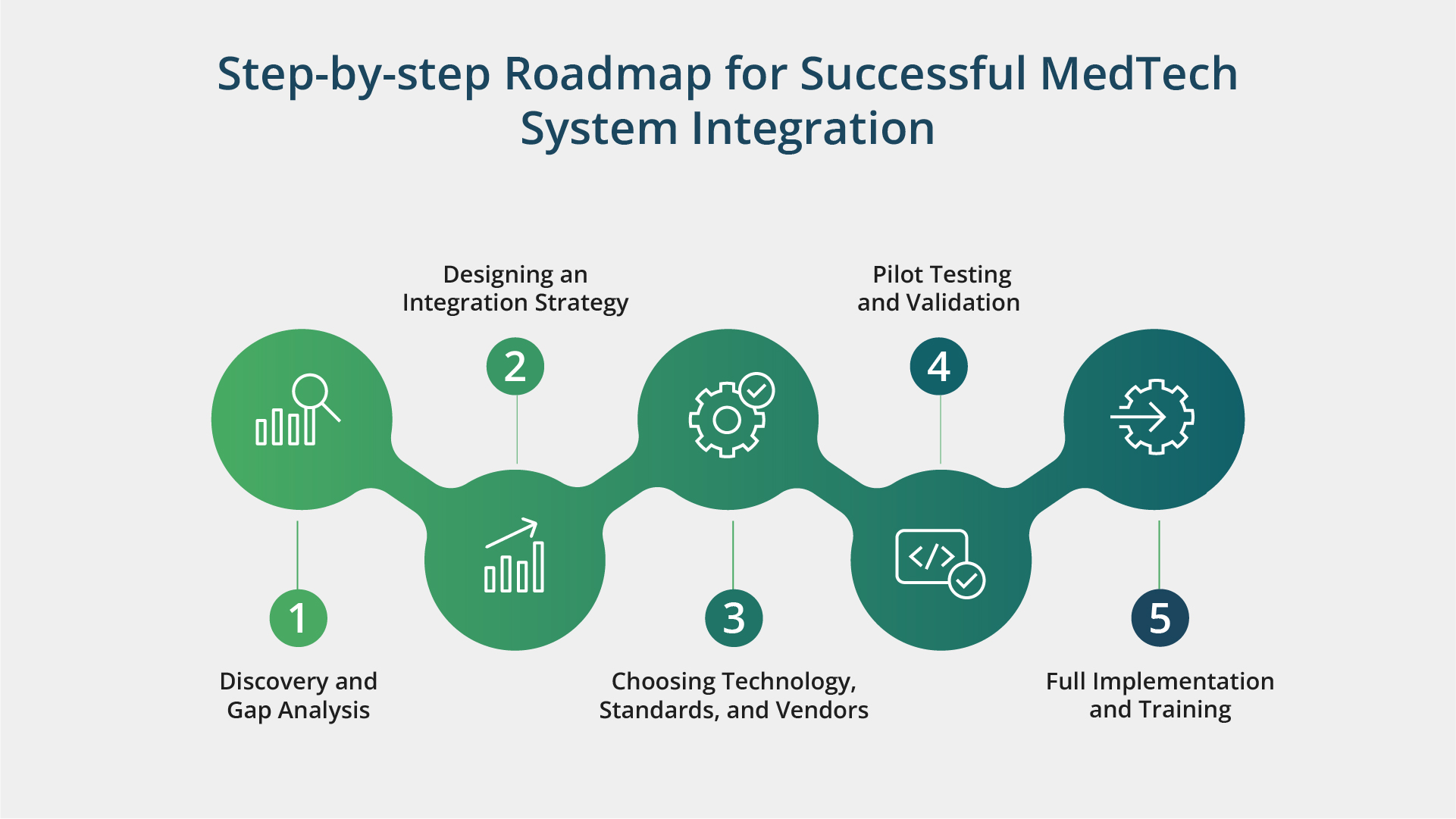
For healthcare organizations, integration boosts efficiency and cuts costs. By eliminating redundant tests and streamlining workflows, providers can allocate resources where they’re needed most. It’s smarter, faster, and ultimately, better care for everyone.Step-by-Step Roadmap for Successful MedTech System Integration
Just like any software development project, medical device integration requires a strategic and phased approach. By breaking down the process into clear, actionable steps, healthcare organizations can tackle challenges effectively and ensure a seamless rollout.
Phase 1: Discovery and Gap Analysis
Start by assessing your current technology landscape and identifying what systems, workflows, and data flows are already in place. Find inefficiencies or gaps, such as devices that don’t communicate or manual processes prone to errors. Pinpoint the integration points that will deliver the most value — whether it’s linking an EHR with remote monitoring tools or integrating an AI-powered healthcare solution to support clinical decision-making.Phase 2: Designing an Integration Strategy
Once you have a clear understanding of your integration needs, the next step is to create a detailed plan. Outline the project’s scope, budget, timelines, and success metrics. Also, don’t forget to build regulatory compliance into your strategy to ensure data security and patient privacy are top priorities.Phase 3: Choosing Technology, Standards, and Vendors
Selecting the right tools and partners is critical. To guarantee interoperability, look for technologies that are compatible with industry standards such as HL7, FHIR, or DICOM. Evaluate potential vendors for their expertise, scalability, and track record in healthcare integrations. Think long-term — your system should grow alongside your organization’s needs.Phase 4: Pilot Testing and Validation
To test the integration in a controlled setting, start small by implementing a pilot program in a single clinic or department. Get user feedback, fix workflow or technological problems, and fine-tune the system based on real-time performance.Phase 5: Full Implementation and Training
Once the pilot is successful, increase the scale up to a full rollout. To ensure that clinicians, IT personnel, and administrators feel comfortable utilizing the new technologies, provide them with specialized training. Offer ongoing support to ensure a smooth transition and high adoption rates. In addition to a clear plan and actionable strategy, successful integration relies on the right partner for a smooth implementation. Check out our comprehensive checklist to guide your decision or reach out to Kanda Software for expert support and tailored solutions.Checklist for Choosing the Right Integration Partner
-
Does the partner have a strong technical expertise?
-
How do they handle clinical data to ensure regulatory compliance?
-
Do they have robust security measures?
-
Which interoperability standards and protocols do they support?
-
What is their track record in integrating hardware vs. software-based medical devices?
-
What is their post-integration support model (e.g., 24/7, tiered support)?
-
Does the solution provider offer SLAs guaranteeing response and resolution times?
-
Can their integration solution handle increases in data volume and device types in the future?
The Bottom Line
In today’s rapidly evolving healthcare landscape, medtech system integration is essential for ensuring smooth data interchange, reducing mistakes, and enhancing patient outcomes. However, successful integration requires a strategic approach, thoughtful planning, and the right technology partner. Kanda Software brings to the table a wealth of experience in developing and integrating value-adding sophisticated health IT systems. Kanda makes sure your systems interact efficiently and securely by integrating advanced interoperability protocols like HL7 and FHIR and adhering to regulations like HIPAA and GDPR. Contact us today to start your integration journey.Related Articles

CMS Prior Authorization Rule 2026: What Health Systems and Payers Actually Need to Build by October 2027
Key Takeaways The 2026 CMS Prior Authorization (CMS-0062-P) rule extends electronic prior authorization requirements to drugs for the first time, closing a major gap left by the 2024 rule. The hard compliance deadline is October 1, 2027 - by that date, systems must be live, not in development or testing. Compliance requires three major technical…Learn More
Unlocking Actionable Insights from Medical Data with Clinical NLP
Key Takeaways Clinical NLP extracts useful details from notes, reports, and other free-text records so teams can work with them. The clearest use cases include coding support, trial matching, safety monitoring, registry work, and population health. The output is only useful if it connects to the standards healthcare teams already use: SNOMED CT, RxNorm, LOINC,…Learn More
Why Omics and Clinical Data Integration Remain a Challenge and How to Fix It
Key Takeaways Omics and clinical data often remain separate, making them harder to use together than they should be. The main challenge is usually not the data itself, but the mismatched formats, siloed systems, and disconnected teams surrounding it Addressing that requires robust infrastructure, shared standards, and workflows that hold up without constant manual intervention.…Learn More
AI Copilots in Healthcare: Minimizing Diagnostic Risks With Smart Virtual Assistants
Key Takeaways AI copilots act as always-on virtual assistants managing documentation, triage, and decision support so clinicians can focus on patients. With 12 million diagnostic errors and up to 80,000 deaths annually, AI copilots are built to catch what overloaded clinicians miss, not replace them. Dragon Copilot saves clinicians around 5 minutes per encounter with…Learn More