

March 12, 2026
General
Custom AI Development vs Off-the-Shelf Solutions: What Delivers Better ROI?
Key Takeaways
- Custom AI development costs more upfront but delivers stronger long-term ROI, especially for core business functions.
- Off-the-shelf tools get you started fast, but subscription costs scale quickly, and vendor lock-in is a real risk.
- Over 80% of AI projects fail, and the most common reason isn’t the technology, it’s misalignment between the solution and the business problem.
- Many companies follow a natural path: start with off-the-shelf, hit limitations, then move to custom where it matters most.
- The best strategy is often a hybrid; buy for commoditized tasks, build for competitive advantage.
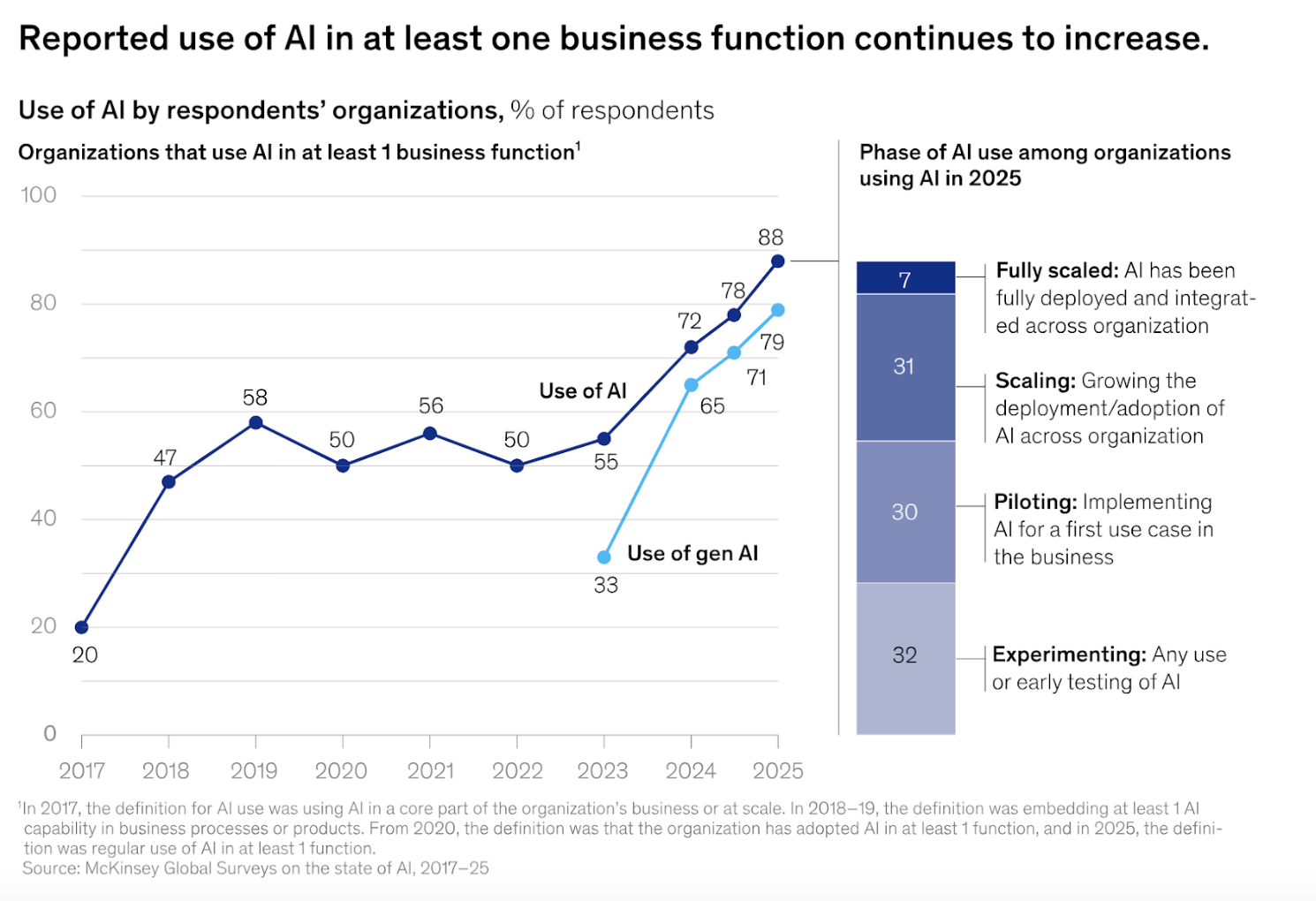 Source: McKinsey
The Real Cost of Custom AI Development
When people hear "custom AI development," their mind usually goes straight to the price. And yes, building custom AI models is a higher initial investment. But the final number depends on a lot of variables, and understanding those variables is what separates a smart investment from a money pit.Upfront Investment Breakdown
Custom AI solutions for business can vary widely in cost depending on the complexity of the problem, the quality and availability of data, and how deeply the system needs to integrate with existing tools and workflows. Several key factors typically drive the overall investment:- Discovery and planning – Scoping the problem, defining success metrics, and assessing data readiness
- Rigorous data preparation – Data collection, cleaning, and labeling, which alone can eat 15–25% of the total budget
- Model development and training – Building, testing, and iterating the custom models themselves
- Infrastructure setup – Cloud or on-premise environments, CI/CD pipelines, monitoring tools
- Integration and deployment – Connecting the AI system to your existing business systems for seamless integration
- Team training and change management – Getting your people ready to actually use the tool
Ongoing Maintenance and Evolution Costs
AI systems aren’t “build it and forget it.” Models drift over time as real-world data changes. You’ll need to retrain them, update infrastructure, patch data security vulnerabilities, and adapt to evolving regulations. Ongoing maintenance typically runs between 17–30% of the initial development cost, depending on complexity and stakes involved.Off-the-Shelf Solutions: Total Ownership Cost Analysis
Off-the-shelf AI solutions look attractively simple at first glance. You sign up, pay a subscription, and start using the tool with lower upfront costs. But the total cost of ownership is a lot more layered than a monthly invoice.Where the Money Actually Goes
Most enterprise AI systems use per-user, per-transaction, or tiered pricing structures, with individual tool subscriptions typically ranging from $10,000 to $100,000+ per year depending on scale. Those numbers add up quickly across an organization—a CloudZero 2025 State of AI Costs report found that average total monthly AI spending reached $85,521 per organization, a 36% jump from 2024. But subscription fees are only the starting line. Here’s a more complete picture of what you’re actually going to be paying: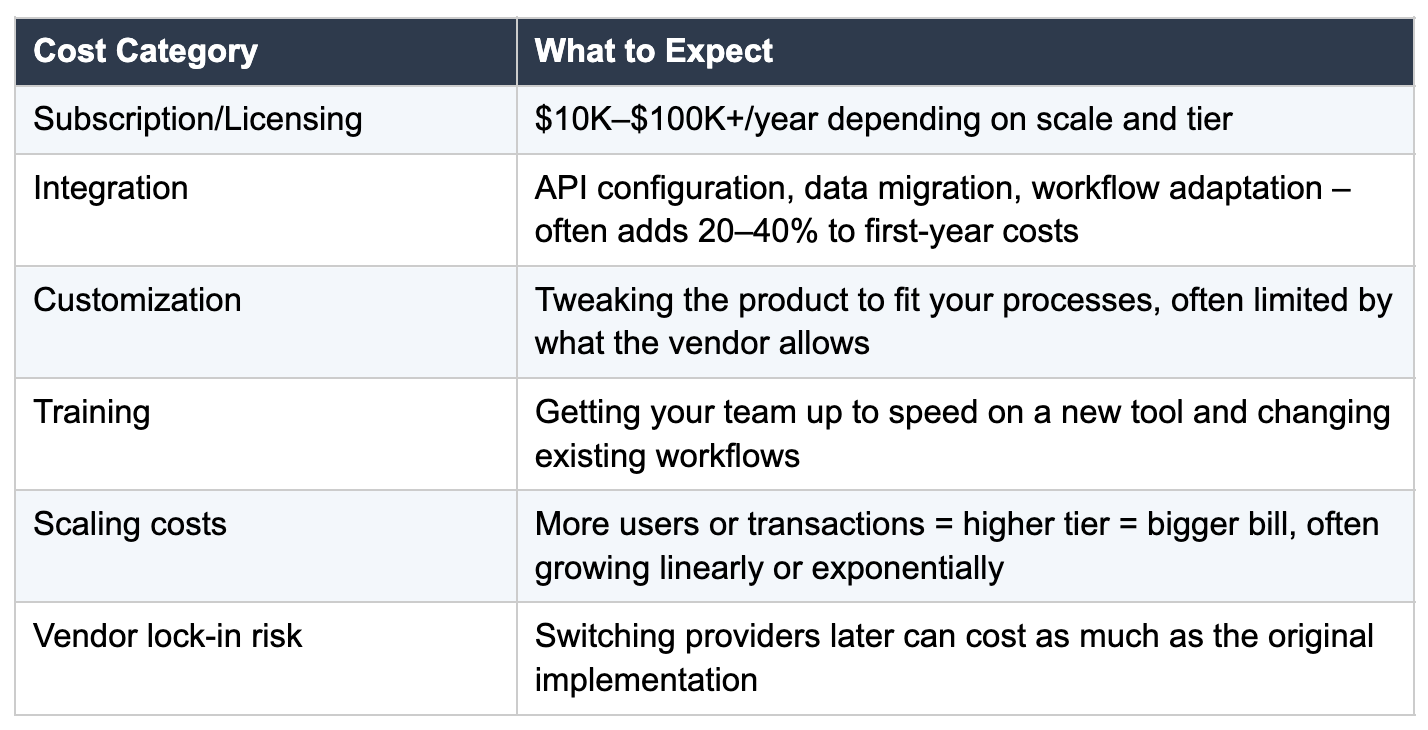 The pattern many companies experience is “easy to start, expensive to scale.” Zylo’s 2026 SaaS Management Index found that organizations spent an average of $1.2M on AI-native apps—a 108% year-over-year increase—and 78% of IT leaders reported unexpected charges tied to consumption-based or AI pricing models. If your processes don’t fit neatly into the product’s default setup, you’re either paying for custom integrations or changing how your team works to fit the tool. Neither option is free.
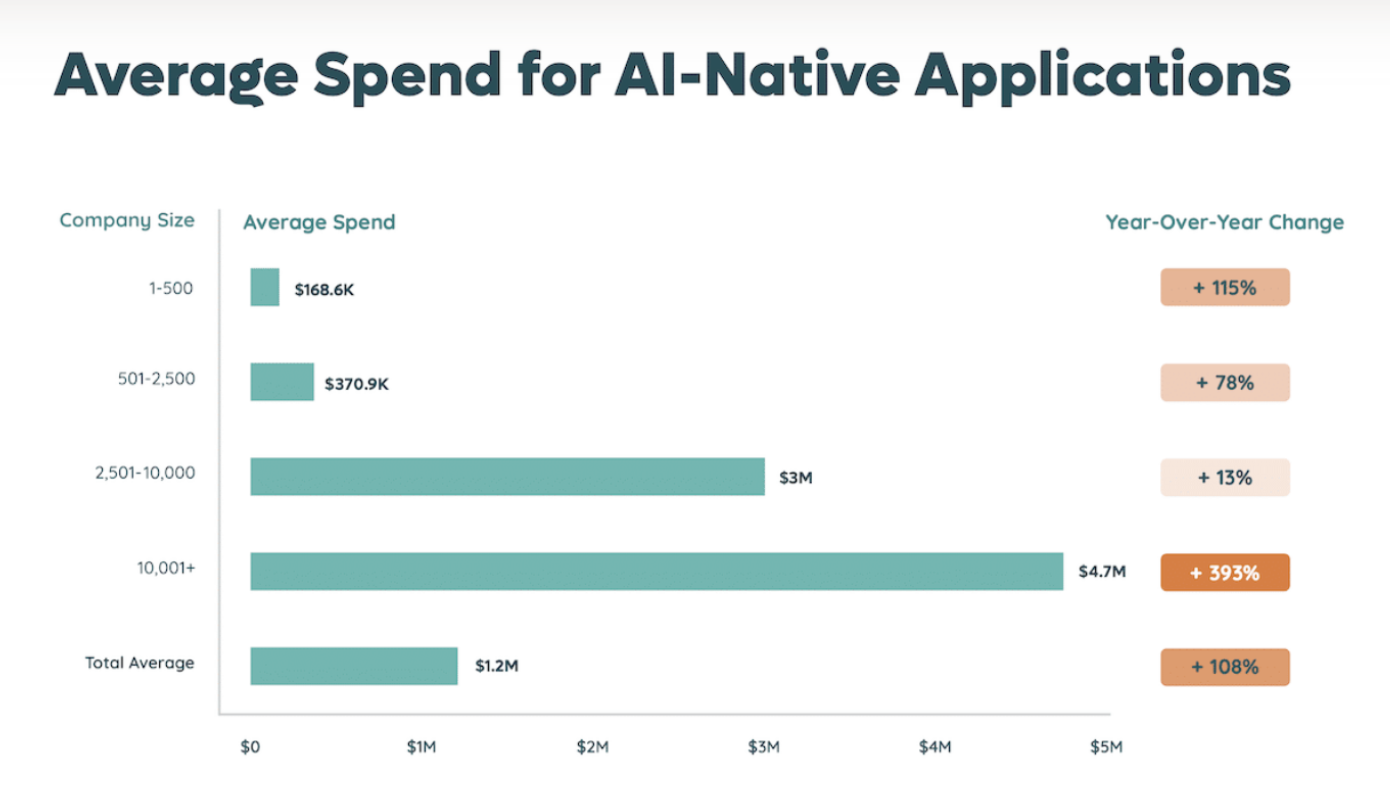 Source: Zylo
ROI Timeline Comparison: Speed to Value
One of the clearest differences between these two approaches is how quickly you start seeing returns on average. Here’s how they compare: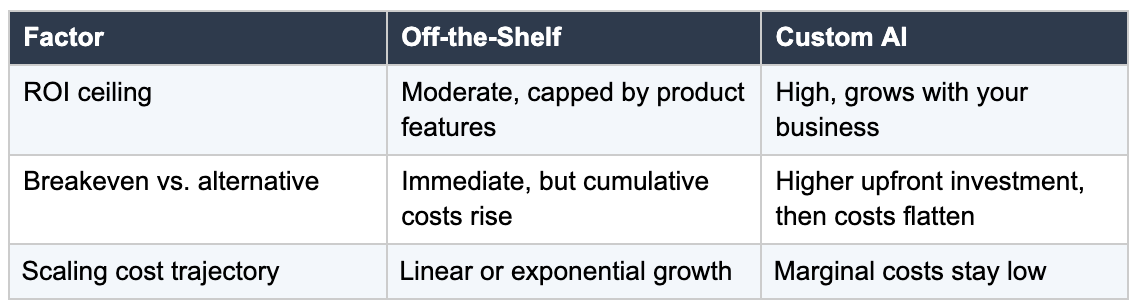 A Google Cloud ROI study from 2025 found that 74% of executives reported achieving ROI from readymade AI within the first year, and half of companies were taking an AI application from idea to production in 3–6 months. That’s encouraging for off-the-shelf speed. But the potential ceiling with custom is much higher. When you build something designed specifically for your workflows, the gains compound over time.
Think of it as renting versus buying a home: rent gives you immediate shelter, but the long-term financial picture tends to favor ownership.
A Google Cloud ROI study from 2025 found that 74% of executives reported achieving ROI from readymade AI within the first year, and half of companies were taking an AI application from idea to production in 3–6 months. That’s encouraging for off-the-shelf speed. But the potential ceiling with custom is much higher. When you build something designed specifically for your workflows, the gains compound over time.
Think of it as renting versus buying a home: rent gives you immediate shelter, but the long-term financial picture tends to favor ownership.
Competitive Advantage and Strategic Value
ROI isn’t only about saving money. It’s also about what your AI capability lets you do that your competitors can’t. When you use the same off-the-shelf tool as everyone else in your industry, you get the same capabilities as everyone else. It levels the playing field, which is fine for non-core functions. But for the processes that truly differentiate your business, generic AI tools can only take you so far. Custom AI can be built around your specific data, your unique processes, and the intellectual property that makes your business different. It becomes a driver of both operational efficiency and long-term business growth. An IDC report sponsored by Microsoft found that while 92% of AI users focus on productivity, the greatest ROI growth is expected in industry-specific, custom use cases over the next 24 months. Companies that invest in AI and machine learning services tailored to their domain are positioning themselves to pull ahead—not just keep up. The numbers reinforce this. Early adopters of generative AI report an average return of $3.70 for every dollar invested, according to data compiled by IDC. But top performers, the companies that go deeper and build custom, domain-specific AI, are seeing returns of $10.30 per dollar. That gap between average and top performers is where the custom advantage lives.Risk Assessment and Hidden ROI Factors
Both approaches carry risk. Being honest about those risks is the only way to get to a real ROI number. Custom AI risks: Project failure (remember, over 80% of AI projects don’t reach production, per RAND), difficulty retaining data scientists and specialized expertise, accumulating technical debt, and longer time-to-market. These are real, and they’re why working with an experienced product engineering partner matters so much. Off-the-shelf risks: Vendor dependency (you’re at the mercy of third-party vendors’ roadmaps and pricing decisions), limited customization with constrained vendor support, data security and ownership concerns, and feature limitations that become more painful as your needs grow. If your vendor gets acquired, changes direction, or raises prices, you have few options that don’t involve significant cost and disruption.Vendor Lock-In vs Technical Debt
When you buy a ready-made tool, you’re essentially committing for the long haul. Once your team is used to it and your data is fully integrated, switching to a different product becomes a massive, expensive undertaking. If you build your own software instead, the risk is technical debt. If you don’t keep the code updated and maintained, the system eventually becomes inefficient and unstable. You can’t avoid these risks completely, but you can definitely manage them if you have a solid plan from the start.Decision Framework: Which Approach Fits Your Business?
Rather than treating this as a philosophical debate, it helps to look at a few concrete variables. Choose off-the-shelf when:- The use case is well-established and widely supported by pre-built tools (standard chatbots, basic document processing, common analytics)
- Speed to market is the top priority and competitive advantage lies elsewhere
- You’re a startup testing product-market fit and don’t have the resources for a build-from-scratch approach
- Your use case involves proprietary data, unique workflows, or complex integrations no off-the-shelf product handles well
- AI is a core differentiator for your business, not just a nice-to-have tool
- You’ve outgrown what off-the-shelf tools can do and you’re paying premium prices for features you don’t use
- You operate in regulated industries where data security and compliance require full control over your infrastructure
- Long-term scalability matters more than short-term time-to-market
The Common Path: Starting Off-the-Shelf and Going Custom
Here’s a pattern that plays out again and again: a company adopts an off-the-shelf AI tool, gets some early wins, and then gradually runs into walls. Maybe the tool handles 70% of what they need, but that last 30%, the part that’s unique to their business, is exactly what matters most. Or the vendor raises prices. Or a key feature gets deprecated. That progression typically looks something like this:- Adopt off-the-shelf: Quick deployment, immediate productivity gains, team gets comfortable with AI concepts
- Hit limitations: Feature gaps emerge, integration workarounds pile up, scaling costs spike
- Evaluate custom: The business case becomes clear based on real-world examples and experience, not theory
- Build what matters: Custom development focused on the specific areas where generic tools fall short
Hybrid Strategies: Getting the Best of Both
Many companies don’t have to pick one approach exclusively. The most pragmatic strategy is often a hybrid: use off-the-shelf tools for commoditized functions (email analytics, meeting transcription, standard reporting) and build custom solutions for the processes that give you a competitive edge, whether that’s fraud detection, predictive maintenance, or natural language processing tailored to your domain. For instance, you might rely on a standard AI-powered CRM for basic customer insights, but build a custom machine learning model that analyzes your proprietary transaction data to predict churn or identify upsell opportunities that generic solutions could never catch. This approach makes sense when you're evaluating AI platforms and tools for different parts of your tech stack. Some things are worth building; others are worth buying. The trick is knowing which is which, and having a team that can help you make that distinction.How Kanda Can Help
At Kanda, we’ve worked with companies at every stage of this journey, from teams just realizing their off-the-shelf tools aren’t meeting their needs, to enterprises ready to build AI capabilities from the ground up. As an AI development company with a proven track record, we’ve seen firsthand what separates a high-ROI AI project from one that stalls out. We can help with:- Providing AI consulting to help you cut through the noise and identify the exact solution that fits your business goals, data, and budget
- Designing and building customized AI solutions tailored to your data, workflows, and competitive goals
- Migrating from off-the-shelf tools when you’ve outgrown them, without losing the data and insights you’ve already built
- Setting up scalable infrastructure and DevOps pipelines so your AI systems grow with you
- Providing ongoing support and model maintenance to keep your AI accurate and compliant as conditions change
Conclusion
There's no universal winner here. The right choice depends on your business, your problem, and what return you need and when. If your use case is straightforward and you need results fast, off-the-shelf works. But if AI and machine learning are touching your core operations, custom development tends to win out over 3–5 years, even with the higher upfront cost. The real risk isn’t picking the wrong approach. It’s picking any approach without a clear business strategy and the right team. Understand the problem first; the tech decisions follow naturally.Related Articles

How to Turn Your Broken Data Workflows Into Scalable Data Pipelines: An Ultimate Guide
Key Takeaways Workflows break at scale not because of selecting wrong tools, but because project-level habits, manual handoffs, copy-pasted scripts become the operating model. The architecture patterns that enable scalability: decoupled storage and compute, deliberate data layering, and orchestration treated as a control plane. Pipeline reliability is a delivery problem too. Version control, CI/CD, and…Learn More
Low-Code, No-Code, or Custom Build? How Enterprises Should Actually Decide
Key Takeaways Low-code accelerates app development for professional developers; no-code empowers non-technical users to build on their own. Custom development costs more upfront but offers full control over security, scalability, and integration. Hidden costs like vendor lock-in, licensing at scale, and security gaps can erode the savings platforms promise. Most successful enterprises use a hybrid…Learn More
Why Using Edge AI for Real-Time Analytics Is Your Next Best Decision
Key Takeaways: Edge AI processes data locally in 1–10 ms, compared to 50–200 ms with cloud-based analytics, making it critical for time-sensitive operations. Organizations can cut data transmission costs by up to 43% and reduce cloud-bound traffic by over 90% by filtering data at the edge. Industries like manufacturing, healthcare, autonomous vehicles, and smart cities…Learn More
Why Human-in-the-Loop AI Is Necessary in the Age of Automation
AI is spreading through businesses much faster than most people anticipated. Data from a Fullview report shows that 78% of organizations now utilize artificial intelligence in at least one part of their operations, which is a significant jump from 55% back in 2023. At the same time, 71% of these companies are regularly using generative AI…Learn More